Last week, I took another trip out to investigate another place that is perhaps not well publicised for it's real ale, in order to see what was on offer for the seasoned and casual drinker. The subject of my attentions on this occasion lies over the county border into Leicestershire, the least visited (from a personal perspective) of the 3 major East Midlands counties. Not too far from East Midlands Airport, is Kegworth.
Kegworth (the w is sometimes silent by locals) is a large village (population of approximately 3,500) and civil parish in Leicestershire, England.
Lying on the River Soar, it is situated on the A6 near junction 24 of the M1 motorway and is also close to East Midlands Airport. An air-crash incident in 1989 was just short of the airport's runway at the eastern side of the airport. Although this was outside the village, it has subsequently been referred to as the Kegworth air disaster.
Nearby places include Long Eaton, Castle Donington, Sutton Bonington, Hathern and Loughborough. The post town is Derby.
The site of Kegworth was situated well within the territory of the Coritani (or Corieltauvi), one of the most powerful Ancient British tribes.
A date cannot be put on the foundations of the first settlement, although Anglo-Saxon burials have been found in Kingston-on-Soar and at Hathern, a pin from the 7th century was also found near the hermitage which may indicate the date and location of the earliest settlers. The name of Kegworth comes from two languages, Old English and Danish, so it must date from some time between 874 and 1086. It means 'worth' or 'enclosure' of a man named Kaggi, the Danish name for redbeard. However, some sources claim it may mean locked enclosure, from caega "key", an Old English word.
It was recorded in the Domesday Book as being held by Earl Harold Godwin, who became the last of the Saxon kings. After Harold's defeat at the Battle of Hastings in 1066 the Earl Hugh of Chester was given the land by William the Conqueror. It was known in those days as Cachworde, Caggworth and Cogga.
After the royalists defeated Simon de Montfort in 1265, estates gained by the Earl of Gloucester included land in Kegworth. The privilege to hold a weekly market was granted in 1290.
During the Middle Ages the parish was responsible for maintaining the condition of the roads. To try to improve the rough roads in the village, an Act of Parliament was passed in 1555 ordering every man in the parish to work for four (later six) days a year on the roads; each farmer had to provide horses and carts according to his land holding. This continued until the early 18th century when, with the increase in traffic, it became necessary to change this to paid labour.
Although farming was a large factor in Kegworth life and still remains on the fringes, industry started in the late 18th century/early 19th century with the introduction of stockingers shops. Some still exist (e.g. behind the former Britannia public house) and can be recognised by the long rows of windows on the first floor. As the industry grew, small courtyards of cottages were built in the old farm yards. Women and children also worked when they could, and the hosiery and lace trade were ranked as two of the most important industries in the village from 1841 onwards. The Kegworth hand frame stockingers were highly skilled in the art of making silk stockings and they received many orders from royalty and people of high rank. Queen Victoria, the Prince of Wales, the Danish Royal Family and the King of Spain were all customers of the stockingers of Kegworth.
Meeting House Yard lay behind the present 'Friends' Cottage', and included a Quaker graveyard. The last trace of these 'yards' was demolished when the entrance to Australia Yard was removed to make way for the library in High Street.
A depression in the 1890s coincided with the introduction of the internal combustion engine, a motorbike factory was started which developed into the present Slack and Parrs.
Domestic service was also important. In 1851 as many as 121 people were described as servants, housekeepers or charwomen. In 1899 their work was arduous with long hours, and the restricted personal freedom and the lack of privacy was poor by the standards of today but at the time they counted themselves lucky to be fed, clothed and housed.
Industrialisation was the beginning of the end of this era in Kegworth’s history, but there were still socks and stockings being made in the village as late as the 1940s.
Despite the growth in trade and manufacturing, there was only a very slight increase in population during the 19th century. The number of inhabitants rose from 1,416 people in 1801 to 2,078 a century later, but with actual decline in some decades, today there are approximately 3,500 people living in the village with 1,500 houses.
Kegworth has always prospered from its advantages of trade and routes. Originally these were farming, road and river, later textiles, railway and canal, and now light industry, motorway and airport. It has been lucky in having relative prosperity and slow but steady growth which has given it the character of a friendly, active community.
Kegworth was part of the Rural District of Castle Donington until 1974 when it became part of the District of North West Leicestershire, whose administrative centre is located at Coalville.
The earliest surviving building is the church. The tower base dates from 1250 and the rest was built in 1370 when the two manors of Kegworth were united under a single Lord of the Manor.
The next oldest building visible is the Cruck Cottage forming the street front of the Cottage Restaurant. This is from the 15th century, but the stucco covering conceals its age. Many other buildings similarly hide their oldest parts under stucco or modern fronts as at the top of Packington Hill, where early 18th century timber frames show at the rear.
Many buildings in High Street and London Road date from the 18th century when the main London to Manchester road went up High Street and down Packington Hill. Some were town houses, others farmhouses with yards. Most of the latter have had their yards subsequently built on. The barn of number 55 High Street was demolished in 1979 to make room for another house, but the farmyard of number 48 remains, although the farmhouse was rebuilt in Victorian times.
The internal road system of the village gradually developed as time went on as it became necessary to obtain access to neighbouring villages.
The Romans used a ford across the River Trent nearby and a Romano-British farm lies at the end of Long Lane. A Saxon cemetery was found two hundred years ago and the bumps and hollows between the A6 and the River Soar may be the remains of a Saxon village.
Kegworth clearly has a lot of history for such a relatively small location and it was with enthusiasm that I made my way here on a very unsettled Thursday, wondering what to expect and the what the pubs I had earmarked would have to offer. Living in Clifton means that the easiest way for me to get to Kegworth was to get a bus from the city centre, a trip that takes over an hour and goes via East Midlands Airport. The trip out took longer than planned due to the normal road to the village being temporarily closed due to an accident on the M1. This still ensured that I got off the bus at my intended stop in the Market Place, just outside the church. The first location for this visit was actually outside the other end of the village, a walking journey of no more than 10 minutes whilst dodging both vehicles, due to the narrow pavements, and the frequent rain showers. Situated by the main road that runs through Kegworth, on the bank of the nearby River Soar, sits The Otter.
The Otter is operated by Mitchells and Butler, as part of its Vintage Inn estate. Originally, known as The Navigation, a succession of inns have stood on this site since 1800. The building was renovated in 1927 when it was taken over by the Shaw family who were well known in the village as they rowed anglers across the river for a penny a head. Inside, this pub/restaurant is the very definition of rustic with traditional features ranging from wooden beams to open fires. The restaurant are takes up the majority of the interior, with tables running down the inside of the building next to the windows that afford a view of the river and the fields beyond. The bar area is to the front of the restaurant section separated from the latter by furniture and a small partition. The bar is fairly long and runs perpendicular to the front entrance. As well as being very well stocked, the bar includes 3 handpulls, offering a choice of Marston's Pedigree, Brakspear Bitter and Doom Bar. I decided to start with the Doom Bar and this was a good choice as it was superb! I took a seat on a long sofa opposite the bar whilst I simultaneously enjoyed my pint and dried off. I also took in my surroundings with glee and perused the impressive sounding food menu. This is definitely worth a visit in the future, hopefully when the weather is a tad more pleasant.
Pint finished and rain abated for now, I now faced the task of making my way back into the village centre. Thankfully, this is a shorter walk than it first appears so it wasn't long before I was getting my bearings and making my way to my next stop, which was just off the Market Place, past the now sadly closed Ye Olde Flying Horse, along High Street. On the right side, sits an unassuming building otherwise known as The Red Lion.
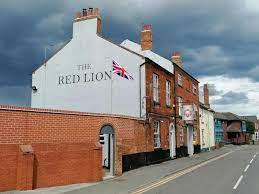
A Georgian property, the pub is first listed in Trade Directories in 1870 when Charles Milne was the tenant. For many years, the pub was the meeting place of Lodge 28 of the Nottingham Oddfellows Friendly Society, one of 2 lodges in the village. Edgar Daniels was tenant from 1925 until well until the 1960s and was in situ when, in the 1930s, a lion from a visiting circus was encaged in the garden. Troops were billeted here during WWII. I was excited about visiting the Red Lion. The pub is Good Beer Guide listed and has an excellent reputation for a prevalence of local beer. The interior is broken up by a dividing wall with a bar on both sides serving 3 or 4 separate rooms. The walls are decorated with photos of the local area and historical artefacts. There is a smoking area to the side of the building and the pub is also dog friendly. One side of the bar includes 2 handpulls and there are others around the multiple sides of the bar, totalling 9 in all. A list of available beers are displayed on a chalkboard above the bar, something which I missed originally until it was pointed out to me by the barmaid. The choice is extensive and the majority is local. Available during my visit are Gales HSB, Bass, Adnams Bitter, Nutbrook The Mild Side, Castle Rock Harvest Pale, Blue Monkey BG Sips, Grainstore Ten Fifty, Charnwood Carousel and Shipstone's Nut Brown. I decided to go local and went for Carousel from Loughborough-based microbrewery Charnwood. This is a very good brew. At 4.2%, this is a well-rounded bitter with copper colours and citrus hops. It is late hopped with 3 American varieties to give a grapefruit aroma and a tropical fruit finish. I sat in a low bench opposite the bar, next to the front door where I'd entered and admired the nostalgia of the premises. The beer was delicious and went down very easily, helped by the comfortable surroundings and friendly regulars and staff. I was certainly glad that I'd made the effort to visit this amazing place!
The Red Lion doesn't just have a reputation for excellent beer. It's also renowned for its alleged ghostly activity and is billed as the most haunted pub in Kegworth. The most notorious apparition is that of an old lady in white who announces her presence with a sudden and dramatic drop in temperature. A workman once fled the property and refused to return after encountering the lady, who is rumoured to be the same spirit that occupies the Hermitage up the road. He was alone in a room, using a step ladder to reach the ceiling when he felt someone distinctly tap him on the back of the head. He fled in a panic. Staff also tell stories about the activity here. The son of some previous owners had some experiences in the upstairs accommodation during the 70s. One evening he awoke in his room and saw a woman standing in his bedroom doorway. He blinked a couple of times but the woman remained before suddenly vanishing. On another occasion, he was listening to music in his room with the door closed. There was a gap under the door to allow the landing light to come in. He saw the shadow of a figure moving back and forth behind the door. He jumped up and opened it but there was nobody there. A former cleaner at the club felt someone tap her on the back of the head as she was cleaning out the fire but found nobody there when she turned around. Another time, she walked into the back room and saw a man wearing a hat standing at the bar. As it was 6am, she asked him what he was doing there but he vanished instead of replying. The landlord John believes that activity in the pub increases when things are changed. On more than one occasion John and barmaid Wendy have seen pint glasses fly from the shelves, plummet from to the floor and not break. There was also a strange episode where pictures were moved, not just on the wall but into different rooms with no explanation. This is certainly a very interesting place indeed!
I was disheartened to leave the Red Lion but time was creeping on and I had another pub to visit before the long bus ride back to Nottingham. The next pub was a moderate walk away, along Station Road, on the bus route from Kegworth to Loughborough. Situated alongside the canal, opposite a bus stop, is The Anchor Inn.
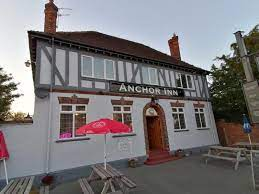
This is a small but very quaint pub with shortened opening hours during the week. The Anchor is also featured in a recently published book of Britain's Heritage Pubs. Monday-Wednesday the pub is open from 5-11 but, with it being a Thursday the pub is open 12-2.30 and then open again from 5. The small bar is directly opposite the entrance and boasts 4 handpulls, 3 of which are in use at the time of my visit. My choices are Adnams Ghost Ship, Bass and Charnwood Vixen. I opted this time for a pint of Ghost Ship which is just as it should be and goes down almost too easily. This is a very comfortable and cosy pub in which to end the day's activities. Soon enough, it became time to leave and make my way back to the Market Place and wait for my bus back to Nottingham. On my way, I passed another of Kegworth's pubs which I unfortunately had no time to visit due to time constraints and the pub's late opening time of 5pm. The Cap & Stocking will have to wait for a return visit.
The trip to Kegworth was certainly worth the time and effort to get there. The pubs are interesting and unique and definitely worth a visit. It's always a pleasure to find a place that often goes unnoticed, where real ale is thriving and popular and where the pubs do their very best to maintain their reputations with the support of the locals. A number of pubs have closed in Kegworth over recent years and it's a relief to see that the ones that have survived are doing all they can to keep their end up, with significant success. In the future, the Cap & Stocking will be subject of a return visit and, who knows, perhaps Ye Olde Flying Horse can yet be resurrected. Until then, we can hope that Kegworth will continue as it has done thus far and keep its excellent drinking establishments ticking over nicely.
Tuesday, November 10, 2015
Monday, October 12, 2015
Third Time's A Charm
The nights are drawing in and the temperature is starting to dip. There is more than a hint of winter in the air, which can mean only one thing: it's that time of year again! The time of the annual pilgrimage to the Robin Hood Beer & Cider Festival.
This was my 3rd consecutive trip to one of the UK's largest and most popular beer festivals, itself celebrating its 40th anniversary. Accompanying me on this year's adventure was a fine cast of close people: Amy (obviously), Matt (who journeyed up from Bristol), Sarah, Emili and Chris from work who was experiencing his first trip to Nottingham's finest beer fest. The day was dry and warm for the time of year as we began the day the way that every beer festival should begin: with a Wetherspoons breakfast and a fortifying pint. Once we had eaten our fill, it was time. Clutching our tickets and with anticipation and excitement etched on every face, we joined the not unimpressive queue outside Nottingham Castle and waited patiently for the gates to open. Finally, just before 11am, the gates were opened and we were in!
The first task was receiving our tokens upon entry which was a quick and easy job and Matt and I relished in receiving extra tokens due to having our CAMRA membership cards. With our tokens and commemorative glasses at the ready, we were all set to begin the days festivities. We decided to begin at the bandstand area in one of the smaller marquees set up for the event. The tough task at any beer festival is working out which beers to try and in what order. My tactic is always beers with interesting names and/or interesting ingredients. Chris and I were instantly rewarded in this respect, thanks to some helpful questions from another festival goer, a girl who had asked for a 'girlie beer'. She was recommended a beer that Chris and I ended up partaking in as our first for the day, Golden Bounty from Sperrin a brewery based in the Warwickshire village of Ansley. This ended up being an excellent choice to start the day. At 4.8% this is a summer ale with hints of chocolate orange, coconut and white rum. It's a superb mix with the orange to the fore and the rum obvious underneath. This first beverage was enough to spur us all on.
Matt, Amy and Emili had started the day on cider, with Matt and Amy opting to begin on Wilkins, a cider from Matt's neck of the woods that packs quite a punch. We made a group decision to make our way up to the main marquee or, as I call it, heaven. Chris was overwhelmed by the sheer scale of the event, something that I can relate to from my first visit. As I was drinking 3rd pint measures, I was already in need of further refreshment and, after further perusal of what was to offer, I went for a beer from Three Kings, based in North Shields. Devil's Advocate (4.3%), as well as being excellently named, is an English pale ale with delicate, mint, grass and floral hop tones. It's certainly very refreshing and everyone is starting to get into their stride as we head outside to enjoy the sunshine whilst it lasts. Chris and Matt had already started on heavier beers such as porters and Emili was hitting the higher ABV beers, no doubt influenced by her job at BrewDog. My next choice of beer for the day was a foray into the realms of darkness, something I've been getting more use too on my recent excursions. From the Summer Wine brewery in Holmfirth, my next beverage was Teleporter (5%), a rich, dark and creamy porter. This was surprisingly drinkable for a heavy beer and I thoroughly enjoyed it. Upon returning from this trip to the bar and once again congregating outside, we came across something marvellous. A gentleman near to our group was drinking green beer. Green beer! Green! Beer! Naturally, we had to find out where this had come from so Chris made some enquiries and we were informed that it came from one of the brewery bars. The search was on! Frustratingly, we didn't appear to be able to find where this unusual concoction was, until Chris and I decided to apply a reverse psychology approach. Needless to say, as soon as we stopped looking for it, we quickly located it. Brewed by Worksop brewery Hale's the beer was being served from a bar shared with Grafton brewery. At 4.6%, the beer is a special brew to celebrate the festival's 40th birthday. Called We're Firkin 40, it is a medium hopped beer with its characteristic green colour making it a surprise hit. It's really easy to drink and the subject of much discussion amongst our group as well as other festival goers.
The day was progressing well by this stage and we were all thoroughly enjoying this year's visit. My decision to drink only thirds was a good one as it meant that I had more vouchers left than anyone else already. I decided to give up another couple on an interesting sounding beer from a relatively local brewery. Attracted by the name, I went for a beer called Lost Time from Torrside brewery in New Mills, Derbyshire. All of the brewery's beers are vegan friendly and this particular one is a 4.8% wheat beer made with trans-Atlantic hops. It's traditional cloudy appearance is matched by its sweet, smooth flavours. I'm a big fan of wheat beers so this was something of a treat. We were waiting for Sarah and her housemates Dom and Sam to arrive so, for the time being, we stayed put in the main marquee. We had only been here for a couple of hours or so, so we knew there was still plenty of time. I had already decided upon my next beer as I had spotted it earlier as was immediately intrigued by it. Brewed by Mid-Glamorgan's Hopcraft brewery, Spanish Main (5.9%) is a Jamaican stout with heaps of piratical character stemming from its base ingredient of rum. I'm definitely getting a stronger taste for dark beers and this would become a bit more of a theme throughout the day. Sarah and co had arrived by now, so we decided, after a brief break to regroup and recuperate, to head back down to the lower bars again. The bandstand was in the process of being set up for the day's entertainment. This happened to be directly opposite the tent that was being operated by Castle Rock. With that in mind, it seemed rude not to check out what they were offering. With Halloween around the corner, I couldn't help but ask for Most Haunted (4.4%), a porter brewed with pumpkin and spices. It has a very festive feel to it and the sweetness of the pumpkin is balanced nicely with the spicy infusion.
We hung around in this area of the site for a little while as we were enjoying the atmosphere of the open air. My next incursion into the smaller marquee reintroduced me to a brewery I am familiar from a couple of excursions, most recently my Cardiff trip. Heavy Industry is based in Henllan in Clwyd and I was immediately drawn to their Freak Chick (4.5%), a red, malty brew with an earth, spicy and zesty character. It was upon retrieving this particular beer that I bumped into people I was not expecting to see, namely Jade's mum, stepdad and brother. Thankfully, the atmosphere was jovial, there was no awkwardness and everyone was pleasant. We regrouped outside of the tent and decided that more food was probably a good plan. Sam opted for a Cornish pasty (his first ever!) whilst Chris and I were tempted by an authentic bratwurst which was an excellent decision. Refuelled, it was time for yet more beer and I was drawn to the offerings from Q Brewery, out of Queniborough in Leicestershire. I opted for the 1630 (5.5%), a strong, dark ruby ale bursting with fruit flavours. We were all in the mood for another walk at this point so we wandered back up to main marquee and gathered near to one of the side entrances, where conversation turned to experiences with mental patients as both Sarah and Matt swapped stories from their respective jobs in mental health care. There are some things that should not be shared!
I made a conscious effort to sample a few local breweries at this year's festival and I'd already managed a few before I got to Milestone, based at Cromwell. Intrigued by the name, I opted for the Springbok (5%), a collaboration brew with Robson's of Durban in South Africa. It was certainly a delicious coalition of flavours and nations and well worth 2 beer tokens. I took a gamble on my next beer and went further afield and significantly stronger with Stockport's Deluded IPA (6.5%), a classic IPA with a generous blend of US hops which give this a heady, fruity kick. Casual conversation was in full swing amongst the posse although it had thankfully moved away from slightly distressing workplace stories. Instead, we were all embroiled in general catch up stories and relationship chat. There was then a mutual decision amongst myself, Amy and Emili to have a crack at the offerings from Blue Monkey, who had a bar set up in the corner of the main tent closest to where we were currently located. As tempted as I initially was by their Big Blue, I instead went for the weaker Junior Ape (4.4%), a pale ale with an assertive profile of American hops and big flavours.
I was already well into a newly purchased set of tokens having exhausted my initial supply so the task now was to find interesting beers on which to spend them. Having had a break to go back to paler beers, it felt like the right time to move back to the dark side of the beer spectrum. This quota was filled nicely by Madhouse from Worksop's Double Top brewery. At 5.2%, this is a modern style porter, silky smooth with hints of coffee. The flavour is intense and delicious and certainly maintains my feelings that dark beers can be very good indeed. The time had come to move on again and the festival was now very busy so we wandered back down towards the bandstand where a very good covers band were halfway through their set. We needed beer to accompany the music so Matt and I made a dive back into the marquee for some further liquid sustenance. I was drawn to Twisted Dragon (5.8%) from Wrexham's Sandstone brewery. This is a premium ale with 5 hops, giving it a truly unique flavour.
Following a good old sing along to, amongst others, Mustang Sally, Sex on Fire and Livin' on a Prayer and with the evening drawing in, we were content to stay in the same place for the foreseeable future. A stone's throw away was the bar of another local brewery, Nottingham Brewery. Deciding it couldn't hurt to look at what was on offer, I had a quick peruse and discovered a couple of beers that I was unfamiliar with. One of these, Spoon & Arrow, ended up being my next choice. This is a hoppy, malty golden ale with a modest strength of 4.5% and very refreshing. The next band had begun by this point and we watched with amusement as we tried to figure out whether they were as good as their predecessors before deciding that this was not the case. Still with some vouchers left, I had plenty of time to pick my next beverage, eventually settling for Rocky Mountain from Shropshire's Big Shed brewery. At 4.8%, this is an American-style pale ale, one of the 'in beers' of the moment with an emphasis on big hop flavours and fruity finishes. The sun was going down by now and the night was getting chilly but thankfully there were enough people around that nobody felt particularly cold. The best designed bar of the festival was definitely that of Fun Fair brewery with its steampunk theme and costumes and a steam-powered meat smoking machine. It was certainly quirky and an interesting change from the marquees and caravans seen elsewhere on the site. Their beer is good too and I was able to partake in Ghost Train (5%) a very dark, scary but tasty stout.
By now, we were all beginning to feel a bit worse for fear, mostly through tiredness than through alcohol consumption. The crowd was the biggest it had been all day but, for now, we weren't deterred and I picked an absolute belter for my penultimate beer of the day. From the Dewsbury based Partners brewery, Tabatha (6%) is a Belgian-style tripel beer, fruity with hints of coriander and bloody gorgeous! Time was ticking on and we'd been here for around 8 hours by this stage. With only a couple of vouchers left and a number of the group beginning to flag, the remainder of us decided to make our departures. Emili, Sam and Dom had already left so Amy, Chris, Sarah, Matt and myself began to head for the exit. I still wanted a final beer. 'One for the road' you could say, and I found it in a beer with an apt title: Stark Reality from the Reality brewery based, I was surprised to learn, in Chilwell. At 4.5%, this is a nice amber bitter with a good malt and hop balance. It was certainly a good climax to the day and, thoroughly impressed with the day as a whole, we made our weary way out.
This year's Robin Hood Beer & Cider Festival was again an enormous success. Much beer was drunk, friendships were cemented and much fun was had by all. The thing that is always wonderful about this event is the fantastic atmosphere, the sheer quantity of people, all there for the same reason and, most importantly the scale of the thing with an unprecedented range of beers of all kinds, of high quality and significant quantities. 40 years on, the momentum shows no signs of slowing. Long may this and other events continue to fly the flag for the real ale movement and long may we all have the privilege of enjoying these for years to come. I don't intend to miss one for as long as I live. Praise goes to all of the breweries, the hundreds of staff and volunteers and, more than that, all of the visitors who made the effort to ensure that the festival is still going strong after 40 years. As a wiser man than me once said, 'If you build it, they will come'. Point definitely proven.
Tuesday, October 6, 2015
Misspent Youth
For my most recent excursion, I changed my normal tactics slightly and opted to move away from my standard formula of investigating the pubs in a specific location. Instead, I decided to have a go at visiting pubs that appeal to a certain type of clientele, all within the confines of Nottingham city centre. The obvious choice on this occasion was to delve into some places that attract the people who perhaps make Nottingham so well done for its drinking establishments, namely it's thriving student population. Nottingham has a vibrant student set, with its 2 universities and, as this was this reason that I first moved to this fine city 9 years ago, it seemed like a good opportunity to see what was on offer for any of this year's influx that happened to have a good taste in beer.
My timing was impeccable as the day of my trip coincided with the first proper day of Nottingham Trent University's Freshers Week. There didn't seem to be a massive number of students around at the time, which I put down to the fact that not all of them had arrived and those that had were asleep/hungover/confused or a combination of all 3. I had an easily accessible itinerary of pubs lined up for the day, all of which are in relatively close proximity to each other.
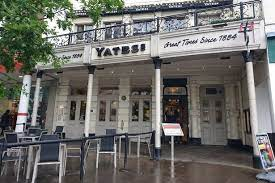
My journey began just across from where my bus stops on Market Square at a place where lots of students get their first introduction to Nottingham nightlife: Yates's.
A well known site in most cities across the UK, this particular branch of Yates's occupies the site where a drinking establishment first stood hundreds of years ago. The first recorded pub on this site was known as the Bull's Head. In 1590, it was owned by the Talbot family and its name was later changed to the Talbot, a name that can still be seen on the high external arch of the building. Talbot is also the name of a hunting hound which features on the coat of arms of the Earl of Shrewsbury, who was then a significant land owner in the county. The overall layout is similar to that of the Talbot, originally opened by local tycoon Edward Cox, to the genuine alarm of the locals. The present building is the latest incarnation of a building which has been demolished, rebuilt and refurbished several times. It was originally bought by the Yates brothers in the 1920's and added to their portfolio of premises from other north. Over the years, the Yates's brand has become synonymous with being a trendy venue for younger drinkers. Inside, the pub is expansive with a downstairs and upstairs bar (open at weekends) and a high, skylit ceiling. Much of the emphasis is on food and standard draught drinks. The décor is functional with some unique touches including a wall covered entirely in small mirrors. The long bar is well stocked and also features 3 handpulls. 2 of these are in use on my visit offering Pedigree and Trooper. I immediately opted for a pint of Trooper and, when I was eventually served, it was excellent.
Following a leisurely time spent enjoying one of my favourite beers, I then moved onto my next destination, situated on Parliament Street. Another well-known student haunt, my next stop was the Blue Bell Inn.
Although primarily situated on Parliament Street, the Blue Bell has 2 entrances, the second of which is on Forman Street, opposite the Cornerhouse. Although on the same level, the front entrance is slightly narrower whilst the rear has an ornamental blue bell hanging above the windows. The Blue Bell is something of a student haven with 2 bars and a host of DJ nights throughout the week. The internal layout is divided into sections of different sizes and there is a snug-like alcove tucked away to one side. I haven't been here too many times in the past but, on my last visit I distinctly remembered there being ale. I was rewarded with the sight of 2 handpulls upon entering but my hopes were quickly dashed when it became clear that neither were being utilised. This was a disappointment but perhaps I'd caught them on a bad day. I was very nearly the only person in the pub at this stage so I hold out hope that the handpulls are used more during busy periods.
I knew my next location like the back of my hand. Situated on Goldsmith Street, directly on the tram route sits my former place of employment and one-time residence, The Horn In Hand.
Despite not having worked here for many years, I still frequent the Horn (as it's colloquially known) on a regular basis as I still know a few of the staff and regulars. I'm also privy to a fair bit of the history surrounding the place. In previous years the pub was known as the Spread Eagle and Fagin's before becoming an alternative/metal bar known as Speak Easy, an identity it had when I first worked there. It had previously been known as The Horn In Hand before this relocated to the larger premises next door (now Spanky's, more on which later) and then reverting back to the smaller premises it now occupies. Speak Easy sadly no longer exists, something which a lot of older drinkers still feel sad about. The pub is operated by Stonegate and was part of the recently disbanded Scream brand. The manager at the time of the reversion back to The Horn In Hand is now running The Phantom in Loughborough (see previous blog). A small flight of steps leads up to the entrance and it is decked out with student friendly décor with lots of seating including benches and sofas, lots of TVs and a smaller upstairs area that houses a pool table. The small, J-shaped bar boasts 3 handpulls which, in quiet periods such as during my visit, offers a single brew, a special edition rugby-themed beer called Ruck N Roll, courtesy of St. Austell Brewery. This is a 4% amber ale with a full, dry palate and a fruity hop balance. It is certainly a delicious beer and I was persuaded enough to have a couple of pints here whilst, as per usual, I reflected upon my time working here.
Although it isn't well documented, I have first hand experience of unexplained things happening in this building. When I first started working here, I heard rumours that members of staff had experienced strange things in the cellar area, including an unknown figure seen at the top of the cellar stairs. The cellar in particular has a strange feel about it, particularly late at night or early in the morning and I once heard a small child giggling behind me whilst collecting stock one evening. When locking up after a shift, myself and another member of staff, both alone and independently from each other, heard the sound of a groan or a cough from the area of the male toilets and the pub kitchen. Strange things also occurred in the staff accommodation above the pub, which I lived in for a while along with the aforementioned staff member. I distinctly heard my name being called from the office when I was the only person in the flat, another phenomenon that other staff have reported. The sound of a cat was often heard, before any such animal lived on the premises. Add to this to the fact that the motion sensors in the pub would randomly go off for no reason and that the pub has survived at least 3 fires (1 that was very serious) and I can testify that something strange was going on. The original building is listed and hundreds of years old so perhaps this is not a surprise.
Moving away from spirits of the human variety, it was now time to relocate myself once again. Luckily, my next stop was just next door at what is now known as Spanky van Dyke's.
Like its neighbour, this is another premises that has been through numerous lives in its long history. It first began life as a music hall and performance venue, something that is commemorated in the dome on the roof, harking back to its origins. Following this, it became an American-style diner before becoming Horn in Hand, before this relocated with the closing of Speak Easy. As part of this change over, the building became what it is now, billed as an 'eatery and funhouse' and operated by a coalition between Mitchells and Butler and Project Tokyo. The premises is part of a chain of similar premises in cities around the country and Spanky's has the added bonus of being the official Freshers Week HQ. Inside, the décor is quirky and arty with dimmed lighting and a mix of furniture. The pub hosts regular music and theme nights and, especially at weekends, is rather busy. The bar has 4 handpulls, during my visit featuring Old Rosie cider, Purity Ubu, Doom Bar and Hop Back Summer Lightning. I decided on a pint of the Ubu, which was very well kept. Of all of the premises visited so far on my trip, Spanky's had the strongest range of ale but this is largely due to it being busier more often outside of term time.
I had deliberately left the next pub until last as it is my favourite pub in Nottingham, largely due to the atmosphere, the style and its fantastic juke box. Around the corner, in Wollaton Street, I give you The Tap N Tumbler.
Essentially a resurrection of Speak Easy in all but name, the Tap is a long-established venue with a history of catering to the rock, metal and alternative scene in Nottingham. It has just celebrated 2 years since the refurb that has given it its current look and feel and is operated almost as a freehold, despite being owned by a large pub company. Inside, the bar is large and curved, featuring 4 handpulls. The walls are decorated with rock memorabilia and drawing, paintings and photos of famous rock stars. The food menu is rock themed and the ales (brewed by Nottingham brewery and rebranded in-house), have names like J'ale Break, Nine Inch Ale, Rebel Y'ale, you get the picture. The pub tends to be quiet on weekday daytimes and so the full range of ale is not normally available until weekends. Indeed, during my visit, only Greene King IPA is available but this is well kept and delicious. The pub also normally features Trooper as a guest ale. I spent my time here enjoying my beer and participating in an obligatory juke box raid as well going back over the day's activities.
The student pub scene in Nottingham is certainly thriving, even though real ale often doesn't get much of a look in. The ones that do it tend to do it well and successfully. The ones that don't are probably responding to trade trends based on their normal circumstances. What has become clear is that it would be unlikely that you would have found ale in this many student pubs a years ago, and also that, whatever your background and whatever your tastes, Nottingham still has much to offer each new influx of students without alienating those who have been in the game for a lot longer. Why do you think I've never gone home?
Wednesday, September 9, 2015
Having A Lough
Last week, once again afforded a Bank Holiday Monday free from work, Amy and I decided that we would bring forward a proposed trip to a place that is becoming something of a haven for real ale, and a place that Amy knows well as she once lived there and both her mother and grandmother are still residents. Taking advantage of the easily accessible bus network, we made our way, on a not unpleasant day, over the Leicestershire border to explore the town of Loughborough.
Loughborough is a town within the Charnwood borough of Leicestershire, England. It is the seat of Charnwood Borough Council and home to Loughborough University. The town had a population of 57,600 in 2004, making it the largest settlement in Leicestershire outside the city of Leicester. The town is close to the Nottinghamshire border and is within a short driving distance of locations such as Nottingham, the East Midlands Airport and Derby.
In 1841, Loughborough was the destination for the first package tour, organised by Thomas Cook for a temperance group from Leicester. The town has the world's largest bell foundry — John Taylor Bellfounders, which made the bells for the Carillon war memorial, a landmark within the Queens Park in the town, Great Paul for St Paul's Cathedral, and York Minster. The first mention of Loughborough is in the 1086 Domesday Book.
To the north of the edges of Loughborough, Dishley Grange Farm was formerly the home of agricultural revolutionist Robert Bakewell. The farm was also once home to the annual Leicestershire County Show. Loughborough's local weekly newspaper is the Loughborough Echo. The town is also served by Leicestershire's daily newspaper, the Leicester Mercury.
The first sign of industrialization in the Loughborough district came in the early years of the 19th century, when John Heathcoat, an inventor from Derbyshire patented in 1809 an improvement to the warp loom, known as the twisted lace machine, which allowed mitts with a lace-like appearance to be made.
Heathcoat, in partnership with the Nottingham manufacturer Charles Lacy, moved his business from there to the village of Hathern, outside Loughborough. The product of this "Loughborough machine" came to be known as English net or bobbinet. However, the factory was attacked in 1816 by Luddites thought to be in the pay of Nottingham competitors and 55 frames were destroyed. This prompted Heathcoat to move his business to a disused woollen mill in Tiverton, Devon.
The character of Loughborough as a whole began to change after 1888, when a charter of incorporation was obtained, allowing a mayor and corporation to be elected. The population increased from 11,000 to 25,000 in the following ten years.
Among the factories established were Robert Taylor's bell foundry John Taylor & Co and the Falcon works, which produced steam locomotives, then motor cars, before it was taken over by Brush Electrical Machines. Inn 1897, Herbert Morris set up a factory in the Empress Works in Moor Lane which become one of the foremost crane manufacturers by the mid-20th century.
There was also strong municipal investment: a new sewage works in 1895, then a waterworks in Blackbrook and a power station in Bridge Street in 1899. The corporation took over Loughborough Gas Company in 1900.
Loughborough was referred to in the 1086 Domesday Book as Lucteburne.
I had never been to Loughborough before and so I was very excited to see what was on offer. With a list of pubs to hand, but no particular route in mind, this was very much a trip in which we intended to make it up as we went along. We identified our first location immediately upon arrival into the town, as it was just around the corner for the bus stop we arrived at. Recently reopened following an expensive refurbishment, we arrived at The Phantom.
Operated by Stonegate Pub Co., The Phantom was formerly part of the Scream brand of student bars until this particular brand was disbanded a month or so ago. As a former Stonegate employee, I'm always intrigued to see how the pubs are doing, especially as this one is run by an old boss of mine. Inside, it's clear that the money expended on the refurb was money well spent. The interior is modern and stylish with a welcoming atmosphere and large seating areas around the bar, which sits horizontally between the 2 entrances. There is also a large, outdoor seating area. The bar is equipped with 5 handpulls, 4 of which are in use, offering Marston's Pedigree, Thwaites' Lancaster Bomber, Old Speckled Hen and Old Golden Hen. There are also 2 craft beers on draught, in this case Grimbergen and Revisionist craft lager. I opted for the Lancaster Bomber, a beer that I'm familiar with and this is well kept and very tasty. Amy decided to start off on lager but I knew she'd make a stab at some ale later as I've been able to introduce her to a few that she enjoys. I was pleased to be able to have a chat with my old boss John who, when I arrived, had been watching some kind of police incident happening in the next street. It's always nice to catch up with old friends in situations like this and he deserves an awful lot of credit for how successful The Phantom is.
The day had started promisingly and we'd already spotted the next place we planned to visit, just around the corner. Pints finished, we made our way to The Organ Grinder.
This is the sister pub to The Organ Grinder on Canning Circus in Nottingham and both premises act as brewery taps for the excellent Blue Monkey brewery. The Loughborough pub is the smaller of the 2 and is situated on a street corner. Inside is the same mix of rustic charm and modern features that can be found in its Nottingham equivalent. The bar is tucked into one corner of the room and there is a small snug-like area to the left of the door. The seating consists of low tables and benches and the pub in general has a very cosy feel to it. The bar hosts 8 handpulls, all featuring Blue Monkey beers as you'd expect. It's an impressive range offering, at the time of our visit, Ape Ale, 99 Red Baboons, Right Turn Clyde, Sanctuary, Marmoset, Guerrilla, BG Sips and Infinity. Being familiar with the majority of these, I went for one of my favourites, 99 Red Baboons which, unsurprisingly, is excellent. Amy went for a pint of Symond's cider which is available on draught along with a couple of craft products. This is the kind of pub in which it would be tempting to spend the whole day and, had our stay not been dependent upon Bank Holiday bus times, we may have done just that. Amy was thoroughly enjoying herself at this stage and it was really nice to have her with me as this is the first time that she's accompanied me on an excursion. I have a feeling she'll be joining me again in the future.
Our next destination was further into the town centre proper and is actually the sister pub to The Phantom. Next up, The Unicorn.
This large, former hotel on Biggin Street has retained much of it's charm with it's traditional exterior frontage and expansive interior. The bar is long and takes up most of one side of the large, single room with the rest of the space given over to a variety of separate seating areas. There are 5 handpulls on the bar offering a choice of Pedigree, Robinson's Twisted Sister, Bass, Greene King IPA and Courage Best Bitter. Amy was curious as to how the Twisted Sister was, as was I as this is a new one on me. We decided to have a pint each and took up a seat on a table in roughly the centre of the room. The beer turned out to be a good choice. At 4%, this is a sister brew to the excellent Dizzy Blonde. Twisted Sister is a blonde beer with a floral aroma, created by the use of Amarillo, Cascade and New Zealand's Nelson Sauvin hops. It's a fruity brew with a very moreish taste and certainly a good way to mark the halfway point of our visit to Loughborough.
Upon leaving the Unicorn, we bumped into Amy's grandma's partner who was randomly on the phone to Amy's mum. After being handed the phone, Amy was pointed in the direction of a pub which I was assured that I would like. Making our way down a nearby road known as The Rushes, we found the pub in question: the Tap & Clapper.
This premises was formerly known as Hobgoblin and was renowned for selling Wychwood beers. Before this, the pub was known as The Black Lion, a name that is still visible on the gable end of the building. Recently refurbished, the pub is named after parts of a bell in honour of the historic bell foundry in the town. Four bells have been commissioned from the foundry especially for the pub and these can be seen behind the bar. The pub markets itself as a good place to watch sport and the 14 TVs, at least one of which is visible from anywhere in the pub, are testament to this. 5 handpulls are present, 4 of which are in use, and these offer Bombardier, Tetley's, Tetley's Gold and Navigation Brittania. Although tempted by the Brittania, I instead decided on Bombardier which was in very good condition. We grabbed a booth opposite the bar, under a light fitting designed in the style of a bell and had a chat about whatever sprang to mind. It's always easy to talk to Amy about anything which is one of the reasons I was glad that she had joined me on this particular trip. By the time it was decided to move on, the jukebox was playing Rage Against The Machine which was unusual but not unwelcome.
Slightly further down The Rushes but on the opposite side of the road, is the local Wetherspoon's which was our next stop. I wondered what to expect from The Amber Rooms.
The pub takes it's unusual name from the fact that The Rushes retail development, which it is part of, occupies the site of what used to be the Loughborough Electricity Works. Electricity takes it's name from the Greek word 'elektron' meaning amber, hence The Amber Rooms. The interior is in the similar Wetherspoon's vein with lots of local history information adorning the walls. The bar is long and to the left of the entrance, and features 8 handpulls consisting of Marston's Old Empire, Hobgoblin Gold, Purple Moose Dark Side of the Moose, Oakham JHB and doubled up Abbot Ale and Ruddles. I swung, in the end, for the Hobgoblin Gold, particularly as the JHB had just gone. The Gold was very tasty and it was at this point that we decided that it was a good time for some food. We perused the menu and took advantage of one of the excellent burger deals, accompanied by another pint of course! Regular readers of this blog will know that I'm, in general, quite a big fan of Wetherspoons for their dedication and determination to feature and maintain real ale to a high standard. They deserve a lot of praise for how keenly they are fighting the good fight.
The final stop on our tour of Loughborough (at least for now), was back over the road at Castle Rock's only pub in Loughborough, The Swan in the Rushes.
Part of the Castle Rock chain for over 25 years, the pub was previously known as the Charnwood. It was closed and unable to find a buyer until Castle Rock saw its potential, gave it a new name and reopened the doors. It has remained an integral part of Loughborough's real ale scene and regular stocks a range of 10 cask ales at any one time as well as up to 5 real ciders and over 30 single malt whiskies. The Swan also regularly serves ale from the area's newest brewery, Charnwood. The interior of the pub is divided by a corridor which leads to one of 2 areas, either side of the entrance, both served by the same bar. 10 handpulls offer 9 ales and a cider, on this occasion Castle Rock Sheriff's Tipple, Harvest Pale and Elsie Mo; Adnams Southwold, Ossett Silver King; Charnwood IPA, Old School, Try Hopped and Vixen as well as Old Rosie cider. I'm still a fan of Castle Rock beers despite a healthy professional rivalry, and I decided on a pint of Elsie Mo, which was excellent. As much as I like Castle Rock pubs, the atmosphere in The Swan didn't feel as welcoming as some of their other pubs. Whether this is due to my familiarity with the venues I have visited more often or that the clientele during our visit is mostly older men I'm unsure. The pub isn't too bad in itself and I can imagine when it's busy that the pub is buzzing.
We were tired by this stage so came to the decision to call it a day with the prospect of a bus ride home during which we could analyse what had happened on our trip. Loughborough has a lot to offer and a promising ale scene which will only improve. There are a significant number of pubs in the town that warrant a visit so this is by no means our last exploration. All in all, Loughborough has been interesting. Stay tuned for a return trip in the future. Who knows what other hidden gems may be lurking in this charming Leicestershire town. Having Amy with me only made the experience more enjoyable so expect more of the same in future.
Wednesday, September 2, 2015
The Long & Short of Long Eaton
I decided to visit another of my old stomping grounds for a recent trip. In this case, it was another area that I had once lived in and frequently visited in the past. Anyway, on an unsettled but warm Monday afternoon, I made the 2 bus journey to Long Eaton.
Long Eaton is a town in Derbyshire, England. It lies just north of the River Trent about 7 miles (11 km) southwest of Nottingham and is part of the Nottingham Urban Area (the conurbation around Nottingham) but not part of the City of Nottingham. Since 1 April 1974, Long Eaton has been part of Erewash borough.
Long Eaton is referred to as Aitone, in the Domesday Book. Several meanings are associated with this name, for example "farm between streams" or "low lying land". This agricultural settlement grew up close to the lowest bridging point of the River Erewash.
In 1228 the village gained the "Long" prefix due to its length. The cottages and farms straggled along the Market Place, High Street and Main Street.
The "Great Fire of Long Eaton" ripped through 14 houses and several other building in the Market Place destroying them in 1694.
The village remained a constant size until the coming of the railways in the nineteenth century. The Midland Counties Railway in 1839 and the Erewash Valley Line in 1844 provided transport links which encouraged growth. Two industries came to employ many people in the growing town, lace-making and railway wagon manufacturing. A large railway yard at Toton Sidings grew just north of the town.
By 1900 the town had grown to have a population of over 10,000. It had expanded with the construction of many new houses, business premises and factories throughout the Victorian period. In 1921 Long Eaton's boundaries were extended bringing Wilsthorpe and parts of both Sandiacre and Sawley into the town.
A notable building in the town is the Palladian Long Eaton Hall. This was originally a private residence, but is now occupied by the borough council, and is attached to the Long Eaton Town Hall complex, which opened in 1991.
The Parish Church of St. Laurence stands to the east of the Market Place. Local tradition dates the church to the 11th century, possibly built under King Cnut. However, it is more likely that it dates to after the Norman Conquest, possibly into the 12th century. It was originally a daughter church of All Saints, Sawley, but gained its independence in the 19th century.
There are several fine examples of industrial architecture in Long Eaton. Most are connected with the town's development as a lace-making centre. By 1907, the town housed almost 1,400 lace machines and the industry employed over 4,000 people (a quarter of the population). One of the largest lace-making mills, Harrington Mill, was built in 1885. It took one and a quarter million bricks to build the 167 metre long factory and it has 224 cast-iron windows down one side. Harrington Mill is a traditional, four-storey, red lace mill, built by a consortium of lace manufacturers. The turrets on the sides of the building house the original staircases.
A glance above the shops on High Street and the Market Place can reveal some interesting architecture. A large part of the centre is made of Victorian and early twentieth century architecture. The New Century Buildings are a good example of late Victorian architecture.
In general Long Eaton's main shopping streets have retained more character than those of most towns of its size.
The High Street and Market Place were pedestrianised during the 1990s and in 2010 work to enhance and improve the layout and paving of Long Eaton town centre was completed.
My previous experience of Long Eaton means that I know where all of the pubs on my planned itinerary are located and the quickest way to get to them all. My first stop was situated on the edge of Long Eaton's market place. Formerly known as The Lockstone, the pub is now called The Oxford.
The pub underwent a significant refurb and name change in August 2014 and is now operated by Amber Taverns. The interior is fairly expansive with a large amount of seating and a large number of TVs showing sports highlights. The long bar has 3 handpulls, 2 of which are in use on my visit. These offer a choice between Caledonian Golden XPA and Navigation Back of the Net. Deciding to show some brand and employee loyalty, I opted for a pint of Back of the Net (4.5%), a golden, seasonal ale brewed to commemorate the start of the football season. It's packed with fruity aromas, sweet flavours and delicate hop and fruit tastes. It's a refreshing start to the day and the pub is quiet apart from a few regulars.
Being back in Long Eaton is a strange experience but I've weirdly missed the place at times like this. My next stop, tucked away down a small, side street further down the high street, is the local Wetherspoons, The Twitchel Inn.
The pub takes its name from the nearby footpath known as 'The Twitchel' which connected Long Eaton with the village of Sawley. The footpath, leading from the junction of High Street and Station Road has since been widened and is now West Gate. The Clifford Street factory, alongside these premises opens onto both Clifford Street and West Gate. This is one of the smaller Wetherspoons pubs that I've been in, taking up the ground floor with a raised section to the rear and the obligatory upstairs toilets. The kinked bar features 12 handpulls, with a wide range of beers on offer. The choices for me on the day are Bateman's Gold, Tring Kotuku, Doom Bar, Springhead Drop O' The Black Stuff, Grainstore Steelback IPA, Pedigree New World (x2), Greene King IPA, Abbot Ale, Ruddles, Old Rosie and Old Rosie Fruit. I decided, after much deliberation, to go for a pint of the Steelback (4.2%), from Oakham's Grainstore Brewery. This is a full bodied beer with characteristic English ale flavours thanks to the use of Goldings and Fuggles hops. I don't often get the chance to enjoy Grainstore beers so it's always good to be able to try them. They certainly know what they're doing as the beer is delicious.
It was, once again, time to move on and my next location was situated at the end of nearby Main Street is a Marston's run premises called The Tappers Harker.
Named after a famous train, the Tappers Harker is a large single roomed building with eating areas divided by wooden banisters and partitions, including a raised area in one corner. The bar sits at the back of the room and is a backwards J shape. There are 4 handpulls offering Pedigree, Hogoblin, Hobgoblin Gold and Jenning's Cumberland. I decided on the Cumberland which is in excellent condition. I took a seat in a small snug area which is equipped with 2 TVs showing Sky Sports News. I took my time with this pint as my next proposed location doesn't open until 2 on a Monday. Despite this, I still managed to arrive before the doors were open so I looped back round, made friends with a cat and then made my way back to the next place on my list.
Situated on Tamworth Road which runs through the town is the previously Good Beer Guide listed, The Barge Inn.
The pub has previously been renowned for its ale and live music scene so I was excited to see what was to offer. Then however, came the big snag. Despite the advertised opening time of 2pm, 10 minutes after this, the door is still closed and the lights appear to be off. The lack of external advertising is also a worrying sign, forcing me to conclude that the pub is closed, at least temporarily. Fingers crossed this isn't a long term measure.
Not to be deterred, I turned my attention instead to a pub further down the road, back towards the town centre, The Stumble Inn, which immediately wins comedy points for funniest pub name.
This is a family run freehold premises which offers a small lounge and larger bar area. As well as being known for having a good range of local ales, the pub featured in 3 consecutive editions of the Good Beer Guide (2011-2013) and now brews on-site with its Songbird micro brewery. 4 of the 6 handpulls were in use during my visit, offering Greene King IPA, Old Speckled Hen, Abbot Ale and their own Alehouse Rock. I decided to try the offering from the pub's own brewery and this turned out to be an excellent and very tasty porter with a lot of complex malt notes and a syrupy, chocolaty aftertaste.
I had one destination left on my list and it was the one that I'd been the most excited about throughout the day. On Regent Street, opposite a doctor's surgery, is The Hole in the Wall.
Privately owned and a regular entry in the Good Beer Guide, The Hole in the Wall offers 2 distinctive drinking areas, a bar with a pool table and a quieter lounge with an old school serving hatch. The bar is central and serves both areas and the walls throughout are adorned with breweriana. The pub has been run by the same individual for many years. 6 handpulls are present, offering Bass Nottingham EPA, Oakham Citra, Doom Bar, Oakham Bishops Farewell and Thirsty Farmer Scrumpy cider. Anyone whose ever read this blog knows that I'm a big fan of Oakham beers so Bishops Farewell was an obvious choice. This was excellently kept and served as a very good end to what I feel is a productive day. As I enjoyed my thirst quenching final pint, I had a chat with the bar maid who offered to pass on my blog details. Hopefully this has meant that a few more people have been reading the recent entries. Welcome to any newcomers!
My day in Long Eaton had been very good. The pubs were pleasant, the beers were good both in quality and quantity and the weather had held out. It's nice to see that ale is keeping up appearances in the area and certain pubs can certainly be commended for their commitment to maintaining this. The Hole in the Wall deserves special praise for the length of time that they have been going strong and The Twitchel carries on the high standards of most Wetherspoons branches elsewhere. In short, Long Eaton is another place that has a growing ale scene. We can hope that this continues into the foreseeable future.
Next time, I'll be bringing you a report into a Bank Holiday trip to Loughborough which turned out to be very good indeed. Until then, take care!
Long Eaton is a town in Derbyshire, England. It lies just north of the River Trent about 7 miles (11 km) southwest of Nottingham and is part of the Nottingham Urban Area (the conurbation around Nottingham) but not part of the City of Nottingham. Since 1 April 1974, Long Eaton has been part of Erewash borough.
Long Eaton is referred to as Aitone, in the Domesday Book. Several meanings are associated with this name, for example "farm between streams" or "low lying land". This agricultural settlement grew up close to the lowest bridging point of the River Erewash.
In 1228 the village gained the "Long" prefix due to its length. The cottages and farms straggled along the Market Place, High Street and Main Street.
The "Great Fire of Long Eaton" ripped through 14 houses and several other building in the Market Place destroying them in 1694.
The village remained a constant size until the coming of the railways in the nineteenth century. The Midland Counties Railway in 1839 and the Erewash Valley Line in 1844 provided transport links which encouraged growth. Two industries came to employ many people in the growing town, lace-making and railway wagon manufacturing. A large railway yard at Toton Sidings grew just north of the town.
By 1900 the town had grown to have a population of over 10,000. It had expanded with the construction of many new houses, business premises and factories throughout the Victorian period. In 1921 Long Eaton's boundaries were extended bringing Wilsthorpe and parts of both Sandiacre and Sawley into the town.
A notable building in the town is the Palladian Long Eaton Hall. This was originally a private residence, but is now occupied by the borough council, and is attached to the Long Eaton Town Hall complex, which opened in 1991.
The Parish Church of St. Laurence stands to the east of the Market Place. Local tradition dates the church to the 11th century, possibly built under King Cnut. However, it is more likely that it dates to after the Norman Conquest, possibly into the 12th century. It was originally a daughter church of All Saints, Sawley, but gained its independence in the 19th century.
A glance above the shops on High Street and the Market Place can reveal some interesting architecture. A large part of the centre is made of Victorian and early twentieth century architecture. The New Century Buildings are a good example of late Victorian architecture.
In general Long Eaton's main shopping streets have retained more character than those of most towns of its size.
The High Street and Market Place were pedestrianised during the 1990s and in 2010 work to enhance and improve the layout and paving of Long Eaton town centre was completed.
My previous experience of Long Eaton means that I know where all of the pubs on my planned itinerary are located and the quickest way to get to them all. My first stop was situated on the edge of Long Eaton's market place. Formerly known as The Lockstone, the pub is now called The Oxford.
The pub underwent a significant refurb and name change in August 2014 and is now operated by Amber Taverns. The interior is fairly expansive with a large amount of seating and a large number of TVs showing sports highlights. The long bar has 3 handpulls, 2 of which are in use on my visit. These offer a choice between Caledonian Golden XPA and Navigation Back of the Net. Deciding to show some brand and employee loyalty, I opted for a pint of Back of the Net (4.5%), a golden, seasonal ale brewed to commemorate the start of the football season. It's packed with fruity aromas, sweet flavours and delicate hop and fruit tastes. It's a refreshing start to the day and the pub is quiet apart from a few regulars.
Being back in Long Eaton is a strange experience but I've weirdly missed the place at times like this. My next stop, tucked away down a small, side street further down the high street, is the local Wetherspoons, The Twitchel Inn.
The pub takes its name from the nearby footpath known as 'The Twitchel' which connected Long Eaton with the village of Sawley. The footpath, leading from the junction of High Street and Station Road has since been widened and is now West Gate. The Clifford Street factory, alongside these premises opens onto both Clifford Street and West Gate. This is one of the smaller Wetherspoons pubs that I've been in, taking up the ground floor with a raised section to the rear and the obligatory upstairs toilets. The kinked bar features 12 handpulls, with a wide range of beers on offer. The choices for me on the day are Bateman's Gold, Tring Kotuku, Doom Bar, Springhead Drop O' The Black Stuff, Grainstore Steelback IPA, Pedigree New World (x2), Greene King IPA, Abbot Ale, Ruddles, Old Rosie and Old Rosie Fruit. I decided, after much deliberation, to go for a pint of the Steelback (4.2%), from Oakham's Grainstore Brewery. This is a full bodied beer with characteristic English ale flavours thanks to the use of Goldings and Fuggles hops. I don't often get the chance to enjoy Grainstore beers so it's always good to be able to try them. They certainly know what they're doing as the beer is delicious.
It was, once again, time to move on and my next location was situated at the end of nearby Main Street is a Marston's run premises called The Tappers Harker.
Named after a famous train, the Tappers Harker is a large single roomed building with eating areas divided by wooden banisters and partitions, including a raised area in one corner. The bar sits at the back of the room and is a backwards J shape. There are 4 handpulls offering Pedigree, Hogoblin, Hobgoblin Gold and Jenning's Cumberland. I decided on the Cumberland which is in excellent condition. I took a seat in a small snug area which is equipped with 2 TVs showing Sky Sports News. I took my time with this pint as my next proposed location doesn't open until 2 on a Monday. Despite this, I still managed to arrive before the doors were open so I looped back round, made friends with a cat and then made my way back to the next place on my list.
Situated on Tamworth Road which runs through the town is the previously Good Beer Guide listed, The Barge Inn.
The pub has previously been renowned for its ale and live music scene so I was excited to see what was to offer. Then however, came the big snag. Despite the advertised opening time of 2pm, 10 minutes after this, the door is still closed and the lights appear to be off. The lack of external advertising is also a worrying sign, forcing me to conclude that the pub is closed, at least temporarily. Fingers crossed this isn't a long term measure.
Not to be deterred, I turned my attention instead to a pub further down the road, back towards the town centre, The Stumble Inn, which immediately wins comedy points for funniest pub name.
This is a family run freehold premises which offers a small lounge and larger bar area. As well as being known for having a good range of local ales, the pub featured in 3 consecutive editions of the Good Beer Guide (2011-2013) and now brews on-site with its Songbird micro brewery. 4 of the 6 handpulls were in use during my visit, offering Greene King IPA, Old Speckled Hen, Abbot Ale and their own Alehouse Rock. I decided to try the offering from the pub's own brewery and this turned out to be an excellent and very tasty porter with a lot of complex malt notes and a syrupy, chocolaty aftertaste.
I had one destination left on my list and it was the one that I'd been the most excited about throughout the day. On Regent Street, opposite a doctor's surgery, is The Hole in the Wall.
Privately owned and a regular entry in the Good Beer Guide, The Hole in the Wall offers 2 distinctive drinking areas, a bar with a pool table and a quieter lounge with an old school serving hatch. The bar is central and serves both areas and the walls throughout are adorned with breweriana. The pub has been run by the same individual for many years. 6 handpulls are present, offering Bass Nottingham EPA, Oakham Citra, Doom Bar, Oakham Bishops Farewell and Thirsty Farmer Scrumpy cider. Anyone whose ever read this blog knows that I'm a big fan of Oakham beers so Bishops Farewell was an obvious choice. This was excellently kept and served as a very good end to what I feel is a productive day. As I enjoyed my thirst quenching final pint, I had a chat with the bar maid who offered to pass on my blog details. Hopefully this has meant that a few more people have been reading the recent entries. Welcome to any newcomers!
My day in Long Eaton had been very good. The pubs were pleasant, the beers were good both in quality and quantity and the weather had held out. It's nice to see that ale is keeping up appearances in the area and certain pubs can certainly be commended for their commitment to maintaining this. The Hole in the Wall deserves special praise for the length of time that they have been going strong and The Twitchel carries on the high standards of most Wetherspoons branches elsewhere. In short, Long Eaton is another place that has a growing ale scene. We can hope that this continues into the foreseeable future.
Next time, I'll be bringing you a report into a Bank Holiday trip to Loughborough which turned out to be very good indeed. Until then, take care!
Sunday, August 23, 2015
Touching Basford
Hot on the heels of my recent trip to Ilkeston, I had an extra day off in the same week of which to make the most. To that end, I decided to travel to somewhere slightly closer to home and investigate what the real ale scene had to offer in the Basford area of Nottingham.
Basford is a suburb in northern Nottingham. Basford parish was absorbed into Nottingham in 1877. It gave its name to the Basford Rural District which existed from 1894 to 1974.
There is both an ‘Old Basford’ and a ‘New Basford’ although New Basford is mainly Victorian. Basford lies close to the River Leen, a tributary of the River Trent. Basford is located on the main route of the Nottingham Express Transit, which connects it to Nottingham City Centre to the south and Hucknall and Bulwell to the north.
The place name comes either from Old English "the ford near the home of Bassa" (Bassa's ford) or French le bas ford, 'the lower ford'.
Close to Basford Register Office is the site of a former workhouse, this was used for Basford and the neighbouring parishes. The workhouse later became a maternity hospital and then a psychiatric hospital. The hospital is due to be demolished.
Near Vernon Park there used to be a complex of high rise flats which consisted of horizontal and vertical blocks connected together by ariel concrete walkways. These were demolished in 1983.
Basford has a good range of shops in the area. It is a large area. Home to Vernon Park, Basford also has football teams who play in the area, and is home to the Bulwell and Basford Rotary Club.
For many years one of the largest industries in Basford was the manufacturing of soap. A soap factory was established in Basford in the 1890s by Gerard Bros. In 1955 Gerard Bros. was acquired by Cussons Sons & Co., manufacturer of Cussons Imperial Leather soap. In 2005 the factory was closed and production was moved to Thailand.
Basford was well served by railways with no less than three stations bearing its name in one form or another. Basford Vernon was the first to be built, on the Midland Railway's Nottingham to Mansfield Line. The next built was Basford North on the Great Northern Railway, which was originally called Dob Park from the land it was built on, then later Basford & Bulwell. Lastly came New Basford on the Great Central Main Line. Basford North and New Basford closed along with the lines on which they were situated. Basford Vernon closed in 1964 but the line on which it stood remained open for freight and was subsequently reopened to passengers as the Robin Hood Line; the station did not reopen but is now the site of Basford tram stop on the Nottingham Express Transit.
Basford also had over the years three breweries, though probably only the main one, Shipstones, will be familiar. The other two were Basford Brewery (taken over via Shipstones) and the redundant Prince of Wales Brewery in Old Basford which closed over 90 years ago. However, its buildings remain pretty much as built in the form of Murphy's Chemical Works on Alpine Street.
I was mildly apprehensive prior to embarking on this particular venture, as Basford has something of a dodgy reputation. However, having lived in Nottingham on and off for nearly 10 years, I know which areas to avoid so I wasn't unduly worried. The weather was overcast but still warm with rain and stormy weather threatening but I was filled with excitement at what I might discover.
My first stop is a place that sits just on the edge of Basford proper, somewhere that I've somehow managed to leave out of previous blog entries. Situated on a junction between Hucknall Road and Mansfield Road, not far from Forest Fields, is The Grosvenor.

The pub is characterised by its glazed signage and gold lettering and is currently operated by John Barras. The pub also has an unnerving tendency to severe flooding in times of particularly heavy weather as its location has positioned it in what is essentially a small basin at the crest of a hill. Inside, the bar is central with seating areas on all 4 sides. The seating is a mixture of wooden tables and upholstered benches. The bar is stocked with 9 handpulls, 8 of which are in use at the time of my visit. The majority of these are doubled up, with 2 each of Greene King IPA, Doom Bar and Abbot Ale. Also available are Well's Bombardier Burning Gold and Old Rosie cider. I opted for a pint of the Burning Gold (4.1%), a sister beer to the original Bombardier, inspired by the words to William Blake's 'Jerusalem', which is a refreshing golden beer which is almost like a lager in texture, but not in an unpleasant way. It's a good way to start the day and I took a seat on a high table right near the door as I looked up the quickest route to the next location using the not so trusty Google Maps.
The pint was smooth and went down quickly and so I decided it was time to venture forth to my next location. This was another day in which a lot of walking was involved, something to which I thankfully have no aversion. In order to reach my next spot, I had to take a long walk down Nottingham Road, the aforementioned main route from Basford to the city centre. After approximately 25 minutes or so of walking, during which I passed several pubs that it was certainly a good idea to avoid, I finally reached the next spot on my itinerary. Almost opposite a local social club is The Willow Tree Inn.

Owned and operated by Stadium Leisure, who also own the social club opposite, this is a bar and restaurant that specialises in steak. The interior is laid out like a restaurant with a public dining area to the front and a private restaurant area to the rear. The bar is slightly to left as you enter. The interior is decorated with fairy lights on a surprising number of surfaces and red tablecloths adorn every table. The atmosphere is a friendly, welcoming one and it is clear that many of the customers are regulars. The bar has 2 handpulls, only one of which is in use and this is proffering Caledonian Deuchars IPA, which is very well kept. I sat on a small sofa that looks out into the main bar area and pondered my surroundings. It's clear that the pub is set up as more of a restaurant business but this appears to be sufficient for the local community and the mere fact they have real ale available is good enough for me!
Next up was a hidden gem of a pub that I'd heard a lot about but never had a chance to visit. This involved a bit more walking but this time it was only about 10-15 minutes away. Situated on Mosley Street in Basford proper, is The Lion Inn.

Located in the shadows of the old Shipstone's Brewery, The Lion Inn is a proper ale house with all the charm and ambience that you would expect. They certainly know what they're doing here as the pub has featured in the CAMRA Good Beer Guide for 10 years in a row. Inside is a mass of rustic charm, from the traditional beams and memorabilia that cover the walls and ceiling to the huge (now, sadly unused) well that occupies the centre of the floor and acts as a sauce station for food. The central bar is U-shaped and opposite the toilets. There is an expansive outdoor seating area and the pub is a stone's throw from the Shipstone Street tram stop so there really is no excuse not to visit. The aforementioned bar is stocked with 11 handpulls, 10 of which are in use on my trip offering a mouth-watering range of beers. 10 real ciders and perries are also available. It took me a while to decide where to begin as I was faced with the following choices: Dukeries Farmer's Branch; Black Iris Bleeding Heart; Camerons Gold Bullion; Shiny 4 Wood; Tim Taylor Landlord; Phesantry Dark Ale; Totally Brewed Slap in the Face; Castle Rock Screech Owl; Castle Rock Harvest Pale and Bass. I eventually decided on 4 Wood (4.5%) from Derby's Shiny Brewery. This is a golden, coppery coloured beer with a good bitter and fruit balance. There is a nice, citrusy hop aroma with a smooth, dry aftertaste. I sat down near the bar, enjoying not just the beer but also the music from the jukebox (Fleetwood Mac in all their glory) and the pub as a whole. So good a time was I having that it would have been rude not to have a second pint. For my next beverage, I went for Bleeding Heart (4.5%) from the now Nottingham-based Black Iris brewery. This is a ruby red ale, brewed in the style of an IPA with Harpoon hops. This began life as a collaboration with Wetherspoon's as part of their craft brewers showcase. This was delicious with a strong, malty backbone and a syrupy finish. I would have loved to have stayed all day and sampled all of their beers but, sadly, time was getting on and I had yet another pub to get too.
Retracing my steps slightly, I reached my last destination, which sits on a corner of Mosley Street and Radford Road. This another pub in the local area that is known for its good beer: The Horse and Groom.

This is another traditional ale pub, formerly owned by Shipstone's that prides itself on bringing in a variety of beers from breweries around the country. The interior is very traditional and decorated with old photographs of the local area. The pub is at the back of the main room and off to the right with a seating area in front and another on the other side of the central entrance passageway. 6 of the 7 handpulls are in use when I'm there, offering a choice of Harvest Pale, Belvoir Beaver, Moorhouse Black Cat and a trio from Whim Ales, Earl Grey, Hartington IPA and Flower Power. After a moment's deliberation, I opted for the Flower Power (5.3%) from Buxton based Whim Ales. This is a pale ale with an initial warmth that is followed by developing intense citrus flavours. It is medium to full bodied with complex hop character, a dry finish and a very hoppy aroma.
As I perched at the bar and thoroughly enjoyed my last pint for this trip, I reflected upon how the day had gone. Overall, it had started slowly but as the day had gone on and the pubs had improved, it became clear that a lot can be said for the quality of the beer in this area. Basford is looked upon disapprovingly by some but, if the quality of its beer and its pubs can be used as a benchmark, that opinion looks set to change rapidly. It's always good to see pubs like The Horse and Groom, and especially The Lion, thriving in areas like this. Basford has intrigued and pleased me when I wasn't necessarily expecting it. That's credit where it is clearly due.
Basford is a suburb in northern Nottingham. Basford parish was absorbed into Nottingham in 1877. It gave its name to the Basford Rural District which existed from 1894 to 1974.
There is both an ‘Old Basford’ and a ‘New Basford’ although New Basford is mainly Victorian. Basford lies close to the River Leen, a tributary of the River Trent. Basford is located on the main route of the Nottingham Express Transit, which connects it to Nottingham City Centre to the south and Hucknall and Bulwell to the north.
The place name comes either from Old English "the ford near the home of Bassa" (Bassa's ford) or French le bas ford, 'the lower ford'.
Close to Basford Register Office is the site of a former workhouse, this was used for Basford and the neighbouring parishes. The workhouse later became a maternity hospital and then a psychiatric hospital. The hospital is due to be demolished.
Near Vernon Park there used to be a complex of high rise flats which consisted of horizontal and vertical blocks connected together by ariel concrete walkways. These were demolished in 1983.
Basford has a good range of shops in the area. It is a large area. Home to Vernon Park, Basford also has football teams who play in the area, and is home to the Bulwell and Basford Rotary Club.
For many years one of the largest industries in Basford was the manufacturing of soap. A soap factory was established in Basford in the 1890s by Gerard Bros. In 1955 Gerard Bros. was acquired by Cussons Sons & Co., manufacturer of Cussons Imperial Leather soap. In 2005 the factory was closed and production was moved to Thailand.
Basford was well served by railways with no less than three stations bearing its name in one form or another. Basford Vernon was the first to be built, on the Midland Railway's Nottingham to Mansfield Line. The next built was Basford North on the Great Northern Railway, which was originally called Dob Park from the land it was built on, then later Basford & Bulwell. Lastly came New Basford on the Great Central Main Line. Basford North and New Basford closed along with the lines on which they were situated. Basford Vernon closed in 1964 but the line on which it stood remained open for freight and was subsequently reopened to passengers as the Robin Hood Line; the station did not reopen but is now the site of Basford tram stop on the Nottingham Express Transit.
Basford also had over the years three breweries, though probably only the main one, Shipstones, will be familiar. The other two were Basford Brewery (taken over via Shipstones) and the redundant Prince of Wales Brewery in Old Basford which closed over 90 years ago. However, its buildings remain pretty much as built in the form of Murphy's Chemical Works on Alpine Street.
I was mildly apprehensive prior to embarking on this particular venture, as Basford has something of a dodgy reputation. However, having lived in Nottingham on and off for nearly 10 years, I know which areas to avoid so I wasn't unduly worried. The weather was overcast but still warm with rain and stormy weather threatening but I was filled with excitement at what I might discover.
My first stop is a place that sits just on the edge of Basford proper, somewhere that I've somehow managed to leave out of previous blog entries. Situated on a junction between Hucknall Road and Mansfield Road, not far from Forest Fields, is The Grosvenor.
The pub is characterised by its glazed signage and gold lettering and is currently operated by John Barras. The pub also has an unnerving tendency to severe flooding in times of particularly heavy weather as its location has positioned it in what is essentially a small basin at the crest of a hill. Inside, the bar is central with seating areas on all 4 sides. The seating is a mixture of wooden tables and upholstered benches. The bar is stocked with 9 handpulls, 8 of which are in use at the time of my visit. The majority of these are doubled up, with 2 each of Greene King IPA, Doom Bar and Abbot Ale. Also available are Well's Bombardier Burning Gold and Old Rosie cider. I opted for a pint of the Burning Gold (4.1%), a sister beer to the original Bombardier, inspired by the words to William Blake's 'Jerusalem', which is a refreshing golden beer which is almost like a lager in texture, but not in an unpleasant way. It's a good way to start the day and I took a seat on a high table right near the door as I looked up the quickest route to the next location using the not so trusty Google Maps.
The pint was smooth and went down quickly and so I decided it was time to venture forth to my next location. This was another day in which a lot of walking was involved, something to which I thankfully have no aversion. In order to reach my next spot, I had to take a long walk down Nottingham Road, the aforementioned main route from Basford to the city centre. After approximately 25 minutes or so of walking, during which I passed several pubs that it was certainly a good idea to avoid, I finally reached the next spot on my itinerary. Almost opposite a local social club is The Willow Tree Inn.
Owned and operated by Stadium Leisure, who also own the social club opposite, this is a bar and restaurant that specialises in steak. The interior is laid out like a restaurant with a public dining area to the front and a private restaurant area to the rear. The bar is slightly to left as you enter. The interior is decorated with fairy lights on a surprising number of surfaces and red tablecloths adorn every table. The atmosphere is a friendly, welcoming one and it is clear that many of the customers are regulars. The bar has 2 handpulls, only one of which is in use and this is proffering Caledonian Deuchars IPA, which is very well kept. I sat on a small sofa that looks out into the main bar area and pondered my surroundings. It's clear that the pub is set up as more of a restaurant business but this appears to be sufficient for the local community and the mere fact they have real ale available is good enough for me!
Next up was a hidden gem of a pub that I'd heard a lot about but never had a chance to visit. This involved a bit more walking but this time it was only about 10-15 minutes away. Situated on Mosley Street in Basford proper, is The Lion Inn.
Located in the shadows of the old Shipstone's Brewery, The Lion Inn is a proper ale house with all the charm and ambience that you would expect. They certainly know what they're doing here as the pub has featured in the CAMRA Good Beer Guide for 10 years in a row. Inside is a mass of rustic charm, from the traditional beams and memorabilia that cover the walls and ceiling to the huge (now, sadly unused) well that occupies the centre of the floor and acts as a sauce station for food. The central bar is U-shaped and opposite the toilets. There is an expansive outdoor seating area and the pub is a stone's throw from the Shipstone Street tram stop so there really is no excuse not to visit. The aforementioned bar is stocked with 11 handpulls, 10 of which are in use on my trip offering a mouth-watering range of beers. 10 real ciders and perries are also available. It took me a while to decide where to begin as I was faced with the following choices: Dukeries Farmer's Branch; Black Iris Bleeding Heart; Camerons Gold Bullion; Shiny 4 Wood; Tim Taylor Landlord; Phesantry Dark Ale; Totally Brewed Slap in the Face; Castle Rock Screech Owl; Castle Rock Harvest Pale and Bass. I eventually decided on 4 Wood (4.5%) from Derby's Shiny Brewery. This is a golden, coppery coloured beer with a good bitter and fruit balance. There is a nice, citrusy hop aroma with a smooth, dry aftertaste. I sat down near the bar, enjoying not just the beer but also the music from the jukebox (Fleetwood Mac in all their glory) and the pub as a whole. So good a time was I having that it would have been rude not to have a second pint. For my next beverage, I went for Bleeding Heart (4.5%) from the now Nottingham-based Black Iris brewery. This is a ruby red ale, brewed in the style of an IPA with Harpoon hops. This began life as a collaboration with Wetherspoon's as part of their craft brewers showcase. This was delicious with a strong, malty backbone and a syrupy finish. I would have loved to have stayed all day and sampled all of their beers but, sadly, time was getting on and I had yet another pub to get too.
Retracing my steps slightly, I reached my last destination, which sits on a corner of Mosley Street and Radford Road. This another pub in the local area that is known for its good beer: The Horse and Groom.
This is another traditional ale pub, formerly owned by Shipstone's that prides itself on bringing in a variety of beers from breweries around the country. The interior is very traditional and decorated with old photographs of the local area. The pub is at the back of the main room and off to the right with a seating area in front and another on the other side of the central entrance passageway. 6 of the 7 handpulls are in use when I'm there, offering a choice of Harvest Pale, Belvoir Beaver, Moorhouse Black Cat and a trio from Whim Ales, Earl Grey, Hartington IPA and Flower Power. After a moment's deliberation, I opted for the Flower Power (5.3%) from Buxton based Whim Ales. This is a pale ale with an initial warmth that is followed by developing intense citrus flavours. It is medium to full bodied with complex hop character, a dry finish and a very hoppy aroma.
As I perched at the bar and thoroughly enjoyed my last pint for this trip, I reflected upon how the day had gone. Overall, it had started slowly but as the day had gone on and the pubs had improved, it became clear that a lot can be said for the quality of the beer in this area. Basford is looked upon disapprovingly by some but, if the quality of its beer and its pubs can be used as a benchmark, that opinion looks set to change rapidly. It's always good to see pubs like The Horse and Groom, and especially The Lion, thriving in areas like this. Basford has intrigued and pleased me when I wasn't necessarily expecting it. That's credit where it is clearly due.
Subscribe to:
Posts (Atom)