On May Bank Holiday weekend, I made a return trip to the beautiful West Country to catch up with Matt and Jess and also to experience more of the ale scene in this wonderful part of the world. During my expedition, we visited some more of Bristol's drinking establishments and took a day trip to the neighbouring city of Bath. What follows is an account of my return to Bristol, with the details of the Bath trip coming very soon in a following blog.
The only thing throughout the weekend that made me regret my trip was the journey down. I, in hindsight rather unwisely, decided that driving down on a Saturday morning would be a good idea, even though it was a Bank Holiday weekend and the weather was disastrous. I ended up on the M4 for a longer time than anyone should ever have too, surrounded by people who had either forgotten how to drive or thought that it was something that happened to other people, all whilst contemplating building an ark to cope with the flume-like conditions on the road.
Anyway, once I eventually arrived at Matt and Jess's flat, it was time for the merriment to commence. Our first destination was Bristol Aquarium, where I was amused to find them selling 'locally sourced' fish and chips in the café. Later, I was accosted by a small child who, for reasons on which I'm still not clear, thought I was her father. I can reassure everyone that I am not. Definitely not. After an hour or two becoming acquainted with our fishy friends and playing a game of 'Is that a shark or a dogfish?', we decided that some food and booze were certainly in order. We ventured over to the Riverside area of the city, where a large number of trendy bars and restaurant-type establishments are located. After some moments of indecision, we settled upon a place called The Stable.
This was somewhat of a departure for me and was essentially a shot in the dark with regards what to expect as none of us had been here before. There was a distinct danger that this could have gone down as a Bavarian Brewhouse style calamity but thankfully it was a pleasant surprise. This is a bar/diner that specialises in homemade pies and pizzas and large quantities of cider. And by large quantities, I mean LOADS. Some ciders are available on draught, in bottles and on hand pull but the back bar is literally crammed with dozens of boxes of cider from all across the country. I was very excited to see what was on offer. Inside, the seating takes the form of picnic benches spread throughout. Each table includes a candle for illumination and ambience and the considerable compliment of staff are certainly not unattractive. We opted for a pizza each and the food was fantastic. I can heartily recommend this place for the pizza alone. Cider-wise, Matt and Jess went for slightly different ciders from the Orchard Pig range whilst, still being something of a cider newbie, went for something that I thought I would be more comfortable with. I went for Fire Dancer from Lilley's Cider. At 4.5%, this was a very sweet, light red cider with a soft fizz and a very enjoyable taste. All in all, it was a good start to the day.
We next headed back into the main part of town, close to the area in which we finished our last trip into Bristol. Our next stop was the King William Ale House on King Street, a Sam Smith's establishment.
This traditional 2-storey pub has a long, curved bar in the centre with the interior divided up into small booths and additional rooms with the use of internal walls and doorways. The interior has also retained many period features, including a resident ghost. Bar staff have reported hearing their names called when no one else is present and phantom footsteps have been heard walking the staircase at the rear of the building. On the bar, the full range of Sam Smith's products are available, totalling 10 in all, including lager and an organic wheat beer. Matt and I went for light and dark versions of their mild. The light mild was delicious and thoroughly drinkable, which is not surprising, seeing as it only has an ABV of 2.8%. We decided that a second drink here would be a good plan, particularly as Jess still had half of her first one left. This time around, I went for the Old Brewery Bitter (4.0%) which is chestnut coloured and malty with a very sweet aftertaste. It was during this second pint that something happened which has convinced me that the crazy people of Somerset hide away until they know that I'm visiting. We were approached by a charity worker, which is completely fine, and proceeded to give him what small change we had on behalf of a children's charity. One of his co-workers who had seen this then tried his luck but we were literally out of shrapnel in all of its forms. He noticed that Matt's cigarette lighter is weatherproof and, having said that he owned a similar one, proceeded by way of demonstration to set light to the sleeve of his jumper with his own lighter. To this day, I'm not entirely sure why. Needless to say, explaining this event to Jess when she returned from the bar was not as easy as it should have been.
Next up was the first pub of the weekend to feature in this Good Beer Guide which, handily, I now bring with me on trips of this sort to aid my explorations. This was the much loved Cornubia on Temple Street.
This traditional free house boasts a very friendly welcome and a convivial, quirky interior. England flags and coats of arms adorn the outside of the building, which is situated down a side street in sight of the fire station. There are lots of pictures around the interior and an extensive outside smoking area boasting a covered section for times of inclement weather. The pub is also dog-friendly and contains a turtle tank. Whether any of these turtles are teenage, mutant or ninja is not immediately obvious. The bar is small but boasts an impressive 12 hand pulls, 4 of which are not in use at the time of our visit. The beer variety is wide and ever changing and there is always a locally brewed beer (from Arbor) and a real cider available. Making use of my CAMRA discount, I opted for White Knight from Goffa Brewery, At 4.7%, this is pale in colour with a faint floral aroma and heavy hop notes. The flavour is indicative of grapefruit and peach and the finish is dry and smooth. We took our beers to the covered smoking area at the side of the building and basked in the friendly atmosphere of this place, which I was very impressed with. It certainly warrants a return visit at a later date. We spent time over our pints here, discussing all manner of topics from Doctor Who to Harry Potter and, I think, the work of Philip Pullman before it was time to move on elsewhere.
Another GBG listed premises was our next port of call, the renowned Seven Stars in Thomas Lane.
This small free house was local CAMRA pub of the year in 2011 and runner up this year. It is a relatively small pub with a mostly wooden interior and a central bar containing 8 hand pulls. A pool table and a rock-oriented juke box are other important features of note. The pub also boasts a reputation for live acoustic music at weekends and hosts regular beer events featuring beers from specifically chosen breweries. We arrived here just as the heavens opened. I've decided that it doesn't rain anywhere like it rains in the West Country. Amongst our choices for consumption were Killer Cat Double Seven, Dawkins Mosaic and Freebird, Arbor Motueka, Hammerpot Mocha Mild, Dunscar DBB and Arran Dark. My first choice here was the Mosaic (4.3%), golden and with a strong, hoppy aroma. The taste was peachy and citrusy with a fresh, crisp finish. Whilst we sat and dried off and enjoyed the juke box tunes, Jess suggested that we should play pool. This seemed like a good plan to begin with. 2 fairly inebriated chaps who were already playing offered to play against me and Jess which given the difference in levels of alcohol consumed, seemed like a battle we could win. However, my hopelessness with a pool cue meant that we sadly got narrowly beaten, even with Jess's impressive skill, both with the cue and in spurning the poorly executed advances of one of our opponents. By the time this had drawn to its conclusion, we decided to stay on for another pint. This time I plumped for the Arbor Motueka (3.9%). This, again, was golden and fruity but with a distinctive kick of hops and a citrus tang that blended nicely into a smooth finish. At this point, Jess offered to play Matt and I at pool and, this time, I was convinced that our superior manly skills was lead to victory. Which made it all the more disappointing when Jess took us to the cleaners like Paul Newman in The Hustler. Secretly, we know we let her win.
Our next and final stop on this tour of Bristol was a place I was very excited about. Small Bar, which is its actual name, is a micropub opposite the King William Ale House that we visited earlier.
It brews its own beer on the premises and has a unique interior design consisting of carved wooden tables and imitation beams with brewery vessels tucked away in a number of corners and dimmed lighting supplemented by candle light to enhance the pleasant atmosphere. Despite brewing its own stuff in situ, the bar boasts beers from a number of other breweries, all served in 2/3 of a pint quantities. The pub was easy during our visit but this is understandable as it was a Saturday night and the pub is in a busy area, evidenced by the presence of at least one stag do. After a minute or so of perusing my options, I eventually decided to try FUBAR from Tiny Rebel. This 4.4% brew is pale and almost lager-like in appearance with a sweet initial flavour and a good malt/hop balance. It went down very easily indeed. We decided to call it a night after this and wandered our weary way back to the bus stop and the nearby food stand where I had a burger that was both surprisingly tasty and did not lead to projectile vomiting, both good results in my book. It had, once again, been a very good experience exploring Bristol and I'm already very excited to return as I'm aware there are still so many more things to do and see. In terms of ale, Bristol is certainly a giant in promoting and producing good quality local beer and long may this legacy continue.
I learned many things from my second trip to Bristol: charity workers will do anything to try and get money, including setting themselves on fire; pizza and cider is an awesome combination; watching a friend getting hit on during a game of pool is funnier than it should be and having very long hair is enough to get you a high five from a stranger. More importantly, Bristol has a lot to offer and everyone should go there. Like right now.
Coming soon, the full account, as best as I can remember it, of the following days trip to Bath, which was excellent and wonderfully entertaining all at the same time. No spoilers here! Wait until next time. It won't be long..........
Monday, July 7, 2014
Friday, May 23, 2014
Pomp(ey) and Circumstance
For my most recent dip into the waters of the ale world, I experienced something that had somehow passed me by in recent years despite it apparently being a more or less regular thing. The event of which I speak is none other than the Portsmouth Beer Festival, held in the cavernous interior of Portsmouth Guildhall. What followed taught me a lot about the benefits of choosing your timing wisely and also about the disadvantages of having friends and family who happen to be lager drinkers.
This year's Portsmouth Beer Festival took place over the 16th and 17th May and, for a change, the gods of English weather were in a good mood as the sunshine was rampant and the temperatures were blistering. The basic agenda for the day had been decided by my drinking companions for the afternoon, namely my dad, my uncle and a few of their friends. It just so happened that May 17th was also the day of this year's FA Cup final and so it made perfect sense to get to the pub for the game and then venture to the beer festival when it was all over (or at least when we thought it was). This turned out to be a good idea in theory as we witnessed one of the best cup finals in recent years with Arsenal coming back from 2-0 down to beat Hull City 3-2 in extra time, win their first trophy in 9 years and keep a certain stoic Frenchman in his job.
Anyway, with the football out of the way and a few pints down us, it was time to embrace the delights of whatever the beer festival could throw our way. Whilst I had never experienced a beer festival in my home town, I was on considerably better footing than my dad who had never been to a beer festival in his life and, based upon how much he enjoyed this one, probably never will again. At this point, it makes good sense to describe the venue.
Portsmouth Guildhall was completed in 1890, having been designed in the neo-classical style by William Hill (not that one), who also designed Bolton Town Hall. Local architect Charles Bevis directed the construction and added to the design when Hill died prior to the building's completion. It was originally the town hall but was renamed Portsmouth Guildhall when Portsmouth was granted city status in 1926. The capacity of the building, a popular entertainment venue, is around 2000. On 10th January 1941, the building was struck by incendiary bombs and gutted. The interior and roof were destroyed with just the outer walls and tower remaining, albeit fire-damaged. It was rebuilt at a cost of £1.5 million and re-opened by Her Majesty the Queen on 8th June 1959. The interior was altered from the original and the external style is missing much of the original detail. The bell tower contains 5 bells known as the Pompey Chimes. The biggest of these is named after Queen Victoria and inscribed with her name. The remaining four were named by public poll and 3 of these were initially called Nelson, Victory and John Pounds. The official naming was stalled due to the popularity of the vote for Harry Redknapp, the former manager of Portsmouth, who left shortly before voting started. Due to the council suspecting foul play, the bells have since remained unnamed. The building itself is one of central Portsmouth's key landmarks and I'd show you a picture but the 'upload' option appears to be lying to me............. The chimes of the Guildhall bells also provide the tune to one of the most famous chants in the football world (at least in League 2), namely 'Play Up Pompey, Pompey Play Up'. We're nothing if not poetic us Southerners.
Anyway, back to the beer festival. Upon entry, having bought our tickets in advance for £10, we were all issued with a commemorative pint glass and two beer tokens, with a nearby price board advising us how to buy more and how much that would cost. I bought a further 8 tokens for £11 as I thought this would be a good place to start. The pricing of beers was reasonable as well; 1 token would get us a half with pints worth 2 tokens. Clutching my program/beer list, I headed into the main room where the beers were all laid out. It was at this point, that I had to instruct my dad as to how a beer festival actually worked, firstly by explaining why the beers were arranged in alphabetical order by brewery, something which I didn't feel needed as much explanation as I was forced to provide. I also then had to explain why he would be unable to find any lager, despite being convinced by my uncle that there would be some, with the simple argument that lager isn't beer in the same way that ice cream isn't soup. With the shame rising inside me, I decided that to continue drinking would be a good idea. The next few minutes showed me the importance of forward planning. This was the final of 3 sessions for this beer festival which, as aforementioned, had started the previous day. This meant that a lot of first choice options for myself and others were no longer available. I didn't look too badly on this though as it means that the beer festival was successful. After a couple of changes due to low stock, I finally settled on Cascadian Black (4.8%) from Yorkshire' Saltaire Brewery. This was a black IPA (a term that still baffles me) with the roast malt flavours of a stout supported by the bitterness, fresh pine and citrus grapefruit flavours of the Cascade hops. It turned out to be a good place to start, even when I returned to the group to find that Dad was still complaining. Myself and Andy, one of my dad's friends were at least enjoying ourselves though, even though I had to guide him through the beer list because he didn't have his glasses. My next choice was something totally different. I opted this time around for Sunburst from Dark Star. At 4.8% again this had a hint of initial sweetness that added to the fruitiness and grapefruit tang without detracting from the clean flavour and rich hop aroma.
This being a beer festival, there was live entertainment on offer and it was at about this point that the next act started up. I can best describe them as a band of (presumably) students who wanted to sound like Mumford & Sons despite being nowhere near as talented and considerably more annoying. However, it was not my fault but theirs (ba dum TISH!). Next on my list of stuff to try was a beer from Derbyshire's Thornbridge brewery. Again with a strength of 4.8%, Jaywick started with a powerful, zesty flavour of grapefruit hop but this was followed by floral rose petals and then a smooth malty taste that balanced the sharp citrus flavours. I enjoyed this one the most at this stage as the random mix of flavours was the equivalent of being caressed with a lemony thorn bush, although a lot more pleasant than that analogy probably came across. Dad and I have a running joke that every time we go somewhere in Portsmouth, I bump into someone I know. This theory was confirmed when I bumped into my old best friend from junior school, for the first time since we went to college together nearly a decade ago. Still reeling from this unexpected but not unpleasant blast from the past, I decided that more beer was needed, at least to drown out the sounds of the band finishing their set with a cover of a song by Mumford & Sons. I stepped down the percentage for my next choice and segued back to Dark Star for a taste of their Partridge Best Bitter (Aha!) at 4.0%. This best bitter is brewed in a traditional Sussex style using Maris Otter, Crystal and Chocolate malts with East Kent Goldings hops. It went down very well indeed.
It was at this point that I sensed that Dad was getting frustrated with his surroundings and this was further confirmed when he began telling me to use my tokens up quickly. Not wanting to annoy him anymore than he'd already annoyed himself I did my best to oblige. My next beer was Sharp's Cornish Coaster (3.6%), weaker than I would normally have opted for but tasty nonetheless with fresh hop aromas blending seamlessly with light fruity-sweet notes. By the time I returned from collecting this beverage, Dad was finally drinking something that he seemed to be enjoying. I later determined that this was Sharp's Cornish Pilsner, winner of World's Best Lager.............. I'm not knocking Sharp's by any stretch of the imagination as their beer is fabulous. I'm just mocking my dad's lack of imagination. He might as well have smuggled cans of Carling in with him. I had time for one more pint before the departure that I think Dad was banking on. Whilst I decided what this was to be, the 'headline' act for the evening appeared onstage. The Southsea Alternative Choir consisted of 8 blokes, 4 of which played a variety of instruments whilst the other 4 just sang, not necessarily at the same time. They essentially came across as looking like the survivors of a fight between The Flaming Lips and The Polyphonic Spree. Make of that what you will. The beer that would turn out to be my final one of the evening was from the Tiny Rebel brewery and named Goldie Lookin' Ale. I gathered it must have been a relatively new brew as the program contained no mention of it. At 4.5%, this was a golden ale with hints of lemon and peach on the nose and a strong, dry malt taste that accompanied a smooth finish. I'm glad I went for a pint of it as it was definitely worth it.
And with that, it was time to go! It had certainly been an interesting day and I had thoroughly enjoyed it, even if the same cannot be said for other members of the Bulley family......... With the sounds of strangely executed trumpet noises echoing in our ears we departed Portsmouth Beer Festival in search of that other well known staple of the lads' night out -- Chinese food. Portsmouth Beer Festival is certainly something that I'd like to make a regular effort to get too, hopefully for longer next time though. It showed me that beer festivals can be done well wherever you go and this is good news, particularly as this represented my first beer festival outside of the Midlands. There are 1 or 2 important things that I took from it that I feel are worth sharing:
1) The earlier you get to a beer festival, the better. There's nothing worse than some of the best ones being sold out before you even arrive. Alternatively, if you would rather go later, don't be one of those people that complains when your first choice brew is gone. You've only really got yourself to blame.
2) This one is very important and I can't stress it strongly enough. Don't take lager drinkers unless they're willing to try stuff. And maybe not even then. They'll only get on your nerves and resort to drinking Pilsner.
All in all, it was a good day out and would recommend it to anyone that happens to be in Portsmouth in mid-May when the beer festival normally takes place. Southerners can do this kind of thing just as well as you weird Northerners.
This year's Portsmouth Beer Festival took place over the 16th and 17th May and, for a change, the gods of English weather were in a good mood as the sunshine was rampant and the temperatures were blistering. The basic agenda for the day had been decided by my drinking companions for the afternoon, namely my dad, my uncle and a few of their friends. It just so happened that May 17th was also the day of this year's FA Cup final and so it made perfect sense to get to the pub for the game and then venture to the beer festival when it was all over (or at least when we thought it was). This turned out to be a good idea in theory as we witnessed one of the best cup finals in recent years with Arsenal coming back from 2-0 down to beat Hull City 3-2 in extra time, win their first trophy in 9 years and keep a certain stoic Frenchman in his job.
Anyway, with the football out of the way and a few pints down us, it was time to embrace the delights of whatever the beer festival could throw our way. Whilst I had never experienced a beer festival in my home town, I was on considerably better footing than my dad who had never been to a beer festival in his life and, based upon how much he enjoyed this one, probably never will again. At this point, it makes good sense to describe the venue.
Portsmouth Guildhall was completed in 1890, having been designed in the neo-classical style by William Hill (not that one), who also designed Bolton Town Hall. Local architect Charles Bevis directed the construction and added to the design when Hill died prior to the building's completion. It was originally the town hall but was renamed Portsmouth Guildhall when Portsmouth was granted city status in 1926. The capacity of the building, a popular entertainment venue, is around 2000. On 10th January 1941, the building was struck by incendiary bombs and gutted. The interior and roof were destroyed with just the outer walls and tower remaining, albeit fire-damaged. It was rebuilt at a cost of £1.5 million and re-opened by Her Majesty the Queen on 8th June 1959. The interior was altered from the original and the external style is missing much of the original detail. The bell tower contains 5 bells known as the Pompey Chimes. The biggest of these is named after Queen Victoria and inscribed with her name. The remaining four were named by public poll and 3 of these were initially called Nelson, Victory and John Pounds. The official naming was stalled due to the popularity of the vote for Harry Redknapp, the former manager of Portsmouth, who left shortly before voting started. Due to the council suspecting foul play, the bells have since remained unnamed. The building itself is one of central Portsmouth's key landmarks and I'd show you a picture but the 'upload' option appears to be lying to me............. The chimes of the Guildhall bells also provide the tune to one of the most famous chants in the football world (at least in League 2), namely 'Play Up Pompey, Pompey Play Up'. We're nothing if not poetic us Southerners.
Anyway, back to the beer festival. Upon entry, having bought our tickets in advance for £10, we were all issued with a commemorative pint glass and two beer tokens, with a nearby price board advising us how to buy more and how much that would cost. I bought a further 8 tokens for £11 as I thought this would be a good place to start. The pricing of beers was reasonable as well; 1 token would get us a half with pints worth 2 tokens. Clutching my program/beer list, I headed into the main room where the beers were all laid out. It was at this point, that I had to instruct my dad as to how a beer festival actually worked, firstly by explaining why the beers were arranged in alphabetical order by brewery, something which I didn't feel needed as much explanation as I was forced to provide. I also then had to explain why he would be unable to find any lager, despite being convinced by my uncle that there would be some, with the simple argument that lager isn't beer in the same way that ice cream isn't soup. With the shame rising inside me, I decided that to continue drinking would be a good idea. The next few minutes showed me the importance of forward planning. This was the final of 3 sessions for this beer festival which, as aforementioned, had started the previous day. This meant that a lot of first choice options for myself and others were no longer available. I didn't look too badly on this though as it means that the beer festival was successful. After a couple of changes due to low stock, I finally settled on Cascadian Black (4.8%) from Yorkshire' Saltaire Brewery. This was a black IPA (a term that still baffles me) with the roast malt flavours of a stout supported by the bitterness, fresh pine and citrus grapefruit flavours of the Cascade hops. It turned out to be a good place to start, even when I returned to the group to find that Dad was still complaining. Myself and Andy, one of my dad's friends were at least enjoying ourselves though, even though I had to guide him through the beer list because he didn't have his glasses. My next choice was something totally different. I opted this time around for Sunburst from Dark Star. At 4.8% again this had a hint of initial sweetness that added to the fruitiness and grapefruit tang without detracting from the clean flavour and rich hop aroma.
This being a beer festival, there was live entertainment on offer and it was at about this point that the next act started up. I can best describe them as a band of (presumably) students who wanted to sound like Mumford & Sons despite being nowhere near as talented and considerably more annoying. However, it was not my fault but theirs (ba dum TISH!). Next on my list of stuff to try was a beer from Derbyshire's Thornbridge brewery. Again with a strength of 4.8%, Jaywick started with a powerful, zesty flavour of grapefruit hop but this was followed by floral rose petals and then a smooth malty taste that balanced the sharp citrus flavours. I enjoyed this one the most at this stage as the random mix of flavours was the equivalent of being caressed with a lemony thorn bush, although a lot more pleasant than that analogy probably came across. Dad and I have a running joke that every time we go somewhere in Portsmouth, I bump into someone I know. This theory was confirmed when I bumped into my old best friend from junior school, for the first time since we went to college together nearly a decade ago. Still reeling from this unexpected but not unpleasant blast from the past, I decided that more beer was needed, at least to drown out the sounds of the band finishing their set with a cover of a song by Mumford & Sons. I stepped down the percentage for my next choice and segued back to Dark Star for a taste of their Partridge Best Bitter (Aha!) at 4.0%. This best bitter is brewed in a traditional Sussex style using Maris Otter, Crystal and Chocolate malts with East Kent Goldings hops. It went down very well indeed.
It was at this point that I sensed that Dad was getting frustrated with his surroundings and this was further confirmed when he began telling me to use my tokens up quickly. Not wanting to annoy him anymore than he'd already annoyed himself I did my best to oblige. My next beer was Sharp's Cornish Coaster (3.6%), weaker than I would normally have opted for but tasty nonetheless with fresh hop aromas blending seamlessly with light fruity-sweet notes. By the time I returned from collecting this beverage, Dad was finally drinking something that he seemed to be enjoying. I later determined that this was Sharp's Cornish Pilsner, winner of World's Best Lager.............. I'm not knocking Sharp's by any stretch of the imagination as their beer is fabulous. I'm just mocking my dad's lack of imagination. He might as well have smuggled cans of Carling in with him. I had time for one more pint before the departure that I think Dad was banking on. Whilst I decided what this was to be, the 'headline' act for the evening appeared onstage. The Southsea Alternative Choir consisted of 8 blokes, 4 of which played a variety of instruments whilst the other 4 just sang, not necessarily at the same time. They essentially came across as looking like the survivors of a fight between The Flaming Lips and The Polyphonic Spree. Make of that what you will. The beer that would turn out to be my final one of the evening was from the Tiny Rebel brewery and named Goldie Lookin' Ale. I gathered it must have been a relatively new brew as the program contained no mention of it. At 4.5%, this was a golden ale with hints of lemon and peach on the nose and a strong, dry malt taste that accompanied a smooth finish. I'm glad I went for a pint of it as it was definitely worth it.
And with that, it was time to go! It had certainly been an interesting day and I had thoroughly enjoyed it, even if the same cannot be said for other members of the Bulley family......... With the sounds of strangely executed trumpet noises echoing in our ears we departed Portsmouth Beer Festival in search of that other well known staple of the lads' night out -- Chinese food. Portsmouth Beer Festival is certainly something that I'd like to make a regular effort to get too, hopefully for longer next time though. It showed me that beer festivals can be done well wherever you go and this is good news, particularly as this represented my first beer festival outside of the Midlands. There are 1 or 2 important things that I took from it that I feel are worth sharing:
1) The earlier you get to a beer festival, the better. There's nothing worse than some of the best ones being sold out before you even arrive. Alternatively, if you would rather go later, don't be one of those people that complains when your first choice brew is gone. You've only really got yourself to blame.
2) This one is very important and I can't stress it strongly enough. Don't take lager drinkers unless they're willing to try stuff. And maybe not even then. They'll only get on your nerves and resort to drinking Pilsner.
All in all, it was a good day out and would recommend it to anyone that happens to be in Portsmouth in mid-May when the beer festival normally takes place. Southerners can do this kind of thing just as well as you weird Northerners.
Thursday, May 15, 2014
Castles, Crows & Caves
I'm back! Once again, there are a number of reasons for my prolonged absence from these pages, most of which are too lengthy and too boring to go into here. However, I will be doing my very best to keep filling these pages in a more regular manner from now on.
Moving on though. Due to a series of unfortunate circumstances I am currently very much a transient between the fair city of Nottingham and the considerably less fair but considerably more southern locale of Portsmouth, my aforementioned hometown. On a recent stay in the best city in the Midlands, I took time out from my busy schedule of cursing my own existence to explore some of the pubs in the area immediately next to Nottingham Castle and extending up the hill in the direction of Derby Road. I have visited a couple of the pubs in this area before but never for blog-related reasons so I decided that the time had come to set this right.
My journey began on a temperamental Wednesday afternoon, at The Castle Inn.
This is not the same Castle that featured in my trip around the Sneinton area. It is instead a much older, stylish building located opposite the gatehouse of Nottingham Castle. The frontage of the building is original brick and the building itself sits at the junction of the main thoroughfare and a smaller, narrower side street. To the front, the mocked up frosted glass boasts a date of 1980 for the current premises but the building, and its use as a pub, date back a lot further. To one side are mullioned windows. Internally, the pub is broken up into smaller sections by the use of small sets of steps. The seating is a mixture of chairs, stools and sofas. The bar is central and L shaped and boasts 6hand pulls, 2 of which are out of use at the time of my visit. The 6 options available are London Pride, Shipstone's Bitter, Doom Bar and Tribute. I decided that Tribute was a good option, being one of my favourite ales and I was pleasantly impressed when it was served in a jar with a handle. It was also in very good condition, which is always nice to see and the whole experience was made all the more enjoyable by the Johnny Cash being pumped from over the sound system. All in all, it was a good start to the day.
My next stop was unplanned on my original itinerary but I took a stab, out of curiosity more than anything else and I'm pleased to say that my faith was rewarded. Opposite the Castle Inn, is the Crafty Crow.
I'm amazed that no-one had told me about this place yet, for reasons that will soon make sense but I get the sense that it hasn't been open very long as I'm fairly sure that it was being constructed/renovated the last time that I was in this part of town. Situated in the building that used to house BZR nightclub, Crafty Crow is the tap house for Magpie Brewery. In addition to this, they specialise in independent British brewers and craft beers. The large, open plan interior is filled with modern décor but with a certain artistic flair to add to the atmosphere. The bar is very large and located right in the centre of the room. Aesthetically it's impressive with empty kegs and an old brewing vessel incorporated into the design of the bar. A fridge to one side is chock full of bottled beers and there are more available on draught from pumps mounted onto the old brewing vessel. There are also 10 (count them!) handpulls, dispensing a variety of goodies. On this occasion, the offerings consisted of Magpie Pale & Nightbus, Flipside English Crown, Growler Suffolk County, Wentwell Jeremiah Mild, Copthorne Cherry Porter, Mallard Drake and Eden Challenger. I swung for a pint of Nightbus (4.2%). This ale was brewed especially for the Trent Barton bus company by Magpie Brewery and is a heavy hopped ruby ale with a base of caramel malt. It went down very well as did my experience of the Crafty Crow as a whole. I would urge anyone who hasn't ventured here yet to make an effort to do so as it is definitely worth it.
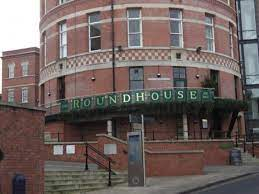
Further up the hill from the castle lies my next stop, The Roundhouse.
As the name accurately describes, this is a tall, circular building in Royal Standard Place. The present building was built on the spot where, during the English Civil War, Charles I raised his standard and asked the people of Nottingham for their support. In more recent times, it was part of Nottingham General Hospital which I am unsure whether still operates. Any readers with a knowledge of hospitals, feel free to enlighten me! Inside, the décor is art deco which fits very well with the general feel of the place. The seating is incorporated well into the shape of the building and there are several really cool character features including some amazing ceiling art. The bar is curved and includes 6 handpulls, 1 of which is not in use at this stage. Available for the ale drinker are Mr Grundy's Pip, Squeak and Wilfred, Mr Grundy's Blighty, Dancing Duck Dark Drake and Round Heart and Tim Taylor Landlord. I took a chance here and decided to try the Blighty. At 4.5% this is a mild, with strong flavours of coffee, a caramel aroma and a creamy head all contributing to a smooth finish. I sat at the bar enjoying my mild, and taking in my surroundings. I have visited here on a couple of prior occasions, most recently on a date, and I never fail to be impressed by it.
Inevitably, because it's England in May, the weather was never going to hold out and the heavens opened as I was on my way to the next location. Even though this wasn't far, by the time I arrived I looked like I'd been for a brisk swim in the Trent. Or, probably more accurately, survived the sinking of the Titanic. I was now at Nottingham Playhouse to investigate Cast, the bar for the venue.
The surroundings of the bar are very contemporary and the bar itself carries out some quite cool colour changing light effects. The handpulls, of which there are 3 are arranged at random points on and behind the bar and are made of chrome, which in itself is quite interesting. My choices here are Shipstone's Bitter, Flipside English Crown and Navigation Traditional. Navigation beers are always a good option and the Traditional was in good condition. I stayed here for a little bit in hopes of drying off and also had the time to take in the majesty of the Sky Mirror which does exactly what you would expect from the name. Eventually, with my pint glass empty and clothing slightly less drippy, I once again braved the elements.
Next up was a place that is well known as an excellent venue for ale in the local area. It has featured in the blog previously as part of an entry about a story telling evening. I am of course referring to the Hand & Heart.
Built into the cave system and with a conservatory above, the Hand & Heart has built up something of a reputation for good food and great beer. It was quiet when I arrived here but this was Wednesday afternoon so that's almost to be expected. Of the 8 available hand pulls, 2 are out of use but the remaining 6 offer up a good mix of Black Iris Stout No.3, Mr Grundy's Olive Branch, Black Hole Aleien Invasion, London Pride, Maypole Little Weed and Dancing Duck Round Heart. I decided on the 3.9% Olive Branch and it proved a wise move. This ale is golden and heavily malted with hints of coffee and a smooth finish. It was almost a shame when I drained the last of it!
I had one stop left on this particular tour and, luckily, I only had to go next door to the The Hawksley.
Though the interior of this premises is modern looking, you only have to look behind the back bar to see the caves that permeate the area. In this case the caves even permeate the nostrils as you can smell the damp coming from underground. It's not an unpleasant smell though thankfully. The seating throughout is mostly tables accompanied by either wooden chairs or red leather sofas, and the walls are decorated with photographs of local sporting legends. 1 of the 4 hand pumps is not in use but the others offer up a selection of Landlord, London Pride and Harvest Pale. I went for the latter and it was in excellent condition. I had plenty of time to reflect on my afternoon of exploration before I went back to my hotel and there was lots to reflect upon. The day had been productive, the venues interesting and the beer good. Generally, I have no reason to complain about a day well spent and a job well done. In future blogs, I may attempt a more far-reaching comparison of Nottingham ale pubs versus Portsmouth ale pubs in an attempt to see which city has it better off, although I have a hunch that I already know the answer. I shall be attempting to investigate as much ale-related in Portsmouth and its environs before my inevitable and glorious return to Nottingham (why fight it?) and I also hope to keep investigating the Nottingham area too. This should give a good indication of the key differences in different areas, not just in terms of breweries and beers available but also attitudes towards ale consumption around the country. Besides which, it's fun!
And it's not like I have much else to do.............
This is not the same Castle that featured in my trip around the Sneinton area. It is instead a much older, stylish building located opposite the gatehouse of Nottingham Castle. The frontage of the building is original brick and the building itself sits at the junction of the main thoroughfare and a smaller, narrower side street. To the front, the mocked up frosted glass boasts a date of 1980 for the current premises but the building, and its use as a pub, date back a lot further. To one side are mullioned windows. Internally, the pub is broken up into smaller sections by the use of small sets of steps. The seating is a mixture of chairs, stools and sofas. The bar is central and L shaped and boasts 6hand pulls, 2 of which are out of use at the time of my visit. The 6 options available are London Pride, Shipstone's Bitter, Doom Bar and Tribute. I decided that Tribute was a good option, being one of my favourite ales and I was pleasantly impressed when it was served in a jar with a handle. It was also in very good condition, which is always nice to see and the whole experience was made all the more enjoyable by the Johnny Cash being pumped from over the sound system. All in all, it was a good start to the day.
My next stop was unplanned on my original itinerary but I took a stab, out of curiosity more than anything else and I'm pleased to say that my faith was rewarded. Opposite the Castle Inn, is the Crafty Crow.
I'm amazed that no-one had told me about this place yet, for reasons that will soon make sense but I get the sense that it hasn't been open very long as I'm fairly sure that it was being constructed/renovated the last time that I was in this part of town. Situated in the building that used to house BZR nightclub, Crafty Crow is the tap house for Magpie Brewery. In addition to this, they specialise in independent British brewers and craft beers. The large, open plan interior is filled with modern décor but with a certain artistic flair to add to the atmosphere. The bar is very large and located right in the centre of the room. Aesthetically it's impressive with empty kegs and an old brewing vessel incorporated into the design of the bar. A fridge to one side is chock full of bottled beers and there are more available on draught from pumps mounted onto the old brewing vessel. There are also 10 (count them!) handpulls, dispensing a variety of goodies. On this occasion, the offerings consisted of Magpie Pale & Nightbus, Flipside English Crown, Growler Suffolk County, Wentwell Jeremiah Mild, Copthorne Cherry Porter, Mallard Drake and Eden Challenger. I swung for a pint of Nightbus (4.2%). This ale was brewed especially for the Trent Barton bus company by Magpie Brewery and is a heavy hopped ruby ale with a base of caramel malt. It went down very well as did my experience of the Crafty Crow as a whole. I would urge anyone who hasn't ventured here yet to make an effort to do so as it is definitely worth it.
Further up the hill from the castle lies my next stop, The Roundhouse.
As the name accurately describes, this is a tall, circular building in Royal Standard Place. The present building was built on the spot where, during the English Civil War, Charles I raised his standard and asked the people of Nottingham for their support. In more recent times, it was part of Nottingham General Hospital which I am unsure whether still operates. Any readers with a knowledge of hospitals, feel free to enlighten me! Inside, the décor is art deco which fits very well with the general feel of the place. The seating is incorporated well into the shape of the building and there are several really cool character features including some amazing ceiling art. The bar is curved and includes 6 handpulls, 1 of which is not in use at this stage. Available for the ale drinker are Mr Grundy's Pip, Squeak and Wilfred, Mr Grundy's Blighty, Dancing Duck Dark Drake and Round Heart and Tim Taylor Landlord. I took a chance here and decided to try the Blighty. At 4.5% this is a mild, with strong flavours of coffee, a caramel aroma and a creamy head all contributing to a smooth finish. I sat at the bar enjoying my mild, and taking in my surroundings. I have visited here on a couple of prior occasions, most recently on a date, and I never fail to be impressed by it.
Inevitably, because it's England in May, the weather was never going to hold out and the heavens opened as I was on my way to the next location. Even though this wasn't far, by the time I arrived I looked like I'd been for a brisk swim in the Trent. Or, probably more accurately, survived the sinking of the Titanic. I was now at Nottingham Playhouse to investigate Cast, the bar for the venue.
The surroundings of the bar are very contemporary and the bar itself carries out some quite cool colour changing light effects. The handpulls, of which there are 3 are arranged at random points on and behind the bar and are made of chrome, which in itself is quite interesting. My choices here are Shipstone's Bitter, Flipside English Crown and Navigation Traditional. Navigation beers are always a good option and the Traditional was in good condition. I stayed here for a little bit in hopes of drying off and also had the time to take in the majesty of the Sky Mirror which does exactly what you would expect from the name. Eventually, with my pint glass empty and clothing slightly less drippy, I once again braved the elements.
Next up was a place that is well known as an excellent venue for ale in the local area. It has featured in the blog previously as part of an entry about a story telling evening. I am of course referring to the Hand & Heart.
Built into the cave system and with a conservatory above, the Hand & Heart has built up something of a reputation for good food and great beer. It was quiet when I arrived here but this was Wednesday afternoon so that's almost to be expected. Of the 8 available hand pulls, 2 are out of use but the remaining 6 offer up a good mix of Black Iris Stout No.3, Mr Grundy's Olive Branch, Black Hole Aleien Invasion, London Pride, Maypole Little Weed and Dancing Duck Round Heart. I decided on the 3.9% Olive Branch and it proved a wise move. This ale is golden and heavily malted with hints of coffee and a smooth finish. It was almost a shame when I drained the last of it!
I had one stop left on this particular tour and, luckily, I only had to go next door to the The Hawksley.
Though the interior of this premises is modern looking, you only have to look behind the back bar to see the caves that permeate the area. In this case the caves even permeate the nostrils as you can smell the damp coming from underground. It's not an unpleasant smell though thankfully. The seating throughout is mostly tables accompanied by either wooden chairs or red leather sofas, and the walls are decorated with photographs of local sporting legends. 1 of the 4 hand pumps is not in use but the others offer up a selection of Landlord, London Pride and Harvest Pale. I went for the latter and it was in excellent condition. I had plenty of time to reflect on my afternoon of exploration before I went back to my hotel and there was lots to reflect upon. The day had been productive, the venues interesting and the beer good. Generally, I have no reason to complain about a day well spent and a job well done. In future blogs, I may attempt a more far-reaching comparison of Nottingham ale pubs versus Portsmouth ale pubs in an attempt to see which city has it better off, although I have a hunch that I already know the answer. I shall be attempting to investigate as much ale-related in Portsmouth and its environs before my inevitable and glorious return to Nottingham (why fight it?) and I also hope to keep investigating the Nottingham area too. This should give a good indication of the key differences in different areas, not just in terms of breweries and beers available but also attitudes towards ale consumption around the country. Besides which, it's fun!
And it's not like I have much else to do.............
Tuesday, February 18, 2014
Go West!
Being a teacher puts me in the enviable position of having a holiday every 6 weeks or so and it just so happened that the weekend after my birthday Buxton adventure was the start of February half term. With this in mind, I had long ago arranged with Matt and Jess to visit them at their new home in Bristol where Matt originates from. This seemed like the perfect opportunity to explore the sites (read pubs) of Bristol and have a thorough look at what the city has to offer for the ale tourist and the tourist in general. I'd never been to Bristol so I didn't really know what to expect but Matt assured me that it would be a thoroughly enjoyable experience. What followed more than lived up to this claim.
Bristol is England's sixth and the United Kingdom's eighth most populous city, one of the Core Cities Group and the most populous city in South West England.
Historically in Gloucestershire, the city received a Royal charter in 1155 and was granted County status in 1373. From the 13th century, for half a millennium, it ranked amongst the top three English cities after London, alongside York and Norwich, on the basis of tax receipts, until the rapid rise of Liverpool, Birmingham and Manchester during the Industrial Revolution in the latter part of the 18th century. It borders the counties of Somerset and Gloucestershire, and is also located near the historic cities of Bath to the south east and Gloucester to the north. The city is built around the River Avon, and it also has a short coastline on the Severn Estuary, which flows into the Bristol Channel.
Bristol is the largest centre of culture, employment and education in the region. Its prosperity has been linked with the sea since its earliest days. The commercial Port of Bristol was originally in the city centre before being moved to the Severn Estuary at Avonmouth; Royal Portbury Dock is on the western edge of the city boundary. In more recent years the economy has depended on the creative media, electronics and aerospace industries, and the city centre docks have been regenerated as a centre of heritage and culture. There are 34 other populated places named Bristol, most in the United States, but also in Peru, Canada, Jamaica, Barbados, and Costa Rica, all presumably commemorating the original. People from Bristol are termed Bristolians.
Archaeological finds believed to be 60,000 years old, discovered at Shirehampton and St Annes, provide "evidence of human activity" in the Bristol area from the Palaeolithic era. Iron Age hill forts near the city are at Leigh Woods and Clifton Down on the side of the Avon Gorge, and on Kingsweston Hill, near Henbury. During the Roman era there was a settlement, Abona, at what is now Sea Mills, connected to Bath by a Roman road, and another at the present-day Inns Court. There were also isolated Roman villas and small Roman forts and settlements throughout the area.
The town of Brycgstow (Old English, "the place at the bridge") appears to have been founded in c.1000 and by c.1020 was an important enough trading centre to possess its own mint, producing silver pennies bearing the town's name. By 1067 the town was clearly a well fortified burh that proved capable of resisting an invasion force sent from Ireland by Harold's sons. Under Norman rule the town acquired one of the strongest castles in southern England.
The area around the original junction of the River Frome with the River Avon, adjacent to the original Bristol Bridge and just outside the town walls, was where the port began to develop in the 11th century. By the 12th century Bristol was an important port, handling much of England's trade with Ireland, including slaves. In 1247 a new stone bridge was built, which was replaced by the current Bristol Bridge in the 1760s, and the town was extended to incorporate neighbouring suburbs, becoming in 1373 a county in its own right. During this period Bristol also became a centre of shipbuilding and manufacturing. By the 14th century Bristol was one of England's three largest medieval towns after London, along with York and Norwich, and it has been suggested that between a third and half of the population were lost during the Black Death of 1348–49. The plague resulted in a prolonged pause in the growth of Bristol's population, with numbers remaining at 10,000–12,000 through most of the 15th and 16th centuries.
The Diocese of Bristol was founded in 1542, with the former Abbey of St. Augustine, founded by Robert Fitzharding in 1140, becoming Bristol Cathedral. Traditionally this is equivalent to the town being granted city status. During the English Civil War the city was occupied by Royalist military, and they built the Royal Fort House on the site of an earlier Parliamentarian stronghold.
Renewed growth came with the 17th century rise of England's American colonies and the rapid 18th century expansion of England's part in the Atlantic trade in Africans taken for slavery in the Americas. Bristol, along with Liverpool, became a centre for the Triangular trade. In the first stage of this trade manufactured goods were taken to West Africa and exchanged for Africans who were then, in the second stage or middle passage, transported across the Atlantic in brutal conditions. The third leg of the triangle brought plantation goods such as sugar, tobacco, rum, rice and cotton and also a small number of slaves who were sold to the aristocracy as house servants, some eventually buying their freedom. During the height of the slave trade, from 1700 to 1807, more than 2,000 slaving ships were fitted out at Bristol, carrying a (conservatively) estimated half a million people from Africa to the Americas and slavery.
The Seven Stars public house, where abolitionist Thomas Clarkson collected information on the slave trade, still exists.
Fishermen from Bristol had fished the Grand Banks of Newfoundland since the 15th century and began settling Newfoundland permanently in larger numbers in the 17th century establishing colonies at Bristol's Hope and Cuper's Cove. Bristol's strong nautical ties meant that maritime safety was an important issue in the city. During the 19th century Samuel Plimsoll, "the sailor's friend", campaigned to make the seas safer; he was shocked by the overloaded cargoes, and successfully fought for a compulsory load line on ships.
Competition from Liverpool from c. 1760, the disruption of maritime commerce caused by wars with France (1793) and the abolition of the slave trade (1807) contributed to the city's failure to keep pace with the newer manufacturing centres of the North of England and the West Midlands. The passage up the heavily tidal Avon Gorge, which had made the port highly secure during the Middle Ages, had become a liability which the construction of a new "Floating Harbour" (designed by William Jessop) in 1804–9 failed to overcome, as the great cost of the scheme led to excessive harbour dues. Nevertheless, Bristol's population (66,000 in 1801) quintupled during the 19th century, supported by new industries and growing commerce. It was particularly associated with the noted Victorian engineer, Isambard Kingdom Brunel, who designed the Great Western Railway between Bristol and London Paddington, two pioneering Bristol-built ocean going steamships, the SS Great Britain and SS Great Western, and the Clifton Suspension Bridge. John Wesley founded the very first Methodist Chapel, called the New Room, in Bristol in 1739. Riots occurred in 1793 and 1831, the first beginning as a protest at renewal of an act levying tolls on Bristol Bridge, and the latter after the rejection of the second Reform Bill.
By 1901, some 330,000 people were living in Bristol and the city would grow steadily as the 20th century progressed. The city's docklands were enhanced in the early 1900s with the opening of Royal Edward Dock. Another new dock – Royal Portbury Dock – was opened in the 1970s.
Its education system received a major boost in 1909 with the formation of the University of Bristol though it really took off in 1925 when its main building was opened. A polytechnic was opened in 1969 to give the city a second higher education institute, which would become the University of the West of England in 1992. With the advent of air travel, aircraft manufacturers set up base at new factories in the city during the first half of the 20th century.
Bristol suffered badly from Luftwaffe air raids in World War II, claiming some 1,300 lives of people living and working in the city, with nearly 100,000 buildings being damaged, at least 3,000 of them beyond repair. The original central shopping area, near the bridge and castle, is now a park containing two bombed out churches and some fragments of the castle. A third bombed church nearby, St Nicholas, has been restored and has been made into a museum which houses a triptych by William Hogarth, painted for the high altar of St Mary Redcliffe in 1756. The museum also contains statues moved from Arno's Court Triumphal Arch, of King Edward I and King Edward III taken from Lawfords' Gate of the city walls when they were demolished around 1760, and 13th century figures from Bristol's Newgate representing Robert, the builder of Bristol Castle, and Geoffrey de Montbray, Bishop of Coutances, builder of the fortified walls of the city.
The rebuilding of Bristol city centre was characterised by 1960s & 70's Skyscrapers, Mid-Century Modern architecture, and the improvement of road infrastructure. Since the 1980s another trend has emerged with the closure of some main roads, the restoration of the Georgian era Queen Square and Portland Square, the regeneration of the Broadmead shopping area, and the loss of one of the city centre's tallest Mid-Century Modern towers.
Bristol's road infrastructure was altered dramatically in the 1960s and 1970s with the development of the M4 and M5 motorways, which meet at an interchange just north of the city and give the city direct motorway links with London (M4 eastbound), Cardiff (M4 westbound across the Estuary of the River Severn), Exeter (M5 southbound) and Birmingham (M5 northbound).
The removal of the docks to Avonmouth Docks and Royal Portbury Dock, 7 miles (11.3 km) downstream from the city centre during the 20th century has also allowed redevelopment of the old central dock area (the "Floating Harbour") in recent decades, although at one time the continued existence of the docks was in jeopardy as it was viewed as a derelict industrial site rather than an asset. However the holding, in 1996, of the first International Festival of the Sea in and around the docks, affirmed the dockside area in its new leisure role as a key feature of the city.
As can be seen, Bristol is a city with a long and varied history and I was very excited for the chance to explore a place that I'd never visited. After an easy but very blustery drive from Long Eaton, I arrived at Matt and Jess' flat in the suburb of Hanham and the day began. After lunch and cocktails (you read that right) at Turtle Bay, we began our journey around the city centre with Matt as a very useful guide. Our first location was The Crown, a very old traditional pub situated on All Saints Lane at the heart of St. Nicholas Market.
The building is Grade II listed and dates from at least 1741. The traditional appearance continues inside with a split level layout and low-beamed ceilings. There is lots of seating in the form of comfy sofas, low and high tables and wall-mounted shelves for those that prefer to lean. The walls are decorated with old photos of the surrounding area and the curved bar is located to one side of the main room. There are 4 handpulls on offer and these include Crown & Glory, Green Duck Duck Turpin, Stunner and High Voltage from Bragdy Heavy Industry Brewery. I went for the High Voltage (4.5%), which is golden in colour, with fruit on the nose and a very hoppy flavour with zest underneath and a smooth finish. It was certainly a good start to the day and the pub surroundings were very nice too with a distinct alternative atmosphere and a very intense man in camouflage trousers who may have been on the angriest date ever. The Crown regularly hosts gigs in the old cellar and this area of the building is allegedly haunted by the apparition of a 17th century gentleman in a Periwig who only appears to women.
We didn't have a set plan for the day so it was very much a case of wandering around until we saw some places we liked the look of. This did not take long at all, as our walk brought us to the Bristol BrewDog!
This glass fronted building is on a smaller and busier scale than it's Nottingham equivalent and it is very busy for a Saturday afternoon, no doubt helped by a live performance from a very impressive acoustic duo. We decided that popping in for a half wouldn't do any harm (famous last words) so we eased our way to the bar. Jess went for Punk IPA, Matt went for a guest cider called Bifrost and I worked my way through a half of 5am Saint, whilst enjoying the entertainment.
We decided that our next destination would The Old Fish Market, a Fuller's operated premises almost opposite.
As its name suggests, this was formally a fish market and now operates as a pub that also houses a Thai restaurant. The building is large, long and made of old brick. Inside there is lots of seating and separate areas divided by internal walls. One wall is covered by a large mural. The bar is located against the wall directly facing the entrance. The 10 available hand pulls are doubles of Chiswick Bitter, London Pride, ESB, Front Row (a 6 Nations special edition) and Butcombe Bitter. Matt opted for the Front Row which I think he soon regretted and Jess decided on a half of Frontier craft lager. I decided that ESB was as good a call as any and it was very well kept, which is what you'd expect for a pub in the Good Beer Guide. We managed to find a small vacant booth awayfrom the main area. The reason for it being empty soon became clear as it smelled strongly of damp and mould was apparent inside some nearby picture frames. We soon worked out that we were in close proximity to the toilets which explained the smell, even if it didn't quite explain the damp. This was a down side to an otherwise very nice place.
For our next destination, we turned back on ourselves slightly and headed for a pub that Matt recommended, The Mother's Ruin.
This is a very alternative pub with a distinct grungy feel which I thoroughly liked. It reminded me of a very similar place in Cambridge. The layout is split level, with stairs leading up to the bar and a further level above that includes comfy sofas and is more open plan. The 2 hand pulls present here offered a choice of either Doom Bar or Old Rosie. Not wishing to go blind this early in the evening, I felt that Doom Bar was a wiser option. It was very nice too which is always a plus. After a few minutes lounging about on the sofas, we finished our drinks and decided what we would do next. Matt did then then realise that he meant to take us to the Irish bar next door instead of to Mother's Ruin but I was having a good time so I wasn't that fussed.
Our next experience certainly belongs in the category designated 'Seemed like a good idea at the time'. Matt had been talking about the Bavarian Beerhouse, an authentic German bierkeller in the heart of the Bristol and we were all determined to check it out.
On the way, I popped into a shop for a pasty which I ate outside the beer house before we went in. This did not prevent a very good-natured German lady from good-naturedly accosting me before we even went in. She only came out to have a laugh because she was bored but I was 5 seconds away from surrendering. Inside, things did slightly improve. The general appearance was essentially a series of wooden picnic benches with a bar to one side and a small stage to the back of the room. It's strictly table service only so Matt and I both ordered steins of quality German beer. I went for the Erdinger Dunkel which was very dark but very very tasty. I thoroughly enjoyed it, which is just as well considering what happened next. Despite my pasty break, we had decided that we would eat here so we happily perused the food menu, which was essentially various sausages presented in various ways. Jess chose more wisely than Matt and I. Whilst she had a frankfurter with mash, Matt and I had ordered what was essentially 2 white sausages served in a bowl of chive water. The sausages were nice enough but we were very confused. The arrival of Matt's friends Pete, probably the most Bristolian man ever, was very timely in the context of what happened next. The only other people in the venue by now were a group of very drunk guys who may have been on a stag do. They enjoyed the following event much more than we did. A large German man (think a lighter, sober Mickey Rourke), took to the stage in short trousers and pedal pushers and began using an electronic keyboard to perform his own renditions of songs such as 'County Roads', 'Is This The Way to Amarillo' and, as we were leaving 'A Little Respect'. I realise that this isn't ale-related but it needed to be shared, as the image is now seared into the back of my eyelids every time I blink.
To detract from the horror we had just witnessed, we visited the fabled Apple, a bar located on a boat.
This is no ordinary bar, this is a cider bar which, amongst a vast range of real ciders, also offers cider cocktails. I'm not generally a cider drinker but, when in Rome and all that. I went for a pint of Wilkins which is one of Matt's favourites. As ciders go, it wasn't bad and I was able to drink the whole thing which I'm claiming as a small victory. The Apple is certainly worth a visit for any fans of real ciders and, although there isn't much on offer for ale drinkers, it has a fantastic and friendly atmosphere that a lot of places would struggle to replicate. And it's on a boat!
What happened at this point becomes quite hazy I must admit. We ventured back on ourselves again and placed ourselves in an outdoor seating area between 2 pubs, The Old Duke and The Llandogr Trow, a Welsh bar. I'll be honest that I don't remember much about either venue, other than that The Old Duke was hosting a very good swing band and that there was Hobgoblin, which wasn't bad. I don't think we went into the Llandoger Trow but subsequent research has revealed that the pub is haunted by a ghostly sailor with a severely injured leg. A TV crew and psychic that visited the site claimed that as many as 14 entities haunt the premises, one of which may be a young boy.
Bristol is certainly a very interesting place, for its history and its sites alone, and it also has a myriad of great pubs that cater for those with an appetite for good beer. I plan on making a return visit later in the year, during which I will endeavour to place more of a focus on some of the other pubs, including some that appear in the Good Beer Guide. Hopefully, this will allow me to amass even more information on the ale scene in this fabulous city. For now though, I feel that this brief visit is a good start and certainly gives me somewhere to jump off from in future. That's all for now though folks. Keep drinking!
Bristol is England's sixth and the United Kingdom's eighth most populous city, one of the Core Cities Group and the most populous city in South West England.
Historically in Gloucestershire, the city received a Royal charter in 1155 and was granted County status in 1373. From the 13th century, for half a millennium, it ranked amongst the top three English cities after London, alongside York and Norwich, on the basis of tax receipts, until the rapid rise of Liverpool, Birmingham and Manchester during the Industrial Revolution in the latter part of the 18th century. It borders the counties of Somerset and Gloucestershire, and is also located near the historic cities of Bath to the south east and Gloucester to the north. The city is built around the River Avon, and it also has a short coastline on the Severn Estuary, which flows into the Bristol Channel.
Bristol is the largest centre of culture, employment and education in the region. Its prosperity has been linked with the sea since its earliest days. The commercial Port of Bristol was originally in the city centre before being moved to the Severn Estuary at Avonmouth; Royal Portbury Dock is on the western edge of the city boundary. In more recent years the economy has depended on the creative media, electronics and aerospace industries, and the city centre docks have been regenerated as a centre of heritage and culture. There are 34 other populated places named Bristol, most in the United States, but also in Peru, Canada, Jamaica, Barbados, and Costa Rica, all presumably commemorating the original. People from Bristol are termed Bristolians.
Archaeological finds believed to be 60,000 years old, discovered at Shirehampton and St Annes, provide "evidence of human activity" in the Bristol area from the Palaeolithic era. Iron Age hill forts near the city are at Leigh Woods and Clifton Down on the side of the Avon Gorge, and on Kingsweston Hill, near Henbury. During the Roman era there was a settlement, Abona, at what is now Sea Mills, connected to Bath by a Roman road, and another at the present-day Inns Court. There were also isolated Roman villas and small Roman forts and settlements throughout the area.
The town of Brycgstow (Old English, "the place at the bridge") appears to have been founded in c.1000 and by c.1020 was an important enough trading centre to possess its own mint, producing silver pennies bearing the town's name. By 1067 the town was clearly a well fortified burh that proved capable of resisting an invasion force sent from Ireland by Harold's sons. Under Norman rule the town acquired one of the strongest castles in southern England.
The area around the original junction of the River Frome with the River Avon, adjacent to the original Bristol Bridge and just outside the town walls, was where the port began to develop in the 11th century. By the 12th century Bristol was an important port, handling much of England's trade with Ireland, including slaves. In 1247 a new stone bridge was built, which was replaced by the current Bristol Bridge in the 1760s, and the town was extended to incorporate neighbouring suburbs, becoming in 1373 a county in its own right. During this period Bristol also became a centre of shipbuilding and manufacturing. By the 14th century Bristol was one of England's three largest medieval towns after London, along with York and Norwich, and it has been suggested that between a third and half of the population were lost during the Black Death of 1348–49. The plague resulted in a prolonged pause in the growth of Bristol's population, with numbers remaining at 10,000–12,000 through most of the 15th and 16th centuries.
The Diocese of Bristol was founded in 1542, with the former Abbey of St. Augustine, founded by Robert Fitzharding in 1140, becoming Bristol Cathedral. Traditionally this is equivalent to the town being granted city status. During the English Civil War the city was occupied by Royalist military, and they built the Royal Fort House on the site of an earlier Parliamentarian stronghold.
Renewed growth came with the 17th century rise of England's American colonies and the rapid 18th century expansion of England's part in the Atlantic trade in Africans taken for slavery in the Americas. Bristol, along with Liverpool, became a centre for the Triangular trade. In the first stage of this trade manufactured goods were taken to West Africa and exchanged for Africans who were then, in the second stage or middle passage, transported across the Atlantic in brutal conditions. The third leg of the triangle brought plantation goods such as sugar, tobacco, rum, rice and cotton and also a small number of slaves who were sold to the aristocracy as house servants, some eventually buying their freedom. During the height of the slave trade, from 1700 to 1807, more than 2,000 slaving ships were fitted out at Bristol, carrying a (conservatively) estimated half a million people from Africa to the Americas and slavery.
The Seven Stars public house, where abolitionist Thomas Clarkson collected information on the slave trade, still exists.
Fishermen from Bristol had fished the Grand Banks of Newfoundland since the 15th century and began settling Newfoundland permanently in larger numbers in the 17th century establishing colonies at Bristol's Hope and Cuper's Cove. Bristol's strong nautical ties meant that maritime safety was an important issue in the city. During the 19th century Samuel Plimsoll, "the sailor's friend", campaigned to make the seas safer; he was shocked by the overloaded cargoes, and successfully fought for a compulsory load line on ships.
Competition from Liverpool from c. 1760, the disruption of maritime commerce caused by wars with France (1793) and the abolition of the slave trade (1807) contributed to the city's failure to keep pace with the newer manufacturing centres of the North of England and the West Midlands. The passage up the heavily tidal Avon Gorge, which had made the port highly secure during the Middle Ages, had become a liability which the construction of a new "Floating Harbour" (designed by William Jessop) in 1804–9 failed to overcome, as the great cost of the scheme led to excessive harbour dues. Nevertheless, Bristol's population (66,000 in 1801) quintupled during the 19th century, supported by new industries and growing commerce. It was particularly associated with the noted Victorian engineer, Isambard Kingdom Brunel, who designed the Great Western Railway between Bristol and London Paddington, two pioneering Bristol-built ocean going steamships, the SS Great Britain and SS Great Western, and the Clifton Suspension Bridge. John Wesley founded the very first Methodist Chapel, called the New Room, in Bristol in 1739. Riots occurred in 1793 and 1831, the first beginning as a protest at renewal of an act levying tolls on Bristol Bridge, and the latter after the rejection of the second Reform Bill.
By 1901, some 330,000 people were living in Bristol and the city would grow steadily as the 20th century progressed. The city's docklands were enhanced in the early 1900s with the opening of Royal Edward Dock. Another new dock – Royal Portbury Dock – was opened in the 1970s.
Its education system received a major boost in 1909 with the formation of the University of Bristol though it really took off in 1925 when its main building was opened. A polytechnic was opened in 1969 to give the city a second higher education institute, which would become the University of the West of England in 1992. With the advent of air travel, aircraft manufacturers set up base at new factories in the city during the first half of the 20th century.
Bristol suffered badly from Luftwaffe air raids in World War II, claiming some 1,300 lives of people living and working in the city, with nearly 100,000 buildings being damaged, at least 3,000 of them beyond repair. The original central shopping area, near the bridge and castle, is now a park containing two bombed out churches and some fragments of the castle. A third bombed church nearby, St Nicholas, has been restored and has been made into a museum which houses a triptych by William Hogarth, painted for the high altar of St Mary Redcliffe in 1756. The museum also contains statues moved from Arno's Court Triumphal Arch, of King Edward I and King Edward III taken from Lawfords' Gate of the city walls when they were demolished around 1760, and 13th century figures from Bristol's Newgate representing Robert, the builder of Bristol Castle, and Geoffrey de Montbray, Bishop of Coutances, builder of the fortified walls of the city.
The rebuilding of Bristol city centre was characterised by 1960s & 70's Skyscrapers, Mid-Century Modern architecture, and the improvement of road infrastructure. Since the 1980s another trend has emerged with the closure of some main roads, the restoration of the Georgian era Queen Square and Portland Square, the regeneration of the Broadmead shopping area, and the loss of one of the city centre's tallest Mid-Century Modern towers.
Bristol's road infrastructure was altered dramatically in the 1960s and 1970s with the development of the M4 and M5 motorways, which meet at an interchange just north of the city and give the city direct motorway links with London (M4 eastbound), Cardiff (M4 westbound across the Estuary of the River Severn), Exeter (M5 southbound) and Birmingham (M5 northbound).
The removal of the docks to Avonmouth Docks and Royal Portbury Dock, 7 miles (11.3 km) downstream from the city centre during the 20th century has also allowed redevelopment of the old central dock area (the "Floating Harbour") in recent decades, although at one time the continued existence of the docks was in jeopardy as it was viewed as a derelict industrial site rather than an asset. However the holding, in 1996, of the first International Festival of the Sea in and around the docks, affirmed the dockside area in its new leisure role as a key feature of the city.
As can be seen, Bristol is a city with a long and varied history and I was very excited for the chance to explore a place that I'd never visited. After an easy but very blustery drive from Long Eaton, I arrived at Matt and Jess' flat in the suburb of Hanham and the day began. After lunch and cocktails (you read that right) at Turtle Bay, we began our journey around the city centre with Matt as a very useful guide. Our first location was The Crown, a very old traditional pub situated on All Saints Lane at the heart of St. Nicholas Market.
The building is Grade II listed and dates from at least 1741. The traditional appearance continues inside with a split level layout and low-beamed ceilings. There is lots of seating in the form of comfy sofas, low and high tables and wall-mounted shelves for those that prefer to lean. The walls are decorated with old photos of the surrounding area and the curved bar is located to one side of the main room. There are 4 handpulls on offer and these include Crown & Glory, Green Duck Duck Turpin, Stunner and High Voltage from Bragdy Heavy Industry Brewery. I went for the High Voltage (4.5%), which is golden in colour, with fruit on the nose and a very hoppy flavour with zest underneath and a smooth finish. It was certainly a good start to the day and the pub surroundings were very nice too with a distinct alternative atmosphere and a very intense man in camouflage trousers who may have been on the angriest date ever. The Crown regularly hosts gigs in the old cellar and this area of the building is allegedly haunted by the apparition of a 17th century gentleman in a Periwig who only appears to women.
We didn't have a set plan for the day so it was very much a case of wandering around until we saw some places we liked the look of. This did not take long at all, as our walk brought us to the Bristol BrewDog!
This glass fronted building is on a smaller and busier scale than it's Nottingham equivalent and it is very busy for a Saturday afternoon, no doubt helped by a live performance from a very impressive acoustic duo. We decided that popping in for a half wouldn't do any harm (famous last words) so we eased our way to the bar. Jess went for Punk IPA, Matt went for a guest cider called Bifrost and I worked my way through a half of 5am Saint, whilst enjoying the entertainment.
We decided that our next destination would The Old Fish Market, a Fuller's operated premises almost opposite.
As its name suggests, this was formally a fish market and now operates as a pub that also houses a Thai restaurant. The building is large, long and made of old brick. Inside there is lots of seating and separate areas divided by internal walls. One wall is covered by a large mural. The bar is located against the wall directly facing the entrance. The 10 available hand pulls are doubles of Chiswick Bitter, London Pride, ESB, Front Row (a 6 Nations special edition) and Butcombe Bitter. Matt opted for the Front Row which I think he soon regretted and Jess decided on a half of Frontier craft lager. I decided that ESB was as good a call as any and it was very well kept, which is what you'd expect for a pub in the Good Beer Guide. We managed to find a small vacant booth awayfrom the main area. The reason for it being empty soon became clear as it smelled strongly of damp and mould was apparent inside some nearby picture frames. We soon worked out that we were in close proximity to the toilets which explained the smell, even if it didn't quite explain the damp. This was a down side to an otherwise very nice place.
For our next destination, we turned back on ourselves slightly and headed for a pub that Matt recommended, The Mother's Ruin.
This is a very alternative pub with a distinct grungy feel which I thoroughly liked. It reminded me of a very similar place in Cambridge. The layout is split level, with stairs leading up to the bar and a further level above that includes comfy sofas and is more open plan. The 2 hand pulls present here offered a choice of either Doom Bar or Old Rosie. Not wishing to go blind this early in the evening, I felt that Doom Bar was a wiser option. It was very nice too which is always a plus. After a few minutes lounging about on the sofas, we finished our drinks and decided what we would do next. Matt did then then realise that he meant to take us to the Irish bar next door instead of to Mother's Ruin but I was having a good time so I wasn't that fussed.
Our next experience certainly belongs in the category designated 'Seemed like a good idea at the time'. Matt had been talking about the Bavarian Beerhouse, an authentic German bierkeller in the heart of the Bristol and we were all determined to check it out.
On the way, I popped into a shop for a pasty which I ate outside the beer house before we went in. This did not prevent a very good-natured German lady from good-naturedly accosting me before we even went in. She only came out to have a laugh because she was bored but I was 5 seconds away from surrendering. Inside, things did slightly improve. The general appearance was essentially a series of wooden picnic benches with a bar to one side and a small stage to the back of the room. It's strictly table service only so Matt and I both ordered steins of quality German beer. I went for the Erdinger Dunkel which was very dark but very very tasty. I thoroughly enjoyed it, which is just as well considering what happened next. Despite my pasty break, we had decided that we would eat here so we happily perused the food menu, which was essentially various sausages presented in various ways. Jess chose more wisely than Matt and I. Whilst she had a frankfurter with mash, Matt and I had ordered what was essentially 2 white sausages served in a bowl of chive water. The sausages were nice enough but we were very confused. The arrival of Matt's friends Pete, probably the most Bristolian man ever, was very timely in the context of what happened next. The only other people in the venue by now were a group of very drunk guys who may have been on a stag do. They enjoyed the following event much more than we did. A large German man (think a lighter, sober Mickey Rourke), took to the stage in short trousers and pedal pushers and began using an electronic keyboard to perform his own renditions of songs such as 'County Roads', 'Is This The Way to Amarillo' and, as we were leaving 'A Little Respect'. I realise that this isn't ale-related but it needed to be shared, as the image is now seared into the back of my eyelids every time I blink.
To detract from the horror we had just witnessed, we visited the fabled Apple, a bar located on a boat.
This is no ordinary bar, this is a cider bar which, amongst a vast range of real ciders, also offers cider cocktails. I'm not generally a cider drinker but, when in Rome and all that. I went for a pint of Wilkins which is one of Matt's favourites. As ciders go, it wasn't bad and I was able to drink the whole thing which I'm claiming as a small victory. The Apple is certainly worth a visit for any fans of real ciders and, although there isn't much on offer for ale drinkers, it has a fantastic and friendly atmosphere that a lot of places would struggle to replicate. And it's on a boat!
What happened at this point becomes quite hazy I must admit. We ventured back on ourselves again and placed ourselves in an outdoor seating area between 2 pubs, The Old Duke and The Llandogr Trow, a Welsh bar. I'll be honest that I don't remember much about either venue, other than that The Old Duke was hosting a very good swing band and that there was Hobgoblin, which wasn't bad. I don't think we went into the Llandoger Trow but subsequent research has revealed that the pub is haunted by a ghostly sailor with a severely injured leg. A TV crew and psychic that visited the site claimed that as many as 14 entities haunt the premises, one of which may be a young boy.
Bristol is certainly a very interesting place, for its history and its sites alone, and it also has a myriad of great pubs that cater for those with an appetite for good beer. I plan on making a return visit later in the year, during which I will endeavour to place more of a focus on some of the other pubs, including some that appear in the Good Beer Guide. Hopefully, this will allow me to amass even more information on the ale scene in this fabulous city. For now though, I feel that this brief visit is a good start and certainly gives me somewhere to jump off from in future. That's all for now though folks. Keep drinking!
Birthday Beer in Buxton
For my birthday this year (I'm 25 again), I decided that it was about time that I made the trip north to the Peak District market town of Buxton, which has become something of a haven for real ale drinkers. A last minute change of plan meant that I would be solo for the Friday night before being joined by George on the Saturday morning. This gave me plenty of time to explore the various pubs on the town's ale trail, as outlined by a very helpful leaflet that Matt had procured for me when he had last visited. Whilst I never made it to all of the pubs on the trail, we certainly attempted most of them and found some others along the way!
Buxton is a spa town in Derbyshire, close to the borders of Cheshire to the west and Staffordshire to the south. Described as the 'gateway to the Peak District', Buxton has the highest elevation of any market town in England. Buxton is home to Poole's Cavern, an extensive limestone cavern, named after a notorious local highwayman and open to the public, and St. Ann's Well, fed by the local geothermal spring bottled and sold internationally by the Buxton Mineral Water Company. The town also houses Buxton Opera House, which hosts several music events and festivals each year. The Devonshire Campus of the University of Derby is located within one of the town's historic buildings. Buxton is twinned with two other towns, namely Oignies in France and Bad Nauheim in Germany.
The town developed from a Roman settlement known as Aquae Arnemetiae (or the spa of the goddess of the grove). The discovery of coins has suggested that the Romans were in Buxton throughout their occupation. The origins of the town's name are uncertain, although it is thought to derive from the Old English for 'Buck Stone' or 'Rocking Stone'. The town grew in importance in the 18th century when it was developed by the Dukes of Devonshire, with a resurgence a century later as the Victorians were drawn to the reputed healing properties of the waters.
Built on the River Wye, and overlooked by Axe Edge Moor, Buxton has a history as a spa town due to its geothermal spring which rises at a constant temperature of 28 °C. The spring waters are piped to St Ann's Well (a shrine to St. Anne since medieval times) opposite the Crescent near the town centre.
The Dukes of Devonshire have been closely involved with Buxton since 1780, when the 5th Duke used the profits from his copper mines to develop the town as a spa in the style of Bath. Their ancestor Bess of Hardwick had taken one of her four husbands, the Earl of Shrewsbury, to "take the waters" at Buxton shortly after he became the gaoler of Mary, Queen of Scots, in 1569, and they took Mary there in 1573. She called Buxton "La Fontagne de Bogsby", and stayed at the site of the Old Hall Hotel. The area features in the poetry of W. H. Auden and the novels of Jane Austen and Emily Brontë.
Instrumental in the popularity of Buxton was the recommendation by Dr Erasmus Darwin of the waters at Buxton and Matlock to Josiah Wedgwood I. The Wedgwood family often went to Buxton on holiday and recommended the area to their friends. Two of Charles Darwin's half-cousins, Edward Levett Darwin and Reginald Darwin, settled there. The arrival of the railway in 1863 stimulated the town's growth: the population of 1,800 in 1861 had grown to over 6,000 by 1881.
Each summer the wells are decorated according to the local tradition of well dressing. The well dressing weekend has developed into a town carnival with live music and funfair. In 2013, the Academy of Urbanism named Buxton as one of the three most attractive towns in Britain.
After battling my way through the Friday evening traffic clogging the town centre, I found my B&B, checked in and enjoyed a welcome shower before deciding my plan of action for the evening. I decided that on my first night, I would try out approximately half a dozen of the pubs on the trail before making a more concerted attempt once George was present.
My next destination was back the way I had come and not too far from my B&B. This was The Old Clubhouse.The Old Clubhouse is a former gentleman's club the sits alongside the Opera House. The layout is very traditional with a central bar and a raised seating area around the edge and a mix of high and low seating. Of the 5 handpulls, 2 are in use providing Old Peculier and Abbot Ale. As I reach the bar, the Old Peculier has run out so I'm limited to Abbot Ale, which is thankfully in very good condition. I took the opportunity to grab some food whilst I was here and thoroughly worthwhile it was too. A chicken and bacon burger with home cooked chips went down very well indeed!
My next stop was just down the road at the Old Hall Hotel.
This smart hotel was originally known as the New Hall and was built by the Earl and Countess of Shrewsbury with the sanction of Elizabeth I, in order to provide accommodation for the captive Mary Queen of Scots. Ghostly activity has been reported from the hotel, in the form of footsteps and indistinct apparitions and these phenomena have been attributed to Mary herself although this has not been substantiated. The interior is very traditional and the bar is open to the public as well as guests. When I arrive, there is some kind of party happening so I felt slightly out of place as I was by myself amongst 30+ other people. Ale-wise there is a choice of Doom Bar, Buxton Moor Top and Thornbridge Lord Marples. I went for the latter and it was very well kept. Whilst I sat perusing recent events and slowly enjoying this delicious beer, I was gradually aware of the fact that the party was now into the buffet stage. An older lady who was sat next to me asked me if I was by myself. Expecting this to lead to a conversation, I said that I was. It turned out that she just wanted the extra chairs around my table............
My next stop involved an uphill walk towards the market place, where the next pub sits on a corner. The King's Head was originally built in 1725 as a Presbyterian Chapel and is a large, comfortable pub with a friendly welcome.
The interior is expansive and open plan with mullioned windows and lots of seating. There are 4 handpulls on the central bar offering Marston's Bitter, Ringwood Scuttle Butt, Marston's Pedigree and Brakspear Oxford Gold. Being a big fan of Ringwood beers, it didn't take long for me to make my choice. Scuttle Butt is golden in colour, very hoppy and with hop flavours underneath an initial citrus aroma. The finish is zesty with a hint of malt on the tongue. All this at only 4.0%.
By now, following a long day at work, a long drive to Buxton and a general heap of stress, I was rather tired, so I decided that one more pub would be enough for tonight. This was literally a stone's throw away.
The Eagle Hotel dates back at least 2 centuries and is thought to be the oldest pub in Buxton. Operated by Hyde's, the atmosphere is decidedly local and I was a bit apprehensive upon entry as I wasn't quite sure what to expect, especially as the pub was so quiet for a Friday night. Hyde's Bitter was available on hand pull and it was well kept, which lessened my fear a little. A small group of lads who were playing pool were very welcoming and friendly so I guess you shouldn't judge a pub by it's exterior and/or décor. I was done in by this stage so I wandered carefully off to the B&B for a nice sleep.
The following day was Saturday so, following a full English, another shower and a chance to wake up and clear my head, I decided that a little recon was in order to prepare for George's arrival and make a plan for the evening. I had a wander around the town identifying the location of pubs that formed the basis of the trail and any others that I thought could be worth a look. This proved to be a fruitful exercise and I formed a coherent plan in my head for later that day. With time to kill before George arrived, I decided that I would pay a visit to couple of pubs that were at the other end of the trail, away from the area we would be visiting. The first of these was the local Wetherspoons, the Wye Bridge House.
This former Midland Railway hotel is on a slightly raised grassy area near the bank of the River Wye which flows nearby. The building boasts a slate brick exterior and is relatively square in layout with bay windows to the side, French windows to the front and an extensive outdoor patio area. The bar is L shaped and off centre and the overall layout is the standard Spoons open plan with a mixture of high and low seating. The bar includes 10 hand pulls. 1 is not in use but the others feature Abbot Ale, Hobgoblin, Ruddles Bitter (2 of each), Old Rosie cider, Ein Stein from Lymestone brewery, Life of Riley from the Wincle Beer Co., and a California Session IPA, brewed as part of the current UK/US collaboration. After a period of thinking, I decided that Life of Riley would be a good call. This is 4.2%, very pale in colour and with a fruity aroma tinged with a touch of hops. On the tongue, there is lemon and peach and a citrus finish. Overall, it was a very nice way to start the day!
I next ventured to a pub that lies just around the corner, underneath the railway arches. Imaginatively named The Railway, this is a Greene King operated stone and brick building that extends back beneath the imposing arches above.
There is a small, central bar with seating and dining areas off to either side. 3 of the 4 handpulls are in use, offering a choice of Greene King IPA, Olde Trip and Railway Bitter, brewed especially for the premises. I went for the Olde Trip, which was in very good condition.
Following a brief detour back to the B&B, I made a swift return to The King's Head for another pint of Scuttle Butt, in hope that they were showing the Liverpool v Arsenal game.
Shortly after leaving the Queens Head, George informed me that he had arrived! After a quick snack, the day began properly. Retracing my steps from the Queen's, we headed to our first planned destination, The Swan.
Regularly featuring in the Good Beer Guide, The Swan is renowned as a proper drinkers pub. This square, stone building is just off of the main market place. There are 3 rooms served from a central bar. 5 hand pulls are present, providing Doom Bar, Tetley's and Hurricane Hubert from Macclesfield's Storm Brewery. I instantly opted for the Hubert, whilst George ordered a coke to help with his hangover (which made me feel better). The beer was very good, 4.5%, chestnut coloured, with a nutty aroma, creamy head and a soft, malty taste with a smooth finish and hints of chocolate malt.
Helpfully, the first few pubs I'd pencilled in for the day were in close proximity which meant that whilst lots of walking would be required later, at least we could ease ourselves into it. The next place on our list was almost opposite The Swan. The Cheshire Cheese is owned and operated by Titanic Brewery, operating almost as an unofficial brewery tap.
The bar is diagonal and located at the back of the room and there is a mix of high and low seating throughout. 7 of the 10 handpulls include offerings from Titanic Brewery, in the form of Anchor, Plum Porter, Capt. Smith's, Iceberg, Steerage, White Star and Compass. Chocolate Stout is available on draught from wall-mounted taps. The remaining 3 handpulls feature Everard's Tiger, Ilkley Black and Cumberland Cumbria Bitter. I went for the White Star at 4.8%. This beer is pale golden in colour, honey flavoured and fruity on the nose with a zesty taste and a smooth finish. George decided on a pint of the Anchor. We thoroughly enjoyed this pub, which features on the trail but had changed hands since the guide was written. During our time here, we heard the barmaid make a joke as bad as one of mine after smashing a glass and I somehow accidentally flirted with George's girlfriend Shellie over the phone. I don't think he minded that much and to be honest, I don't really know how I managed it.
Sadly, we realised we had to move on and ventured 2 doors down to the Old Sun Inn.
This is an old, traditional building with low beams, flagged floors and open fires. Lots of rooms are arranged around the central entrance. The small bar has 5 handpulls, 3 of which are currently in use and offering Pedigree, Marston's Bitter and Sun Inn Ale, brewed for the pub. We both decided on a pint of the Sun Inn Ale which, despite only having an ABV of 3.6%, was very nice with a good hop/bitter balance, a pale appearance and a smooth finish with a hoppy kick. It being a Saturday in February, the Six Nations was in full swing. Our next task became finding a venue in which we could watch the England v Scotland game.
Following the rugby, the walking properly began and we made our way back up the hill to a pub I'd spotted just off of the Market Place, The New Inn.
This brands itself as a cask ale house and is small inside, consisting of a single room with seating around the room and the bar against the back wall and a coal fire making the place nice and warm. The 8 hand pulls contain a variety of different brews including Titanic Cherry Stout, Stout and Full Steam Ahead, Robinson's Unicorn, Trooper, Blonde and Old Tom and Hartley's Cumbria Way. It's this last option that I eventually went for, copper coloured, malty in aroma and zesty in flavour with a hoppy finish. The general feel of this pub was a disappointment as it seemed to be full of mainly older people keeping to themselves. Of all the pubs over the weekend, we enjoyed this one the least.
Our next location was further downhill, and tucked off the main streets.
The Buxton Tap House is the brewery tap for Buxton Brewery and very nice it is too! Modern and shiny inside with a small rectangular bar and 8 handpulls, most of which (obviously) feature Buxton products. On offer are Buxton Bitter, Moor Top, Rednik Stout, Axe Edge and a couple of others. The Rednik Stout was very nice, with a deep browny-black appearance and a creamy latte head, at a strength of 4.1%. It was getting to the stage of the evening where serious conversation began to take place, which should have been a sign that it was time to go home. However, I was determined to drag George to Ramsay's Bar. Whilst here, supping our final pints, we sampled the cuisine, in the form of the steak and ale pie, which was fantastic! With our appetites sated and our blood safely diluted by alcohol we wound out weary way back to the B&B.
It had been a very good day, to top off an excellent weekend. Buxton certainly has a lot to offer the seasoned drinker and even those who are new to the ale scene. If you don't mind walking and lots of wind, a trip to Buxton is something that everyone should try at least once. I do intend on a return visit in the future, to visit the pubs that we missed out but also to go caving as George assures me that it's brilliant. All in all, this was a successful trip and certainly one of the most interesting that I've done since this blog was conceived. A happy birthday indeed!
Buxton is a spa town in Derbyshire, close to the borders of Cheshire to the west and Staffordshire to the south. Described as the 'gateway to the Peak District', Buxton has the highest elevation of any market town in England. Buxton is home to Poole's Cavern, an extensive limestone cavern, named after a notorious local highwayman and open to the public, and St. Ann's Well, fed by the local geothermal spring bottled and sold internationally by the Buxton Mineral Water Company. The town also houses Buxton Opera House, which hosts several music events and festivals each year. The Devonshire Campus of the University of Derby is located within one of the town's historic buildings. Buxton is twinned with two other towns, namely Oignies in France and Bad Nauheim in Germany.
The town developed from a Roman settlement known as Aquae Arnemetiae (or the spa of the goddess of the grove). The discovery of coins has suggested that the Romans were in Buxton throughout their occupation. The origins of the town's name are uncertain, although it is thought to derive from the Old English for 'Buck Stone' or 'Rocking Stone'. The town grew in importance in the 18th century when it was developed by the Dukes of Devonshire, with a resurgence a century later as the Victorians were drawn to the reputed healing properties of the waters.
Built on the River Wye, and overlooked by Axe Edge Moor, Buxton has a history as a spa town due to its geothermal spring which rises at a constant temperature of 28 °C. The spring waters are piped to St Ann's Well (a shrine to St. Anne since medieval times) opposite the Crescent near the town centre.
The Dukes of Devonshire have been closely involved with Buxton since 1780, when the 5th Duke used the profits from his copper mines to develop the town as a spa in the style of Bath. Their ancestor Bess of Hardwick had taken one of her four husbands, the Earl of Shrewsbury, to "take the waters" at Buxton shortly after he became the gaoler of Mary, Queen of Scots, in 1569, and they took Mary there in 1573. She called Buxton "La Fontagne de Bogsby", and stayed at the site of the Old Hall Hotel. The area features in the poetry of W. H. Auden and the novels of Jane Austen and Emily Brontë.
Instrumental in the popularity of Buxton was the recommendation by Dr Erasmus Darwin of the waters at Buxton and Matlock to Josiah Wedgwood I. The Wedgwood family often went to Buxton on holiday and recommended the area to their friends. Two of Charles Darwin's half-cousins, Edward Levett Darwin and Reginald Darwin, settled there. The arrival of the railway in 1863 stimulated the town's growth: the population of 1,800 in 1861 had grown to over 6,000 by 1881.
Each summer the wells are decorated according to the local tradition of well dressing. The well dressing weekend has developed into a town carnival with live music and funfair. In 2013, the Academy of Urbanism named Buxton as one of the three most attractive towns in Britain.
After battling my way through the Friday evening traffic clogging the town centre, I found my B&B, checked in and enjoyed a welcome shower before deciding my plan of action for the evening. I decided that on my first night, I would try out approximately half a dozen of the pubs on the trail before making a more concerted attempt once George was present.
Handily, the ale trail leaflet included a map so I knew exactly where I needed to go to begin my journey. Admittedly, the map isn't the best and I did change direction several times before I located my first port of call for the evening: Ramsay's Bar at the Buckingham Hotel.
Ramsay's Real Ale Bar is a public bar situated inside the Buckingham Hotel and much loved by guests and general public alike. Named after local artist George Ramsay, the interior is L shaped and relatively open plan with the U shaped bar central to the wall and an area of low, round tables to one side, suitable for dining. The overall appearance throughout is more bar-like. As an added bonus, at the time of my visit, the bar is crewed by 2 bar staff. Of the 8 available handpulls, 3 are in use, providing Thornbridge Kipling, Whim Ales Hartington Bitter and Yankie Driver from Sheffield's Tool Maker brewery. My first pint in Buxton was the Yankie Driver and it was a wise choice. At 4.2%, this is pale in colour with a zesty aroma, top notes of peach and a fruity flavour with a smooth, citrusy finish and a soft, hoppy aftertaste. Given the quality of the beer and, if I'm honest, the view, I felt it was only fair to stay on for a second. This time I opted for the Kipling (5.2%). This is a pacific pale ale with a grapefruit flavour accompanied by aromas of mango and peach. The smooth, creamy flavour and zesty aftertaste are backed up by a citrus kick. Both of these beers are of excellent quality and it's easy to see how this bar made it into the 2014 Good Beer Guide. I decided that it was time to move on to a second venue, mainly through fear of embarrassing myself.
My next destination was back the way I had come and not too far from my B&B. This was The Old Clubhouse.The Old Clubhouse is a former gentleman's club the sits alongside the Opera House. The layout is very traditional with a central bar and a raised seating area around the edge and a mix of high and low seating. Of the 5 handpulls, 2 are in use providing Old Peculier and Abbot Ale. As I reach the bar, the Old Peculier has run out so I'm limited to Abbot Ale, which is thankfully in very good condition. I took the opportunity to grab some food whilst I was here and thoroughly worthwhile it was too. A chicken and bacon burger with home cooked chips went down very well indeed!
My next stop was just down the road at the Old Hall Hotel.
This smart hotel was originally known as the New Hall and was built by the Earl and Countess of Shrewsbury with the sanction of Elizabeth I, in order to provide accommodation for the captive Mary Queen of Scots. Ghostly activity has been reported from the hotel, in the form of footsteps and indistinct apparitions and these phenomena have been attributed to Mary herself although this has not been substantiated. The interior is very traditional and the bar is open to the public as well as guests. When I arrive, there is some kind of party happening so I felt slightly out of place as I was by myself amongst 30+ other people. Ale-wise there is a choice of Doom Bar, Buxton Moor Top and Thornbridge Lord Marples. I went for the latter and it was very well kept. Whilst I sat perusing recent events and slowly enjoying this delicious beer, I was gradually aware of the fact that the party was now into the buffet stage. An older lady who was sat next to me asked me if I was by myself. Expecting this to lead to a conversation, I said that I was. It turned out that she just wanted the extra chairs around my table............
My next stop involved an uphill walk towards the market place, where the next pub sits on a corner. The King's Head was originally built in 1725 as a Presbyterian Chapel and is a large, comfortable pub with a friendly welcome.
The interior is expansive and open plan with mullioned windows and lots of seating. There are 4 handpulls on the central bar offering Marston's Bitter, Ringwood Scuttle Butt, Marston's Pedigree and Brakspear Oxford Gold. Being a big fan of Ringwood beers, it didn't take long for me to make my choice. Scuttle Butt is golden in colour, very hoppy and with hop flavours underneath an initial citrus aroma. The finish is zesty with a hint of malt on the tongue. All this at only 4.0%.
By now, following a long day at work, a long drive to Buxton and a general heap of stress, I was rather tired, so I decided that one more pub would be enough for tonight. This was literally a stone's throw away.
The Eagle Hotel dates back at least 2 centuries and is thought to be the oldest pub in Buxton. Operated by Hyde's, the atmosphere is decidedly local and I was a bit apprehensive upon entry as I wasn't quite sure what to expect, especially as the pub was so quiet for a Friday night. Hyde's Bitter was available on hand pull and it was well kept, which lessened my fear a little. A small group of lads who were playing pool were very welcoming and friendly so I guess you shouldn't judge a pub by it's exterior and/or décor. I was done in by this stage so I wandered carefully off to the B&B for a nice sleep.
The following day was Saturday so, following a full English, another shower and a chance to wake up and clear my head, I decided that a little recon was in order to prepare for George's arrival and make a plan for the evening. I had a wander around the town identifying the location of pubs that formed the basis of the trail and any others that I thought could be worth a look. This proved to be a fruitful exercise and I formed a coherent plan in my head for later that day. With time to kill before George arrived, I decided that I would pay a visit to couple of pubs that were at the other end of the trail, away from the area we would be visiting. The first of these was the local Wetherspoons, the Wye Bridge House.
This former Midland Railway hotel is on a slightly raised grassy area near the bank of the River Wye which flows nearby. The building boasts a slate brick exterior and is relatively square in layout with bay windows to the side, French windows to the front and an extensive outdoor patio area. The bar is L shaped and off centre and the overall layout is the standard Spoons open plan with a mixture of high and low seating. The bar includes 10 hand pulls. 1 is not in use but the others feature Abbot Ale, Hobgoblin, Ruddles Bitter (2 of each), Old Rosie cider, Ein Stein from Lymestone brewery, Life of Riley from the Wincle Beer Co., and a California Session IPA, brewed as part of the current UK/US collaboration. After a period of thinking, I decided that Life of Riley would be a good call. This is 4.2%, very pale in colour and with a fruity aroma tinged with a touch of hops. On the tongue, there is lemon and peach and a citrus finish. Overall, it was a very nice way to start the day!
I next ventured to a pub that lies just around the corner, underneath the railway arches. Imaginatively named The Railway, this is a Greene King operated stone and brick building that extends back beneath the imposing arches above.
There is a small, central bar with seating and dining areas off to either side. 3 of the 4 handpulls are in use, offering a choice of Greene King IPA, Olde Trip and Railway Bitter, brewed especially for the premises. I went for the Olde Trip, which was in very good condition.
Following a brief detour back to the B&B, I made a swift return to The King's Head for another pint of Scuttle Butt, in hope that they were showing the Liverpool v Arsenal game.
They weren't but the Queen's Head Hotel, further down the street, were.
I wandered down to this pub, which also features on the trail, with the decision in my head not to drink more beer until George arrived. The Queen's Head has been in the same family for half a century and has a well stocked bar that offered Old Speckled Hen and a couple of beers from Buxton Brewery. I stuck to my initial decision though and lost man points by ordering a coke, whilst I watched Liverpool pull Arsenal to pieces.
Shortly after leaving the Queens Head, George informed me that he had arrived! After a quick snack, the day began properly. Retracing my steps from the Queen's, we headed to our first planned destination, The Swan.
Regularly featuring in the Good Beer Guide, The Swan is renowned as a proper drinkers pub. This square, stone building is just off of the main market place. There are 3 rooms served from a central bar. 5 hand pulls are present, providing Doom Bar, Tetley's and Hurricane Hubert from Macclesfield's Storm Brewery. I instantly opted for the Hubert, whilst George ordered a coke to help with his hangover (which made me feel better). The beer was very good, 4.5%, chestnut coloured, with a nutty aroma, creamy head and a soft, malty taste with a smooth finish and hints of chocolate malt.
Helpfully, the first few pubs I'd pencilled in for the day were in close proximity which meant that whilst lots of walking would be required later, at least we could ease ourselves into it. The next place on our list was almost opposite The Swan. The Cheshire Cheese is owned and operated by Titanic Brewery, operating almost as an unofficial brewery tap.
The bar is diagonal and located at the back of the room and there is a mix of high and low seating throughout. 7 of the 10 handpulls include offerings from Titanic Brewery, in the form of Anchor, Plum Porter, Capt. Smith's, Iceberg, Steerage, White Star and Compass. Chocolate Stout is available on draught from wall-mounted taps. The remaining 3 handpulls feature Everard's Tiger, Ilkley Black and Cumberland Cumbria Bitter. I went for the White Star at 4.8%. This beer is pale golden in colour, honey flavoured and fruity on the nose with a zesty taste and a smooth finish. George decided on a pint of the Anchor. We thoroughly enjoyed this pub, which features on the trail but had changed hands since the guide was written. During our time here, we heard the barmaid make a joke as bad as one of mine after smashing a glass and I somehow accidentally flirted with George's girlfriend Shellie over the phone. I don't think he minded that much and to be honest, I don't really know how I managed it.
Sadly, we realised we had to move on and ventured 2 doors down to the Old Sun Inn.
This is an old, traditional building with low beams, flagged floors and open fires. Lots of rooms are arranged around the central entrance. The small bar has 5 handpulls, 3 of which are currently in use and offering Pedigree, Marston's Bitter and Sun Inn Ale, brewed for the pub. We both decided on a pint of the Sun Inn Ale which, despite only having an ABV of 3.6%, was very nice with a good hop/bitter balance, a pale appearance and a smooth finish with a hoppy kick. It being a Saturday in February, the Six Nations was in full swing. Our next task became finding a venue in which we could watch the England v Scotland game.
To that end, we were directed back down the hill to the London Road Inn, which would definitely be showing it.
This is a one roomed traditional street corner boozer with a small amount of furniture an open dance floor space and an L shaped central bar. 4 hand pulls were present, with 3 in use that included Tetley's, Courage Director's and Manchester Pale Ale. George and I both went for the MPA at 3.7%. This was pale and hoppy with a fruity aftertaste. We settled down to watch the rugby, which had already started and which England went on to comfortably win. The atmosphere in the pub was very friendly with lots of chat, conversation and banter. George's beard was a subject of discussion and he was asked jokingly (I think) if he was a Muslim. Apparently that's the only reason he would have a beard.......
Following the rugby, the walking properly began and we made our way back up the hill to a pub I'd spotted just off of the Market Place, The New Inn.
This brands itself as a cask ale house and is small inside, consisting of a single room with seating around the room and the bar against the back wall and a coal fire making the place nice and warm. The 8 hand pulls contain a variety of different brews including Titanic Cherry Stout, Stout and Full Steam Ahead, Robinson's Unicorn, Trooper, Blonde and Old Tom and Hartley's Cumbria Way. It's this last option that I eventually went for, copper coloured, malty in aroma and zesty in flavour with a hoppy finish. The general feel of this pub was a disappointment as it seemed to be full of mainly older people keeping to themselves. Of all the pubs over the weekend, we enjoyed this one the least.
Our next location was further downhill, and tucked off the main streets.
The Buxton Tap House is the brewery tap for Buxton Brewery and very nice it is too! Modern and shiny inside with a small rectangular bar and 8 handpulls, most of which (obviously) feature Buxton products. On offer are Buxton Bitter, Moor Top, Rednik Stout, Axe Edge and a couple of others. The Rednik Stout was very nice, with a deep browny-black appearance and a creamy latte head, at a strength of 4.1%. It was getting to the stage of the evening where serious conversation began to take place, which should have been a sign that it was time to go home. However, I was determined to drag George to Ramsay's Bar. Whilst here, supping our final pints, we sampled the cuisine, in the form of the steak and ale pie, which was fantastic! With our appetites sated and our blood safely diluted by alcohol we wound out weary way back to the B&B.
It had been a very good day, to top off an excellent weekend. Buxton certainly has a lot to offer the seasoned drinker and even those who are new to the ale scene. If you don't mind walking and lots of wind, a trip to Buxton is something that everyone should try at least once. I do intend on a return visit in the future, to visit the pubs that we missed out but also to go caving as George assures me that it's brilliant. All in all, this was a successful trip and certainly one of the most interesting that I've done since this blog was conceived. A happy birthday indeed!
Thursday, January 30, 2014
Drinking the 'Spoons!
The arrival of this year's bunch of Wetherspoons money off vouchers from CAMRA coincided nicely with my next planned excursion which was to visit all of Nottingham's 5 Wetherspoons venues on one rather cold and rainy Saturday afternoon. My decision to brave the weather may have been foolhardy but I was in the mood to see the state of the ale scene across the Nottingham Wetherspoons franchise.
My first stop on this trip was The Company Inn, which has been a previously visited location in this blog.
This pub is situated on the canal side, in a building that was once a warehouse owned and built by the Trent Navigation Company, hence the name. The bar, located at the back of the room contains 10 hand pulls. As well as the Spoons regulars of Abbot Ale and Ruddles, beers on offer were varied. One hand pull was not in use but the others contained Hobgoblin (twice), Adnams Broadside, Purity Mad Goose, Grafton Framboise, Stone Double IPA and Nottingham Centurion ND. I almost went for the Stone IPA until I saw the ABV (a whopping 8.5%) but instead opted for a significantly milder brew, the Grafton Framboise at 4.0%. This was an interesting beer that tasted different to what I expected, but only in a good way. It was pale and fruity with top notes of hops, a zesty aroma and a smooth finish. It went down very quickly indeed and soon it was time to move on to my next Spoons venue.
Situated on St. James' Street, just off of Market Square in the centre of town, sits The Roebuck Inn.
Formerly the Varsity student bar, the original site was the location of the Nottingham Women's Hospital which itself had replaced a Victorian mansion called Smithfield House. The first patients arrived at the hospital in 1930, with the last baby being delivered here in November 1981. The site was then partly cleared for the building of a licensed premises. The Gooseberry Bush is named after this past and harks back to the place where babies were said to arrive in old wives' tales. The main entrance is elevated above the pavement and accessible up a set of steps. The bar is U shaped and located to the left of the entrance, with the seating being a mix of high and low tables. 10 hand pulls grace the bar here, namely Abbot Ale (twice), Ruddles (twice), Bombardier, Deuchars IPA, Brains SA Bitter, Kelham Island Pale Rider, Doom Bar and Exmoor Beast. This time I decided to have a go with the Pale Rider. This pale beer carries a strong hop aroma, a very fruity flavour and a smooth, creamy aftertaste, all at a strength of 5.2%. I tend to be a big fan of Kelham Island beers and it had been a while since I'd had one so this made a nice change.
For my next location, I wandered back into the town centre to a large premises that sits facing across Market Square, The Joseph Else.
This art deco looking building boasts a roughly square internal layout with stairs to a smaller upstairs area and a roughly circular central bar. The 5 hand pulls include Ruddles, Abbot Ale, Nottingham EPA, Falstaff The Good, The Bad and The Drunk and a strawberry flavoured real cider. Limited on options, I selected EPA, only to be told that it had run out. I had no choice but to go for Ruddles which was at least in good condition. Other than that, Lloyds Bar was a disappointment, which isn't a surprise in as much that it is more a bar than a pub and isn't exactly designed to cater for ale connoisseurs.
Despite the disappointment of the last venue, overall I was impressed with the effort that Wetherspoons goes to too look after real ale drinkers. This is obviously reason that they have teamed up with CAMRA to provide the money off vouchers. In a world where big companies and corporate heavyweights have been responsible for the demise of many a small (and not so small) brewery, Wetherspoons really do have the drinkers in mind. They, at least, are amongst the few doing it right.
My first stop on this trip was The Company Inn, which has been a previously visited location in this blog.
This pub is situated on the canal side, in a building that was once a warehouse owned and built by the Trent Navigation Company, hence the name. The bar, located at the back of the room contains 10 hand pulls. As well as the Spoons regulars of Abbot Ale and Ruddles, beers on offer were varied. One hand pull was not in use but the others contained Hobgoblin (twice), Adnams Broadside, Purity Mad Goose, Grafton Framboise, Stone Double IPA and Nottingham Centurion ND. I almost went for the Stone IPA until I saw the ABV (a whopping 8.5%) but instead opted for a significantly milder brew, the Grafton Framboise at 4.0%. This was an interesting beer that tasted different to what I expected, but only in a good way. It was pale and fruity with top notes of hops, a zesty aroma and a smooth finish. It went down very quickly indeed and soon it was time to move on to my next Spoons venue.
Situated on St. James' Street, just off of Market Square in the centre of town, sits The Roebuck Inn.
The Roebuck lies opposite the Malt Cross, formerly a music hall and yet another previous visitor to these pages. The Malt Cross sits on the site of a public house that was known as The Roebuck and the name has been continued on at the Wetherspoons venue. This is one of Nottingham's largest and probably the best Wetherspoons venue in the city. This is a large 2 storey building with a very long, curved central bar and lots of seating throughout a spacious interior. The 15 hand pulls include 2 each of Abbot Ale and Ruddles and a good mix of other beers. The selection includes Kelham Island Pale Rider, Milestone Rich Ruby, Mr. Grundy's Big Willie, Grafton Coco Loco and Framboise, Funfair Twister, Loddon Hullaballoo, Medieval Courtly Love, Conwy Infusion, Nottingham EPA, Flipside Random Toss and Magpie Flyer. I instantly went for Twister from Funfair brewery. This beer stacks up at 4.1%, is dark ruby in colour with a malty aroma and a slightly bitter taste. There are top notes of roasted malt and an overall chocolaty flavour with a bitter aftertaste.
Next, after walking to Victoria Centre, I decided to make my way to a Werherspoons that is a little tucked away, namely The Gooseberry Bush on Peel Street.
Formerly the Varsity student bar, the original site was the location of the Nottingham Women's Hospital which itself had replaced a Victorian mansion called Smithfield House. The first patients arrived at the hospital in 1930, with the last baby being delivered here in November 1981. The site was then partly cleared for the building of a licensed premises. The Gooseberry Bush is named after this past and harks back to the place where babies were said to arrive in old wives' tales. The main entrance is elevated above the pavement and accessible up a set of steps. The bar is U shaped and located to the left of the entrance, with the seating being a mix of high and low tables. 10 hand pulls grace the bar here, namely Abbot Ale (twice), Ruddles (twice), Bombardier, Deuchars IPA, Brains SA Bitter, Kelham Island Pale Rider, Doom Bar and Exmoor Beast. This time I decided to have a go with the Pale Rider. This pale beer carries a strong hop aroma, a very fruity flavour and a smooth, creamy aftertaste, all at a strength of 5.2%. I tend to be a big fan of Kelham Island beers and it had been a while since I'd had one so this made a nice change.
For my next location, I wandered back into the town centre to a large premises that sits facing across Market Square, The Joseph Else.
Names after a locally born sculptor, this large square building contains a bar that is roughly halfway down the main room. The seating is low throughout and arranged over a roughly split level layout. The bar includes 10 hand pulls: 2 each of Ruddles and Abbot Ale, Nottingham Legend, Burton Bridge Bitter, Oakleaf India Pale Ale, Stone Double IPA, Milestone Colonial and Gadds No. 3. Oakleaf Brewery is based in Gosport in Hampshire where my parents live so it would have been rude not too try it. Pale in colour with a fruity aroma and a nice balance of malt and hops, a smooth creamy flavour and a malty finish. With a strength of 5.5%, it packs a punch too.
I had one place left to go and I was uncertain whether it was a good idea. I eventually convinced myself to give it a try, on the grounds that otherwise I would never know. That destination, situated on the edge of Hockley was Lloyds Bar.
This art deco looking building boasts a roughly square internal layout with stairs to a smaller upstairs area and a roughly circular central bar. The 5 hand pulls include Ruddles, Abbot Ale, Nottingham EPA, Falstaff The Good, The Bad and The Drunk and a strawberry flavoured real cider. Limited on options, I selected EPA, only to be told that it had run out. I had no choice but to go for Ruddles which was at least in good condition. Other than that, Lloyds Bar was a disappointment, which isn't a surprise in as much that it is more a bar than a pub and isn't exactly designed to cater for ale connoisseurs.
Despite the disappointment of the last venue, overall I was impressed with the effort that Wetherspoons goes to too look after real ale drinkers. This is obviously reason that they have teamed up with CAMRA to provide the money off vouchers. In a world where big companies and corporate heavyweights have been responsible for the demise of many a small (and not so small) brewery, Wetherspoons really do have the drinkers in mind. They, at least, are amongst the few doing it right.
Subscribe to:
Posts (Atom)