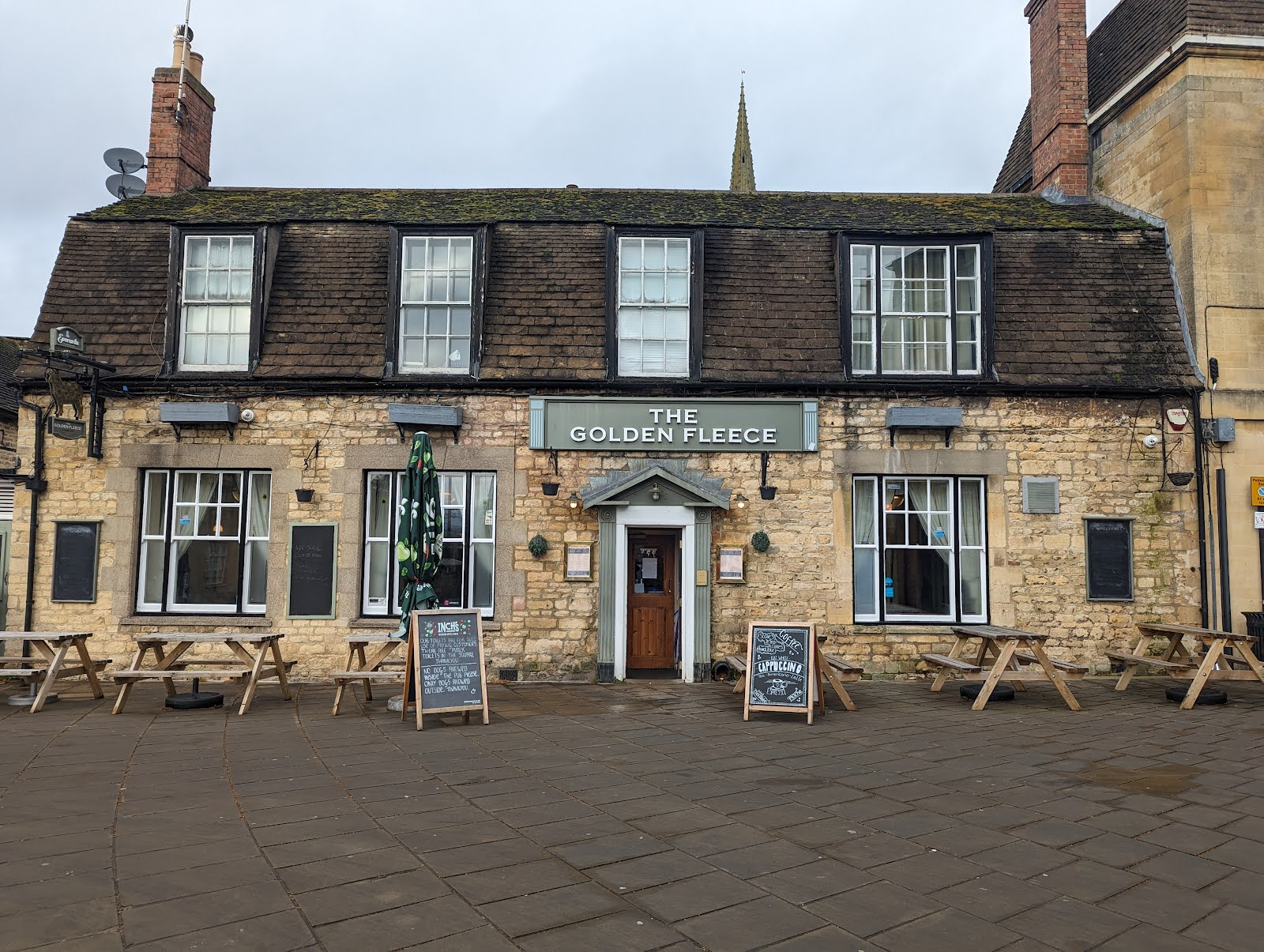
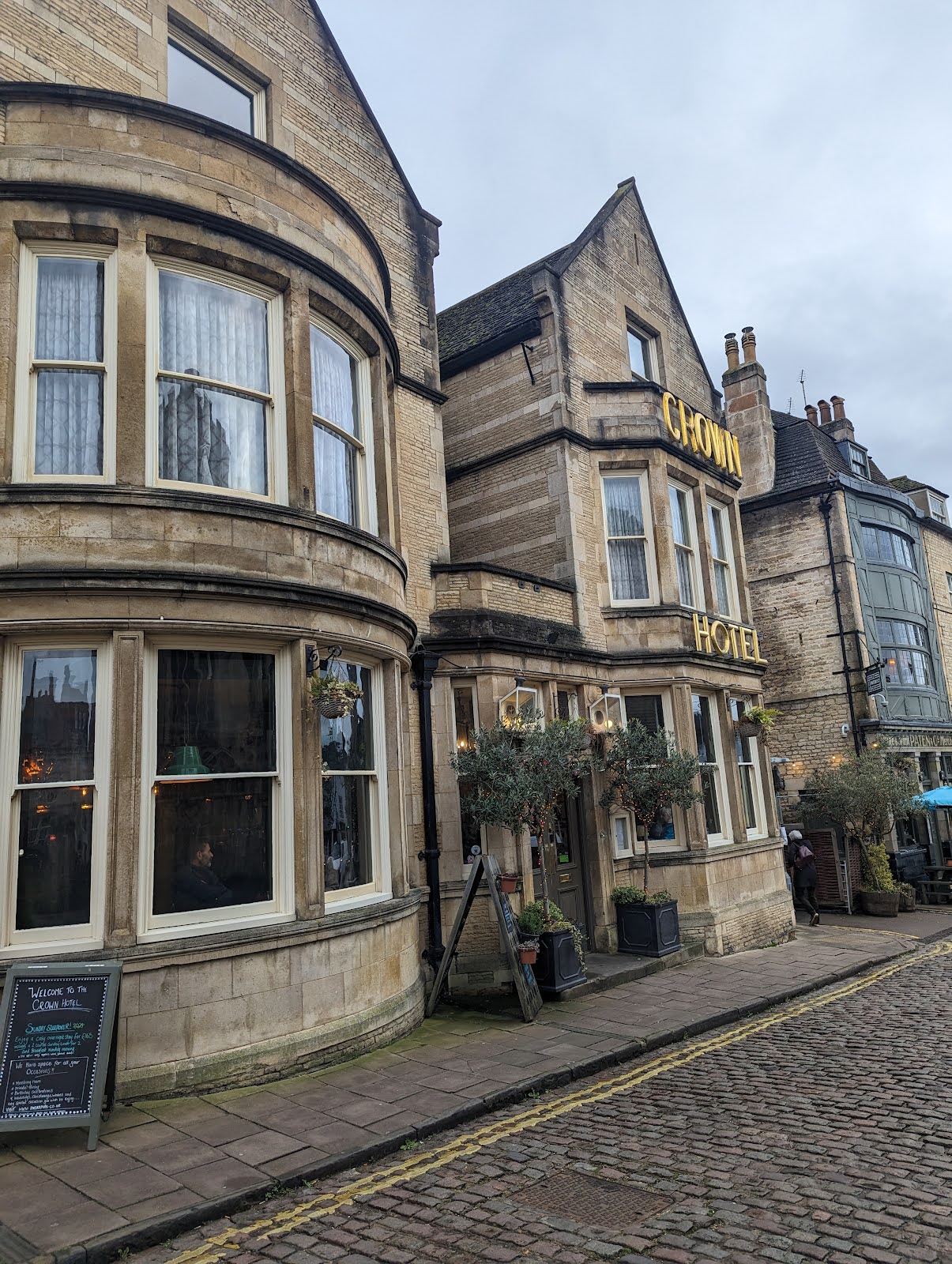
As normal for our trips to the big smoke, we decided to make use of National Express and get the coach down. This has been our preferred method of transport for a while, as it works out considerably cheaper than getting the train and, in the present moment, is also considerably more reliable. We left Nottingham at around 7.45am and arrived at Marble Arch, our preferred disembarkation point, shortly before 11am. We had several activities planned for our time in London, spread out across the three days, and the first of these wouldn't be taking place until the evening of day one which, to clarify, was Wednesday. That meant we'd given ourselves a whole afternoon to do a bit of exploring. As we were unable to check into our hotel before 3pm, I wanted to check out a couple of pubs that are renowned in the local area for both their history and their excellent beers. Following a brief browse along Oxford Street, we made our way to Oxford Circus tube station. From there, we travelled a couple of stops to Charing Cross where we emerged into a grey and rather unsettled Covent Garden, which was already beginning to get busy. The weather would be a bit all over the shop for the duration of our visit but luckily we were as prepared as we could be. Or so we thought. Having reached Trafalgar Square, we turned right and headed into the back streets of Covent Garden in search of our first stop, a pub that I was determined to visit and whose reputation very much proceeded it. Making our way through narrow alleys, we finally found our way to Chandos Place and The Harp.

Dating from 1785, the pub was known as the Welsh Harp until 1995. For many years, it was tenanted and then eventually owned by legendary Irish landlady Binnie Walsh. Under her guidance, The Harp became Greater London's first ever winner of National Pub of the Year in 2010. It has subsequently won local branch Pub of the Year in every even numbered year since 2014 (being ineligible to win in the intervening 'odd' years) and is the current Pub of the Year for the area. In 2014, Fuller's purchased the pub and, other than upgrading the wiring and plumbing, made a commitment to leave this iconic drinker's pub unchanged. Inside, the old charm still remains. One room features a wooden, pillared bar to the left. High benches and stools occupy space opposite the bar and at the far end of the room. Seating is also located behind the front windows at the end of the bar. The decor throughout is primarily mirrors and portraits of local celebrities. The wall above the bar is decorated with thousands of pump clips of beers served in the pub down its long history. A staircase to the rear leads to an upstairs room, which is normally much quieter than the downstairs space. The toilets are also located on the upper level. Musicians and stage hands from the nearby Coliseum Theatre are amongst the clientele and there is even a rear door specifically for them, allowing them to slip in and avoid the hustle and bustle of the main entrance. I was very pleased to have been able to visit this legendary pub for the first time and both Amy & I were impressed by the welcoming atmosphere and the feel of the place. Next, the most important bit: the beer. 10 handpulls are located on the bar here. Our choices here were numerous: Harvey's Sussex Best Bitter, Dark Star Hophead (doubled up), Bristol Beer Factory Launch Approval, Cellar Head 'Merica, Kelham Island Easy Rider, Sambrook's Pumphouse, Fuller's London Pride, Pig & Porter Plum Porter and Dark Star American Pale Ale. With such a quantity of ales to choose from, I needed a minute but finally went for something local, in the shape of Pumphouse (4.2%) from Sambrook's. Amy decided to start on craft beer and ordered a pint of Beavertown Neck Oil. In total, our pints came to £13.75 which, given the area we were in, we were pleased by. We definitely expected the price to be pushing into the £15 territory. We retreated away from the bar and perched on stools at a drinking ledge, equidistant between the bar and the rear staircase, where we could be slightly away from the crowd but could also take the place in. The Harp is deservedly recognised for its beer quality. As well as its numerous awards, it also features in the 2024 Good Beer Guide. The Pumphouse is proof of why. This is a pale ale with a balanced sweetness and hop character. It's late hopped with the New Zealand hop Wakatua to give a pleasant floral aroma with light spice notes. It's a delicious beer and the perfect one to start off our London excursion.
The Harp is truly deserving of its iconic status at the heart of Covent Garden's drinking scene and I was hoping that our next stop, at a similarly touted location, would also live up to its regard. Leaving The Harp, we turned right. Heading deeper into Covent Garden, we were able to quickly find our way over to Garrick Street, where our next location can be found down an alleyway. Turning into Rose Street will bring you to the Lamb & Flag.

Lamb & Flag ticked off and the afternoon well and truly upon us, we decided to head over to the hotel to check in, freshen up and then head back out. A short tube ride from Embankment to Tower Hill, followed by a short stroll down Tower Bridge Road took us to our hotel. We checked in, unpacked, briefly recharged bodies and phones and soon, we were on our way again. The destination: Victoria. The reason: we were seeing Hamilton at the Victoria Palace Theatre later that evening. We'd decided to give ourselves plenty of time so we'd be able to get some food before the show, as well as to get our bearings. Arriving at Victoria tube station, we emerged onto the street to see the theatre almost directly to our right. Using that as a wayfinder, we immediately started looking for places where we could while away the time before we needed to enter the theatre. Luckily, I'd identified a potential location, for both food and drink, not far from our present location. Turning right onto Vauxhall Bridge Road, we made our way to the Brass Monkey.
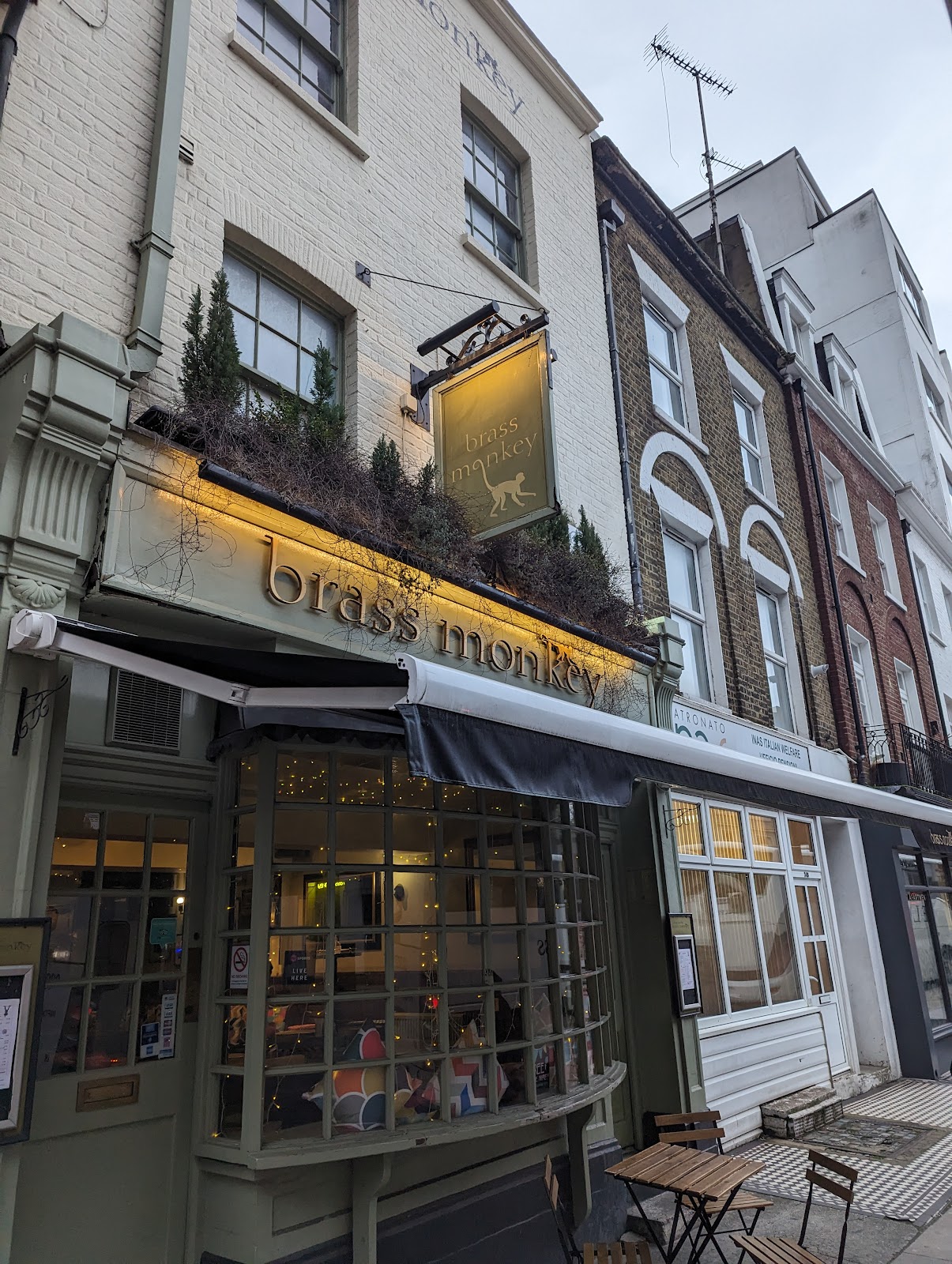
Formerly the Lord Burleigh, the Brass Monkey was originally an 1852 beer house. The origin of the name is a matter of dispute. The pub claims it derives from the nautical term 'brass monkeys', triangular shaped enclosures that were used to hold cannonballs. When the temperature dropped, the 'monkeys' would contract, causing the cannonballs to roll all over the deck, hence the phrase 'cold enough to freeze the balls off a brass monkey'. However, the name is believed to actually be associated with tourist-souvenir sets of brass monkeys made in China and Japan in the nineteenth and twentieth centuries. Inside, the pub is one room, with the bar over in one corner. The decor is light and modern with furniture a mixture of high tables and low sofas. A tiny raised area is at one end, with a staircase to one side that leads to the toilets. Upon researching this place, I was hopeful that this would be a cosy place to enjoy a good pint and some tasty food. Sadly, it was not to be. We were the only customers when we first arrived and I was immediately struck by the absence of handpulls on the bar, with only keg beer available. Being the only ones in, and having already been spotted by the lady behind the bar, we couldn't really just bail out. Instead, we ordered a pint of Neck Oil (for me, albeit begrudgingly) and Amy settled for a large Diet Coke (total price £10.70) and we retired to a table to ponder our next move. The food menu here is Korean food, including tapas and sharers. Neither of us have anything against that particular cuisine, but it wasn't what we were really in the mood for at that particular time so we decided we'd be better served elsewhere, especially when the in-house speaker started playing early-00s R&B and hip-hop.
On our way to the Brass Monkey, we had seen a place that we knew would serve our purposes better, at least in a food sense if not for beer. Retracing our steps until we were virtually opposite the tube station, we decided to try our luck at Greenwood.
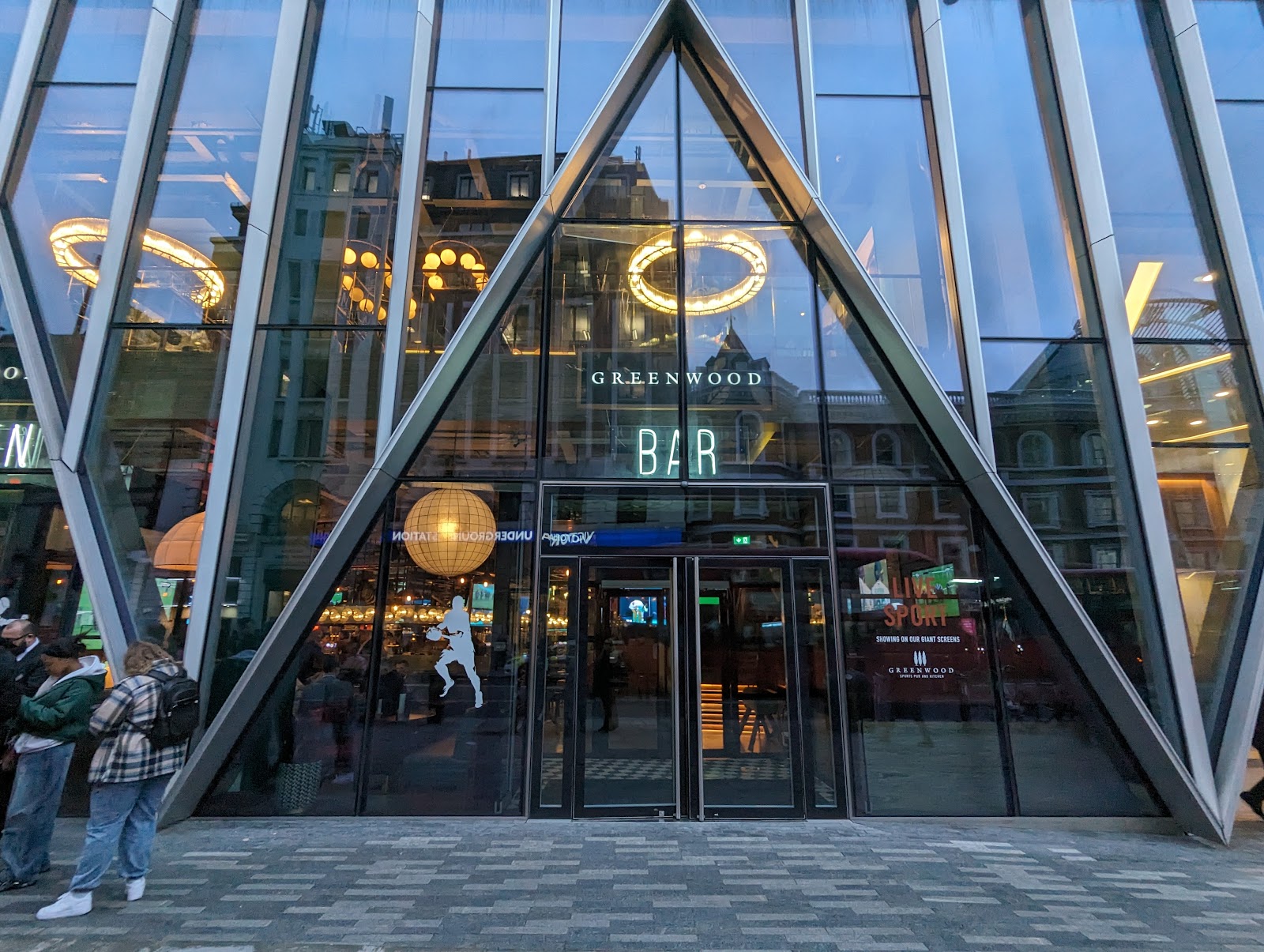
Greenwood is a massive sports bar, located in the huge Nova development on Victoria Street. The frontage is all glass, with multiple entrances leading through into an interior that's best described as an American college common room and library from the 1970s, but on an enormous scale. The downstairs room is a large, open-plan space with industrial-style ceiling and a square island bar, that is overhung by four copper beer tanks. Throughout, there are multiple seating areas. The main room is split level with more intimate areas tucked away at the sides. There are screens everywhere, showing all manner of sports. The bar alone boasts at least a dozen screens. Upstairs, a large bookcase has been decorated with sporting equipment and there is a bookable sports lounge that houses a further 5 screens. There is also an 8-ball pool table and two shuffleboard tables. The whole experience is as if someone airlifted an American sports bar and dropped it into the middle of Victoria. We weren't holding out much hope for the beer choice here and we were proven correct. Beer is dispensed in keg only, although local breweries are often featured. On this occasion we both went for Neck Oil (£15 for two pints) and just managed to find a table. It was already very busy here and seating was at a premium. It was definitely food time now. Food can either be ordered directly from the bar or by scanning a QR code on the menus. We had planned on doing the latter but our table number was missing so it was easier to go to the nearby bar and do things the old fashioned way. The food here was reasonably priced and very nice. Amy had a chicken wrap and I had a hotdog. It's exactly the sort of fare you'd associate with this sort of venue but it fits with the theme and is good quality. We spent a bit of time here, observing the controlled chaos mitigated by the very efficient bar staff. They had a good system in place. Some staff only serve, others take out food and drinks to those who have ordered online whilst some are literally just there to patrol the floor and glass collect. It's easy to see this place being packed to the rafters during major sporting events. Even as a sports fan, I was getting a little bit of screen fatigue and was anxious for some more 'proper beer' before we went to see the show.
Leaving Greenwood, we turned left and headed back in the direction of Vauxhall Bridge Road, this time swerving off left onto Gillingham Street. I had identified a pub in the area that not only sold real ale but that was also not too far from the theatre. A short walk away, we approached the Victoria Taps.

Built in 1828 as the Warwick Arms, this large, single-roomed pub has also been known as the Brougham and the Elusive Camel, before being christened with its current moniker in 2021. The pub was enlarged in 1898 and the join of this work can be seen from the outside. Now operated by Stonegate, the pub boasts a large, tiled bar, wooden floor and a mixture of seating, including banquettes, chairs and stools. We entered to find the pub very busy although there was plenty of space at the bar. The bar occupies the majority of the right hand side of the room. A raised snug to one side can be booked for functions. The rest of the room consists of modern decor, furniture and subdued lighting as well as a welcome display of LGBTQIA+ flags on the ceiling. We were immediately struck by this, as well as the cheesy 80s and 90s pop soundtrack coming over the speakers. We knew we'd come to the right place! As well as this, my heart was warmed by the sight of a trio of handpulls, 2 of which were in use and offering a choice between Fuller's London Pride and Sharp's Doom Bar. Doom Bar it was to be, with Amy going for an offering from the extensive craft beer wall on the back bar. The two pints set us back £13.55 in total and we perched at the end of the bar as it was literally standing room only. The pub was very busy, especially to say this was a Wednesday evening, and seemed to be full of a couple of work groups but the atmosphere was fantastic. Between the reasonable (for London) beer prices, the all-inclusive vibe and the throwback pop music (including Salt N Pepa and Right Said Fred, before they became anti-vax COVID conspiracy nutjobs), we were really glad to have found this place. It was a pleasant surprise and the Doom Bar certainly passed muster.
The Victoria Taps would be our last pub of the evening. It was finally time! We headed back over to the theatre and made our way inside. Amy had amazingly been able to procure discount tickets, as she regularly speaks to the theatre and they'd also given us a box in the stalls from which to watch the show. We knew all of this going in but what we didn't know was that the box came with butler service. No queuing at the bar for us! And we didn't have to share the box so it made the whole evening even more memorable. As for the show itself, it was incredible! Hamilton is by far, and without a shadow of a doubt, the best musical I have ever seen. I knew it would be good but, wow! After nearly 3 hours in the room where it happens, we endured a very tired tube ride back to Tower Hill and the comfort of the hotel. Thus endeth day one.
Day two dawned even more unsettled than our first day, with persistent rain, grey skies and a wind that belied our weather apps' claims that it was 12 degrees. Absolutely not. After a hearty breakfast, we were just about ready to brave the conditions and see what Thursday would have in store. We had a couple of things booked for later in the day which meant that we had a very loose plan for the morning. We already knew that Thursday would involve a lot of walking, although I don't think either of us realised quite how much. We started off with a tube ride to Embankment and a wander to Trafalgar Square from where we wanted to walk The Mall down to Buckingham Palace and back. Despite the wind, fighting to keep the umbrella from disembowelling itself and the drizzle, we achieved this without incident. I'd never seen Buckingham Palace up close and, whatever your views on the monarchy, it is certainly impressive. Having made our way back to Trafalgar Square, we now intended to do a bit more exploring of Theatreland and Soho. We wandered around for a while, visited the M&M store, a very random Harry Potter shop that I'm not sure was official, and photographed the statues of British screen icons in Leicester Square, as well as a number of theatres to boot. We had a slow stroll through Chinatown, with the weather having abated slightly by this point, and on into the back streets of Soho. I had planned for us to visit a couple of pubs early in the day as we were booked into visit St. Paul's Cathedral in the afternoon. The first of these, once we'd found it after I had, admittedly, gotten us lost was the John Snow on Broadwick Street in the heart of Soho.

Formerly called the Newcastle-upon-Tyne, although nobody seems to know why, this Victorian pub was renamed in 1956. John Snow (1813-58) was a prominent local medical practitioner of the Victorian age who correctly identified the local water pump as the cause of an outbreak of cholera. Until this discovery, cholera was thought to be caused by a 'miasma' or bad air. Snow's identification of it as a waterborne disease, and the subsequent removal of the pump, led to a dramatic fall in the number of cholera cases in the area. He went on to later fame as the inventor of chloroform, which he would later administer to Queen Victoria during the birth of her son Prince Leopold. Snow's name is now forever immortalised, not just in the annals of medical history but as the name of this back-street street corner boozer. We arrived at the John Snow shortly prior to its opening, hoping to be able to avoid the rain for a few minutes if nothing else. Shortly afterwards, the doors were opened and we were in! To what turned out to be a Sam Smith's pub. Oops. We were here now though and, the first ones in for the day. Once it was established that we were just in for a drink, we were directed through to the lounge bar where we could better peruse our options. This a strange little pub. The trademark Sam Smith's etched glass and wooden interior is apparent. The bar is curved and serves two distinct areas, divided by a partition, which you have to duck down to get through. I've never seen anything like that anywhere else. Why it hasn't been removed is anyone's guess although it is in keeping with the rest of the interior and may well be a listed feature. Seating is in the form of banquettes and wooden tables and chairs. A restaurant area upstairs is reserved for dining. On the bar, as expected, there are no handpumps but there are several keg taps, offering the full range of Sam Smith's beers. Across the ten taps are Samuel Smith Sovereign Bitter, Organic Lager (doubled up), Dark Mild (doubled up), Taddy Lager, Extra Stout, Alpine Lager, Cider Reserve and Old Brewery Bitter. A pint of Old Brewery Bitter for me and Alpine Lager for Amy (£10.30) and we sat in a curved banquette, adjacent to the weird partition and next to a heater which at least helped us dry off a bit. Some of you may be confused by my initial reluctance about Sam Smith's pubs. I have been in some before and some have even featured in the blog but I've had my misgivings since I found out that the brewery owner is against mobile phones, laptops or any kind of modern technology. I'm all for preserving the traditions of pubs but some modern minutiae will eventually encroach on these and can be embraced without going against principles. In the end, I'm wondering whether I've been too hasty. The beer was very nice and certainly reasonably priced! Plus, the staff here didn't seem too bothered about our phones being out on the table so I think it must come down to managerial preference. There had been another reason I'd wanted to come here though. Something strange lurks within. A indistinct figure has been seen in the inner recesses of the pub, with a pained expression on its face, seemingly staring into space. Nobody has been able to provide an identity but it may well be a victim of cholera. Members of staff have also reported the sensation of being watched when alone in the building. Spooky stuff indeed.
Dried off and refreshed, we were now on our way again. Our next planned stop would be closer to St. Paul's so that we would be in close proximity for our visit timeslot later in the day. Leaving the John Snow, we made our way back through the side streets of Soho until we reached the tube station at Tottenham Court Road. A short journey later, we emerged in Holborn where a short walk took us to Hatton Garden, London's famed jewellery district. Off of Hatton Garden, tucked down an alleyway, is the Olde Mitre.
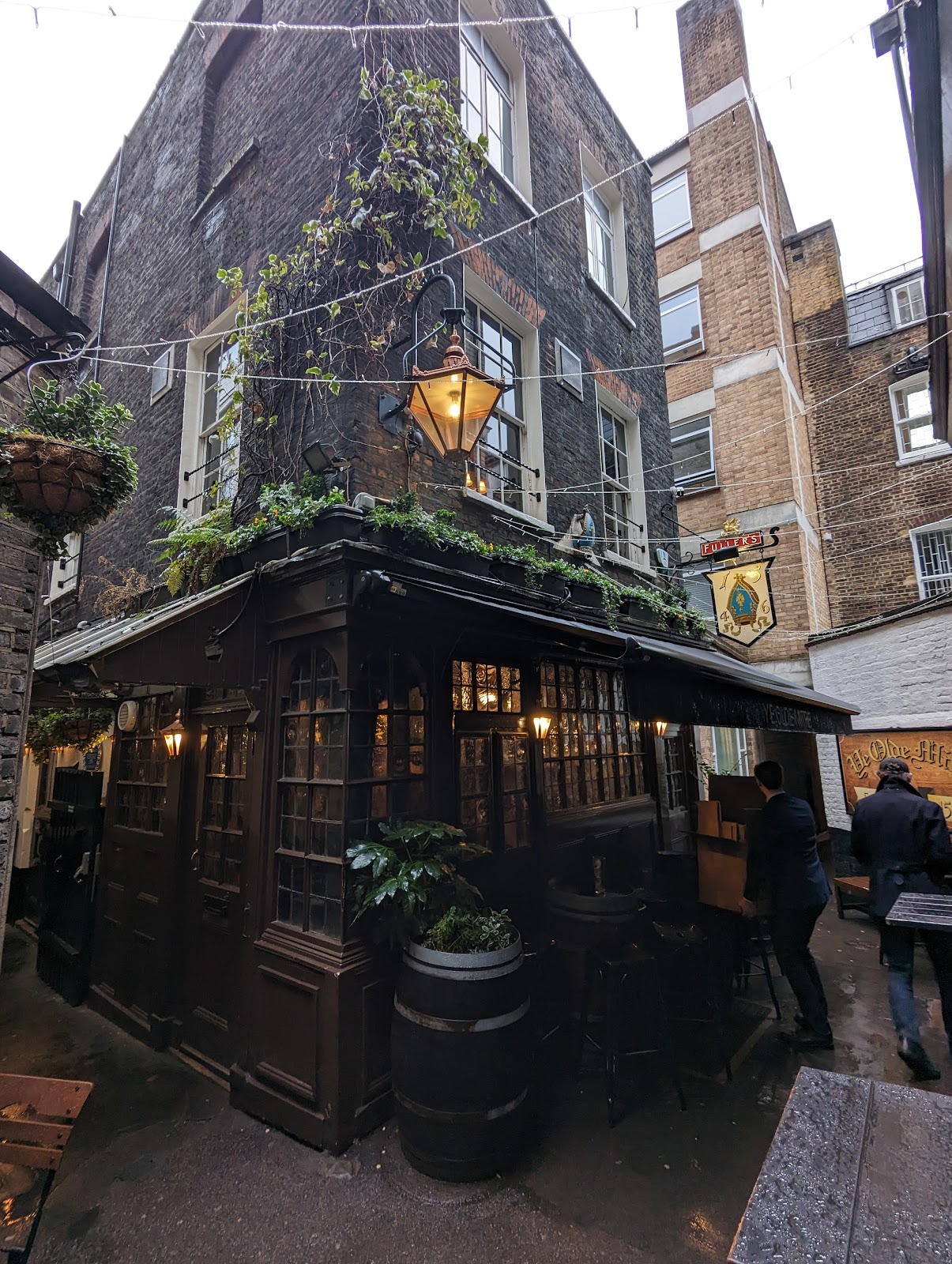
Another pub that can be hard to find (we almost missed it), the Grade II listed Olde Mitre was originally built in 1546 for the servants of the Bishop of Ely, whose London house stood nearby. Featured in the 2024 Good Beer Guide, the pub is identified by CAMRA as having a regionally important historic interior. This site, and the adjacent properties in Ely Place, were cleared when the Crown took control of the site in 1772. The site was rebuilt at the end of the 18th century and the interior is a 1930 remodelling in Tudor-style. There are two rooms, served by a central bar, both accessed from outside. The front room is the smaller of the two, with the larger room to the rear also featuring a small snug ('ye olde closet') located off of it. The original off-sales hatch is located by the entrance and between the front and rear bars. In the front room, behind a glazed panel, is the trunk of a cherry tree that once marked the boundary between the bishop's property and those of Sir Christopher Hatton, a courtier of Elizabeth I, after whom Hatton Garden is named. There are rumours that Elizabeth I once danced around this same tree. Whether that tale is linked to the apparition of a lady in Tudor clothing that is once believed to have haunted the site, but hasn't been reported for some time, is unclear. A narrow staircase leads to the Bishop's Room, used occasionally, as well as the ladies toilets. The gents facilities are outside in the courtyard. A passage around the outside of the pub has repurposed casks used for external drinking. The words 'hidden gem' are used a lot in these pages but this definitely fits that bill. I'd already decided that it had been worth the trip before I'd even seen the offerings on the bar. There are 7 handpulls here, spread across both bars. At the time of our visit, the options were Brick Peckham Rye, Elephant School Gold Rush, Milestone Luck of the Irish, Renegade Good Old Boy, Potbelly Different and Brockley Harcourt Red, with the final pump reserved for Harry's Haymaker cider. Despite being operated by Fuller's the beer choice was purely of the guest variety and I couldn't wait to get stuck in. I opted for the Peckham Rye (4.7%), whilst Amy went for a small Diet Coke to begin with (total price £8) and we grabbed a table immediately next to the bar. We found ourselves in the smaller front bar, at one of only three tables. Another was taken up by a group of local workers who were doing nothing to dispel the yuppie stereotypes whilst a lone gentleman took up the final slot. I was really glad we'd come here. Amy wasn't as much of a fan, largely because of the size of room we were in and also because the lack of background music meant that everyone could hear what everyone else was saying. The beer was cracking though. Amy joined me on the Peckham Rye for our second round and wholeheartedly agreed that it's an ace beer. Red in style, it's brewed with rye malt for an added biscuity quality and dryness. The character is that of caramel, pine, citrus and spice with more citrus on the nose. Overall, there's the flavour of caramel, a residual sweetness and full bodied hit of US hops. A belter if ever there was one. We were looking for some lunch at this stage of our second day. The food offering here is toasties but that was more than enough to satiate our palates. Stomachs appeased and glasses empty, we made our way out.
It was only a short walk to St. Paul's Cathedral and before long we were marvelling at the majesty of Sir Christopher Wren's masterpiece. The decoration and elaboration of London's most iconic place of worship really is something to behold. I'm not a religious person and have never claimed to be but I can still appreciate the architecture and sheer scale of a place, and its importance, without believing in what it represents. After an hour exploring the Cathedral and all its wares, including the crypt which features, amongst others, the tombs of Sir Christopher Wren himself, the Duke of Wellington, Admiral Lord Nelson and a memorial to Florence Nightingale, we were back out in the unsettled London afternoon, on our way to our next location. The next part of our day would involve another short tube hop, this time to Aldgate East, via Mansion House. The reason for our venturing into this part of east London was simple. We were booked onto a Jack the Ripper walking tour later that evening. We had planned to get there early to get our bearings and hopefully obtain some more substantial food before the evening's activities commenced. We had identified a couple of locations nearby where we could complete both these tasks, and enjoy good beer besides. This area of London has been synonymous for years with the Jack the Ripper case and that would continue to be clear throughout our evening. Having emerged on Whitechapel High Street and identified our meeting place for later, we made our way to the closest pub: The White Hart.
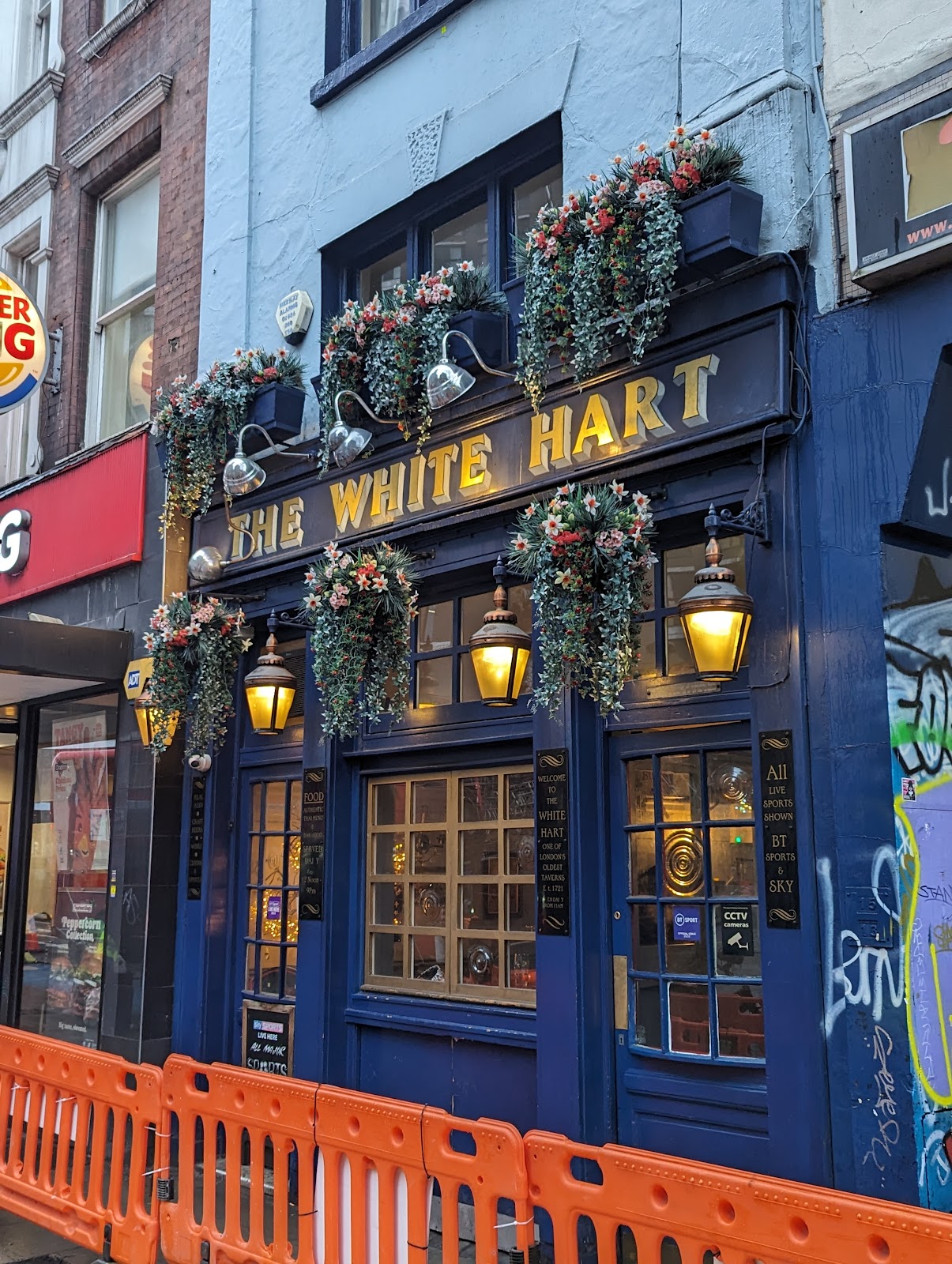
Built in 1721, this former Allied pub is a long, narrow building with a single bar along one wall. Seating opposite the bar is high tables and stools, with lower furniture towards the rear, in a larger space that includes a dartboard. A couple of TVs are located throughout, normally showing news or sport. Wood panelling and old photos of the area dominate the walls, along with Irish memorabilia reflecting the landlord's heritage. 12 handpulls can be found on the bar but, when we walked in, it didn't look like any of these were in use, although some did have pump clips on, albeit facing the wrong way. Instead we ordered two pints of Neck Oil (£14.20), before I managed to spot the solitary handpump offering London Pride. Balls. Still, the landlord was pleasant enough and the pub is light and airy. We procured a seat opposite the bar and Amy charged her phone behind the bar. Despite my disappointment that I missed out on real ale here, it wasn't at all a bad place to while away some time. It also has its own grisly link to the Jack the Ripper case. On 8th August 1888, the body of Martha Tabram was found on the steps outside George Yard Buildings, a block of tenement flats. These were accessed through an alleyway from the street, which used to run next to the pub. Martha had been stabbed 39 times and was quite clearly dead. Although not counted amongst the 'canonical five' Ripper victims, amongst investigators who suggest the kill count may have been higher, Martha Tabram is touted as being a likely victim of the legendary unknown killer, quite possibly the first. Martha Tabram's murder, along with other similar unsolved crimes, including those of the Ripper, are lumped together under a series of incidents now known as The Whitechapel Murders, widely agreed to have taken place between 3rd April 1888 and 13th February 1891.
Leaving this rather gruesome tidbit firmly in the past, it was time to put The White Hart behind us. Just down the road, although on the opposite side, was another pub and one at which we were hoping to get some food. Our attention now turned to the Hoop & Grapes.
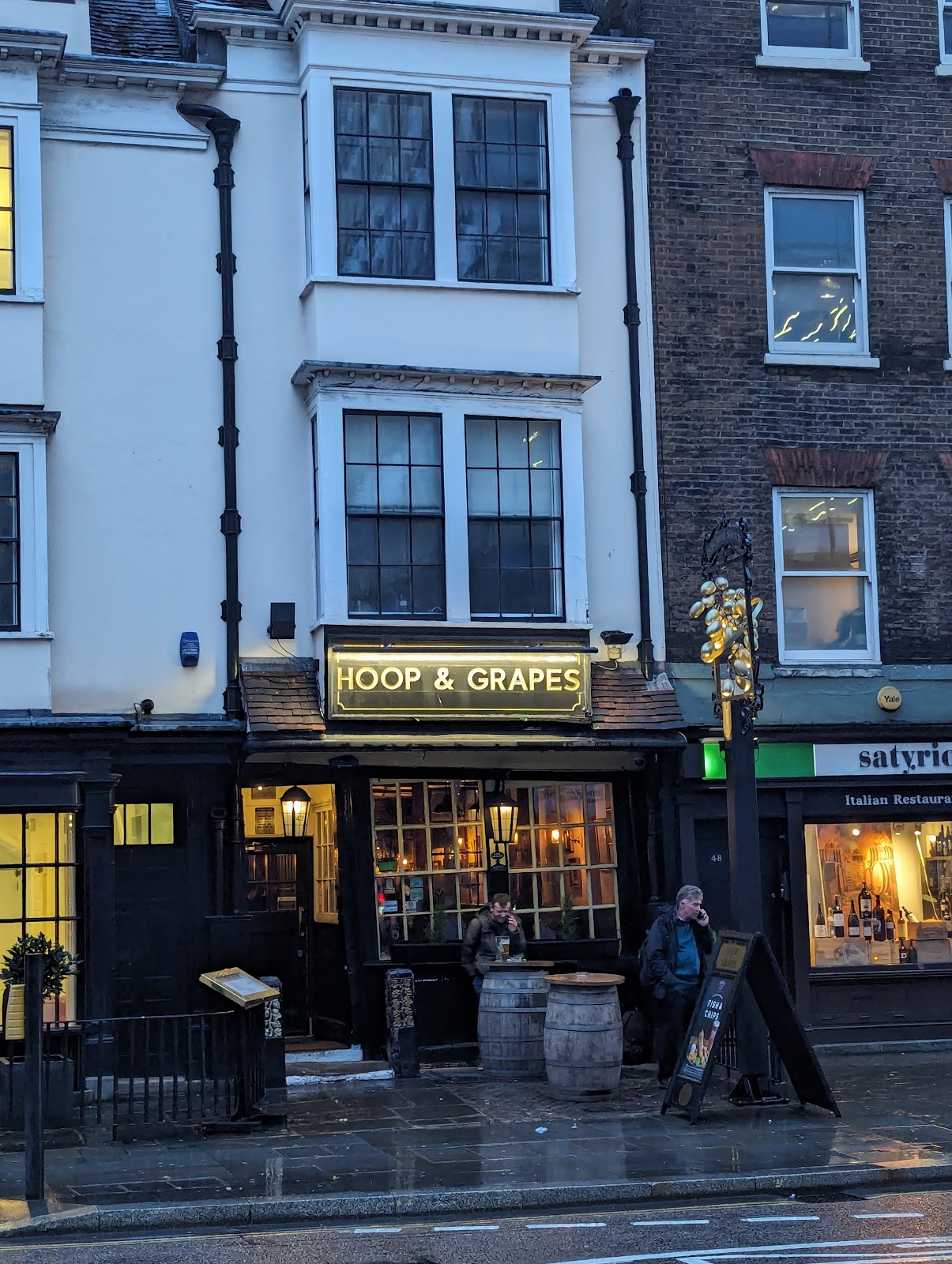
Our next objective was definitely to get some food. A quick Google search flagged up a place that seemed perfect. Leaving the Hoop & Grapes, we took a right and then right again onto Leman Street. Heading on down the road, we reached a modern looking development, where we located our target: The Running Horse.

Occupying the ground floor of the Goodman's Fields development, The Running Horse is a modern pub offering real ales, craft beer and food. The glass frontage leads through into a large space with the bar front and centre. Seating is long benches and there are raised areas to both sides of the room. Tank fresh beer is distributed from a vessel above the bar. Everything is very modern and shiny. Three handpulls on the front of the bar offer local beers, in this case a trio from Sambrook's, namely Wandle, Junction and Drop Kick. There was definitely a recurring theme of rugby-centred beers during our trip. It is Six Nations season after all! To that end, I opted for the Drop Kick (4.3%), whilst Amy selected something crafty. After parting with the suspiciously reasonable sum of £11.80, we found a table in one of the raised areas and eagerly scanned the menu. Given its modern trappings and good prices, the Running Horse seemed surprisingly quiet, even for a Thursday in London. Perhaps location and time of day worked in our favour on this occasion. After a couple of minutes to decide, we both decided on the buttermilk chicken burger, which turned out to be ace! The beer was also very good. Drop Kick is a pale ale with a good, clean nose, floral hop notes and a dry, refreshing finish. The Running Horse had turned out to be a great stop off.
Still with a little bit more time to kill (no pun intended) before our walking tour, we decided we could sneak one more pint in. We left The Running Horse, dodging the elaborate equine-themed water feature out the front as well as the rain, which had started to come down aggressively again, and retraced our steps, stopping at a venue that was literally almost next door. Next up, the Leman Street Tavern.

Opened in 2016 as part of the Goodman's Fields development, the Leman Street Tavern is a large bar and restaurant operated by Young's. Behind the brick and glass exterior is a central room, with a round, central island bar, with a restaurant area to the left of the entrance. To the rear, as well as toilet access, is an open kitchen. The design is generally modern with open ductwork and exposed brickwork. This was another very busy venue when we arrived, seemingly full of the post work crowd, some of whom had reserved an area to one side. I was initially cheered by the trio of handpumps on the bar, all badged with Young's Original but this turned out to be off so it's back to the craft options. Two pints of Beavertown Gamma Ray later, and £11.70 lighter, we pulled up some stools at the bar to observe the action. The Leman Street Tavern seems to do a roaring trade in cocktails and we watched the time consuming construction of several of these. This is another trendy and modern venue seemingly frequented by people who have no concept of an inside voice. During our time here, we were amused by the general behaviour of the London set and by the saddest pub 'library' I've ever. A shelving unit next to the door housed exactly 7 books and two of these were Harry Potter novels.
Pints drunk, we made our escape and headed back down Leman Street, past the White Hart to the Whitechapel Art Gallery, from whence our tour would depart. A few minutes later, our tour guide led us, and around a dozen others out into the backstreets of Whitechapel, stopping at all the spots relevant to the Jack the Ripper case, including the locations of the 'canonical five' murders. It was a thoroughly interesting walk which covered all of the known and well-publicised events but also featured less well-known details as well as never before seen photos of both the scenes and victims. Learning the full details of London's most infamous and never identified murderer and, of course the unfortunate victims, against the backdrop of the area where the crimes took place was at times both atmospheric and an intensely sobering experience. Even now, the area around Whitechapel seems to carry the weight of those heinous autumn days of 1888 on the very winds. Towards the end of the tour, we found ourselves in a unique position when it came to our final stop. Not many tours, especially ones of this type, end at a pub. This one does; at The Bell.
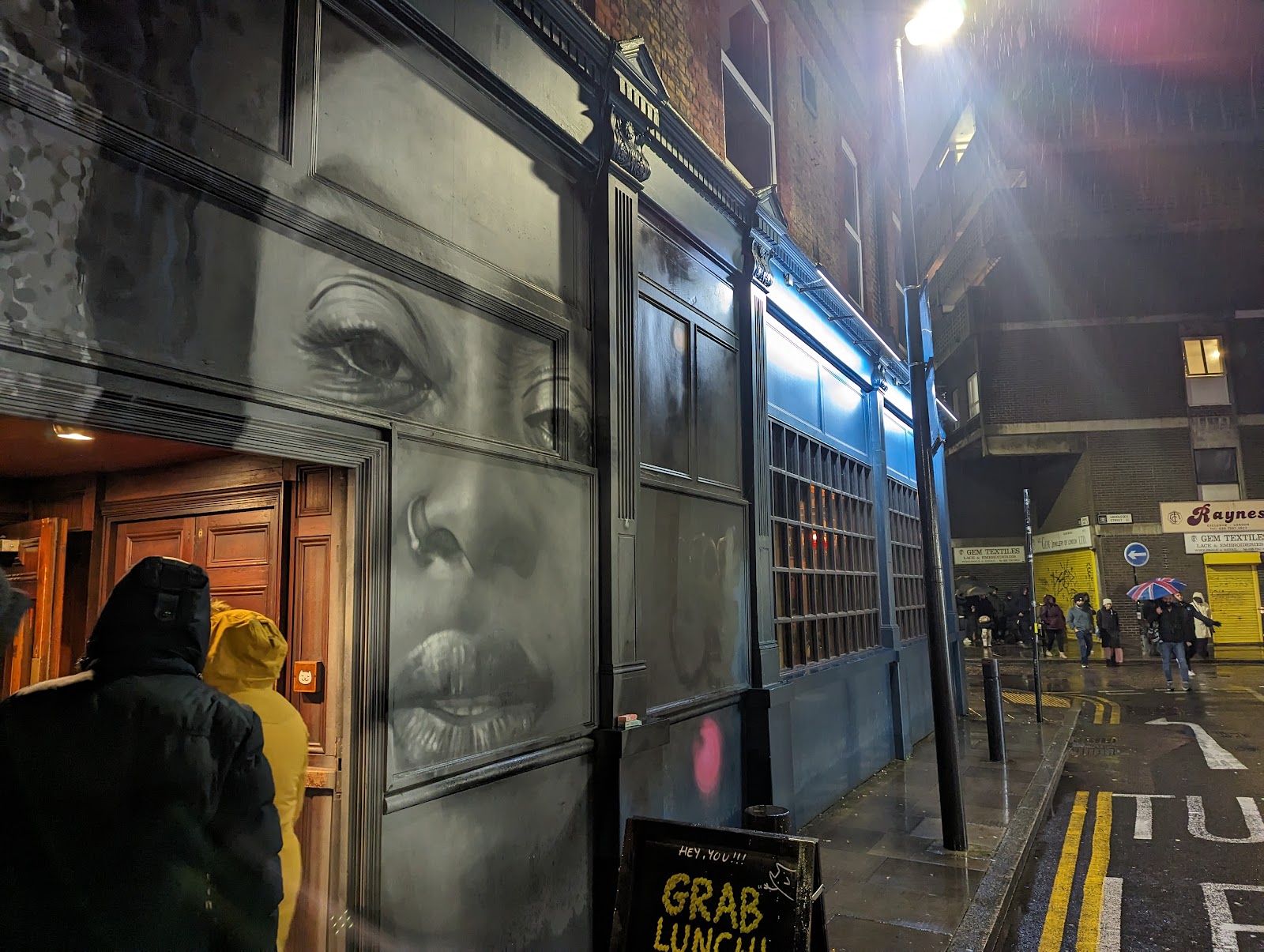
Situated on the corner of Middlesex Street and New Goulston Street, the age of The Bell is unclear, although the current structure dates from the 19th century. In the mid-18th century, a Black Bell Alley stood on this site. Whether the pub is named after this, or after nearby Bell Lane remains unknown. In 1888, William Rose was the landlord here and the pub itself was owned by Truman's. Following William's death, his wife Sarah took over the lease and remained in charge until 1899. Middlesex Street, on which the pub stands, was previously known as Petticoat Lane (a thinly veiled reference to prostitution) and for many years, this was the only pub on the road. As well as being the final destination of our tour, the Bell also has its own ties to the Jack the Ripper mythology. Francis Coles, alleged by some to be the last victim of the Ripper, and the last victim included in the Whitechapel Murders group, was seen drinking here on February 12th 1891, the night before she was found murdered, with her throat slashed. She was accompanied by James Sadler, who would eventually stand trial for her murder but would be acquitted due to having an alibi of fighting with dock workers at the time. Francis Coles' murder was never solved but something may remain. The Bell is allegedly haunted. Disembodied footsteps are heard, ghostly figures have been seen and the lights have a tendency to misbehave, turning themselves on and off of their own volition. Certainly an atmospheric place for the tour to end and, luckily they do good beer as well. The L-shaped bar downstairs features 4 handpulls, 2 of which happened to be available at the time, with a choice of Timothy Taylor Landlord or St. Austell Tribute. I went for Tribute whilst Amy decided on Diet Coke (£9.40) before we headed up to the first floor where our tour would come to and end. The tour ends in this location every time, by prior arrangement with the pub. With the tour drawn to a close, we purchased two books from our excellent tour guide, one about the Ripper case and another about the psychology behind American mass shootings, and returned downstairs to see off the last of our drinks. The interior of The Bell is quirky, with bright lights, good music and eclectic decor throughout. Large murals of local faces occupy the external walls. We thoroughly enjoyed our brief stay here and, in a way, it was a shame that we hadn't been able to hang around for longer. It had been a long day and we were both starting to flag. Luckily we were one tube stop from home. Day two in the books.
Day Three. Friday. My birthday. Our last day in London for this trip would be one conducted at a slightly more leisurely pace than we had managed so far. We weren't expecting to get anywhere close to the near 29000 steps we'd managed the day before but we still had a lot of ambling planned. First things first though. Having revitalised ourselves with breakfast and me choking down the existential crisis I was facing at the thought of now being 37 (aaaaaaaaaaaaaaahhhhhhhhhhhh!!!!), it was back out into the city. The second half of the day would be taken up with the, seemingly now traditional, birthday pub crawl but, to begin with, there was something else on our agenda. To start our day, we would be visiting Westminster Abbey, one of the oldest places of worship in Britain, constructed in the 11th century by the Normans, on the site of a much earlier Anglo-Saxon building. This required a short tube journey to Westminster and before long we were making our way inside. The appeal of Westminster Abbey is less in the aesthetics, as is the case for St. Paul's. In this case, the appeal lies both in the age of the building but also in the myriad of famous burials within its walls. Not only is this the site where British monarchs are traditionally crowned, most recently last year, but is also the final resting place of several monarchs dating back hundreds of years. The most recent monarch to be laid to rest here is George II in 1760, with subsequent monarchs interred at Windsor Castle. Besides all of the royal burials, the Abbey is also the final resting place of several Prime Ministers as well as notable people from the arts and sciences. We arrived not long after opening, showed our pre-booked tickets, and were soon making our way around. Luckily, despite how busy the Abbey was, we were still able to see everything we wanted to see, including the joint tomb of Mary I and her half sister Elizabeth I, the tomb of Mary, Queen of Scots, from whom our current royal family is descended, the tomb of Anne of Cleves, fourth wife of Henry VIII and the tombs and memorials of a number of intellectuals such as Charles Darwin, Charles Dickens, Isaac Newton, Stephen Hawking (a personal highlight), Rudyard Kipling (author, not cakes) and a memorial to the Bronte sisters. Despite the overarching religious significance of this place, being able to see the location of the resting place of the mortal remains of such luminaries was nothing short of humbling.
Having completed our exploration of Westminster Abbey, the second half of our day was set to begin. I had compiled a pub crawl route that I thought would suit our purposes, reduce the amount of walking required for the day and ultimately lead back to where we were staying. The plan was simple: get the tube back over the river and explore the pubs along the south bank and Bankside, dipping into Borough Market before finishing up on Tooley Street which connects to Tower Bridge Road. From there, it would be a few short minutes back to the hotel. I was excited, as I always am about exploring new pubs or places that I've been researching for ages. Getting back on the tube at Westminster, we travelled a stop or two to Waterloo where we disembarked. The weather had already improved significantly after the previous day but, although the rain had held off, there was still a grey sky and a surprisingly strong wind which immediately did a number on the umbrella as soon as we left Waterloo tube station. Crossing the road, we headed down a neighbouring side street and into the back roads of Waterloo, in the direction of the South Bank. Our first stop had intended to be the Mulberry Bush on Upper Ground but this turned out to be temporarily closed for refurbishment, which looked to be an extensive one based on the amount of work being carried out when we walked past. Thankfully, our next stop was only around the corner. Bypassing the Mulberry Bush, we took a right and then a left onto Stamford Street. Located on the corner is the Thirsty Bear.
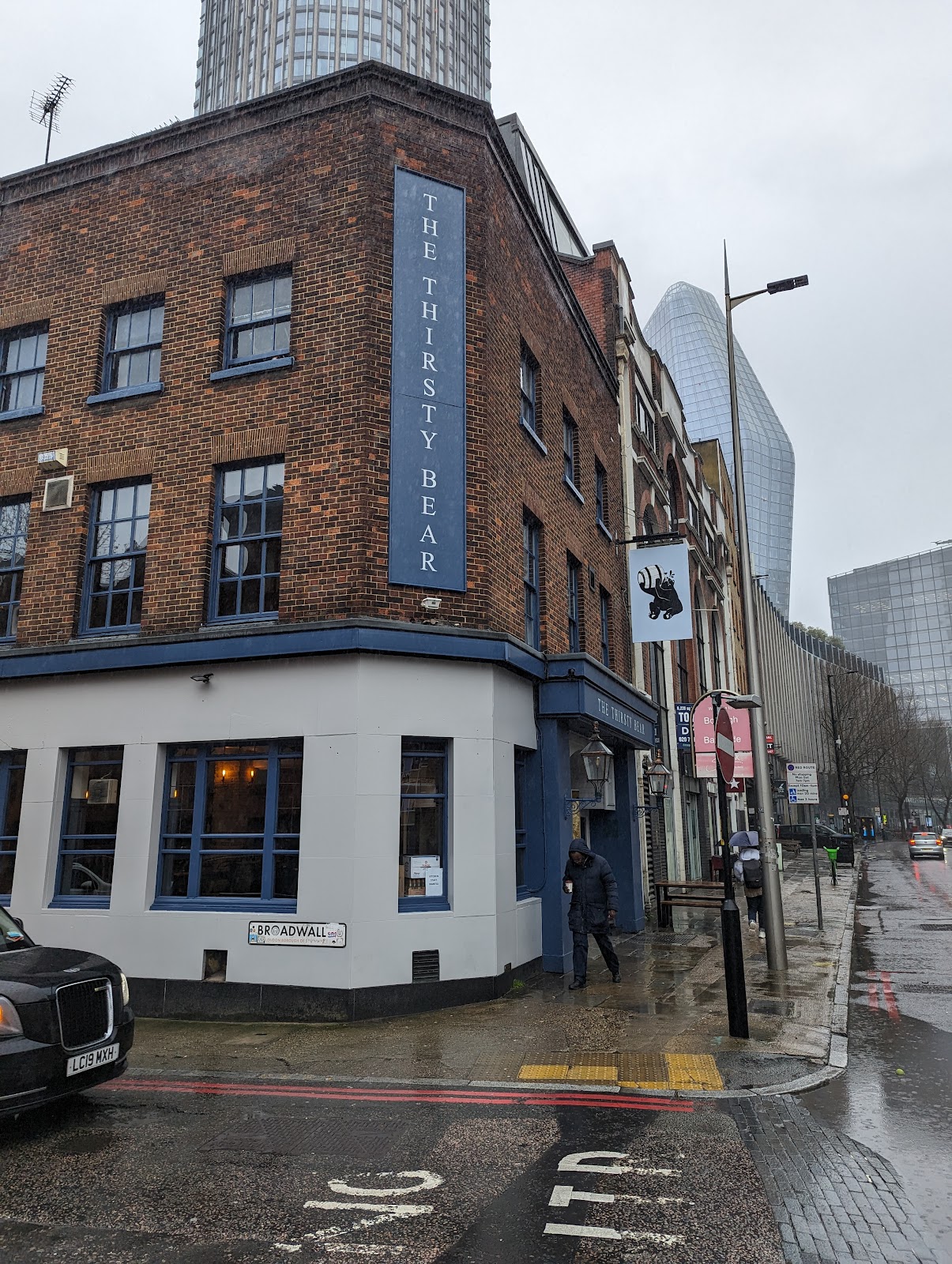
Formerly known as the Stamford Arms, this is a large corner pub over two floors. Downstairs, is a traditional pub layout with wooden furniture, dividing pillars and a large bar to one side. The floor is wooden and the decor is bright and wooden. Neon signs, murals and beer adverts, primarily for craft breweries hang on the walls. Another area is accessed up a staircase. Toilets are to the rear. Some tables have their own metered keg dispensers which can be hired out for groups. The bar here houses 2 handpulls. When we wandered in, shortly before midday, just one of these was in use with Home Turf Pale from Portobello as the sole ale. I went for this whilst Amy went for Neck Oil and headed to a quiet area behind the bar. A disclaimer: given the number of pubs we'd be visiting on the day (12) we would mostly be drinking halves. However, we decided to start with a pint here as a warmup. Prices will reflect the different quantities. Our two pints here cost £11.70, fairly reasonable and cheaper than a fair few places from earlier in the week. The Thirsty Bear was quiet at this time of day but it has very much a student feel about it, suggesting that it's likely quite busy at evenings and weekends. What of the beer? Home Turf Pale (4%) is a session pale ale, brewed specially for major rugby competitions. It's crisp, clear and lightly fruity. All in all, a good way to ease into the day's activities. The atmosphere at The Thirsty Bear is relatively chilled. Uniquely, they offer the facility to hire charging packs from a compartment behind the bar. Presumably this is done to prevent people from using the pub's own electricity without asking. It's a decent enough pub and the landlord sounds like Severus Snape. Trust me when I say that, once you hear it, it cannot be unheard!
We'd be edging closer to the river for the next stretch of the journey. Leaving the Thirsty Bear, we immediately turned right and headed through the housing estate behind the pub. Turning right again, we found ourselves parallel with the river, in the shadow of the OXO Tower. Passing some modern office buildings on our left, we turned left into a cut-through, which brought us onto Hopton Street and right above the Thames bank where, immediately to our right, we found the Founder's Arms.

Overlooking the Thames and immediately in the shadow of the Tate Modern, the Founder's Arms is a roughly hexagonal, modern pub, owned and operated by Young's. There is plenty of outside seating for much warmer and calmer days than the one on which we dropped in and the interior is largely open plan. Floor-length windows cover the majority of the exterior. Inside, a long, curved bar runs along most of one wall, with seating arranged throughout. Furniture is wooden tables and chairs. The ladies and accessible toilets are inside the main entrance with the gents located up a staircase to the floor above. All the glass gives the building a bright and airy feel. This pub, and the area in general, are popular with tourists which certainly seems to be the case when we arrive, although the pub is by no means full and we are able to easily find a table. This being a Young's pub, no prizes for guessing which beers dominate. There are 9 handpulls here, divided into banks of 3. These are offering London Original and London Special (tripled) from Young's plus a guest beer, Southwark Bankside Blonde (also tripled). With this Young's pub actually having their own product available we both settled in for a half of London Special (£6.20) and took a seat about two thirds of the way around the room. It's easy to imagine how busy this pub must get in warmer weather, especially in summers like the one the UK has experienced for the past couple of years. The view over the Thames, with St. Paul's silhouetted against the clouds is certainly a picturesque one. Unfortunately, the beer lets this place down a bit. I've had London Special before and it's been better than it was here. That's not to say that the beer wasn't drinkable. It was just a bit mediocre and lacked a bit of the nuttiness and earthy qualities that I would have expected. Still, onto the next.
Making our way out the way we came in, we turned left and continued along the river with the Tate Modern on our right. Shortly, we passed the replica of Shakespeare's Globe, a sure sign that we had almost reached the next pub on our route. Rounding a slight bend, we found ourselves on Park Street, whereupon we found the Anchor.

This Greene King operated premises dates from the early 1800s, although another pub of the same name stood on the site much earlier. The pub plays on the story that it was rebuilt after being destroyed in the Great Fire of London, although this is impossible as the fire never spread south of the river. It is believed that Samuel Pepys watched the fire's effects from the pub that previously stood on this site. Its proximity to the site of Shakespeare's Globe has led to suggestions that the Bard himself once drank here between performances and he may well have done as it is the closest to where the original theatre once stood. In the 18th century, the previous incarnation of the Anchor also doubled as a brothel and was considered a rather unsavoury area at night. Its closeness to the river was of great advantage to the press gangs, who would abduct unsuspecting merchant seamen into their service. It is from this dark time that the pub's saddest story comes. It it is told that, on one particular night, the local press gang had sized up a likely victim. In their attempts to capture the poor soul, the pub dog attempted to intervene. In the altercation that followed, one of the unpleasant fellows slammed the dog's tail in the pub door, severing it. The dog, badly injured, fled into the night and never returned. Not in mortal form anyway. Staff have reportedly heard the padding of a dog's paws around the pub and some have also seen the spectral form of a dog wandering around as if looking for something. Another, unrelated tale, speaks of muddy child sized footprints randomly appearing in the pub, believed to belong to the spirits of three children who drowned in the river whilst 'mudlarking' (searching for valuables in the tidal shallows). I have only found one source for this latter story so, without corroborating evidence, it's hard to know how much stock to put in it. However, in less ethereal realms, Amy and I entered the Anchor. I had actually been in this pub once before, many years ago, and was eager to see if it was how I remembered it. The interior is split level, with a small flight of steps leading between the upper and lower sections, both served by a central bar. A staircase to one side leads to a further seating area upstairs. As with most Greene King establishments, the furniture is wooden tables and chairs. Toilets can be found in the upper section with more on the first floor. The Anchor was fairly busy when we arrived, largely with the lunchtime crowd and small groups of drinkers. There was still plenty of room however and we were served at the bar in no time at all. 7 handpulls are spread across both sections of the bar. 4 of these happened to be in use, doubled up with Greene King IPA and Abbot Ale. I decided to give the Abbot a try whilst Amy settled for Birra Moretti (a half of each cost us £7.00). We found a table not far from the door we came in through, all the better to appraise the place. I have vague memories of this place being under the Taylor Walker brand when I was last here and they are now under the Greene King umbrella so I suppose not much has changed. I can at least confirm that the Abbot is in good condition. We felt galvanised. Our day was going swimmingly!
Before long, we were on our way again. Our next destination was another few minutes walk away, though still on the riverside. This was a pub that we'd been to on a previous London trip together although it hasn't featured in the blog until now. Passing The Clink Prison Museum and the remains of Winchester Palace, we turned left and found ourselves at the Olde Thameside Inn.
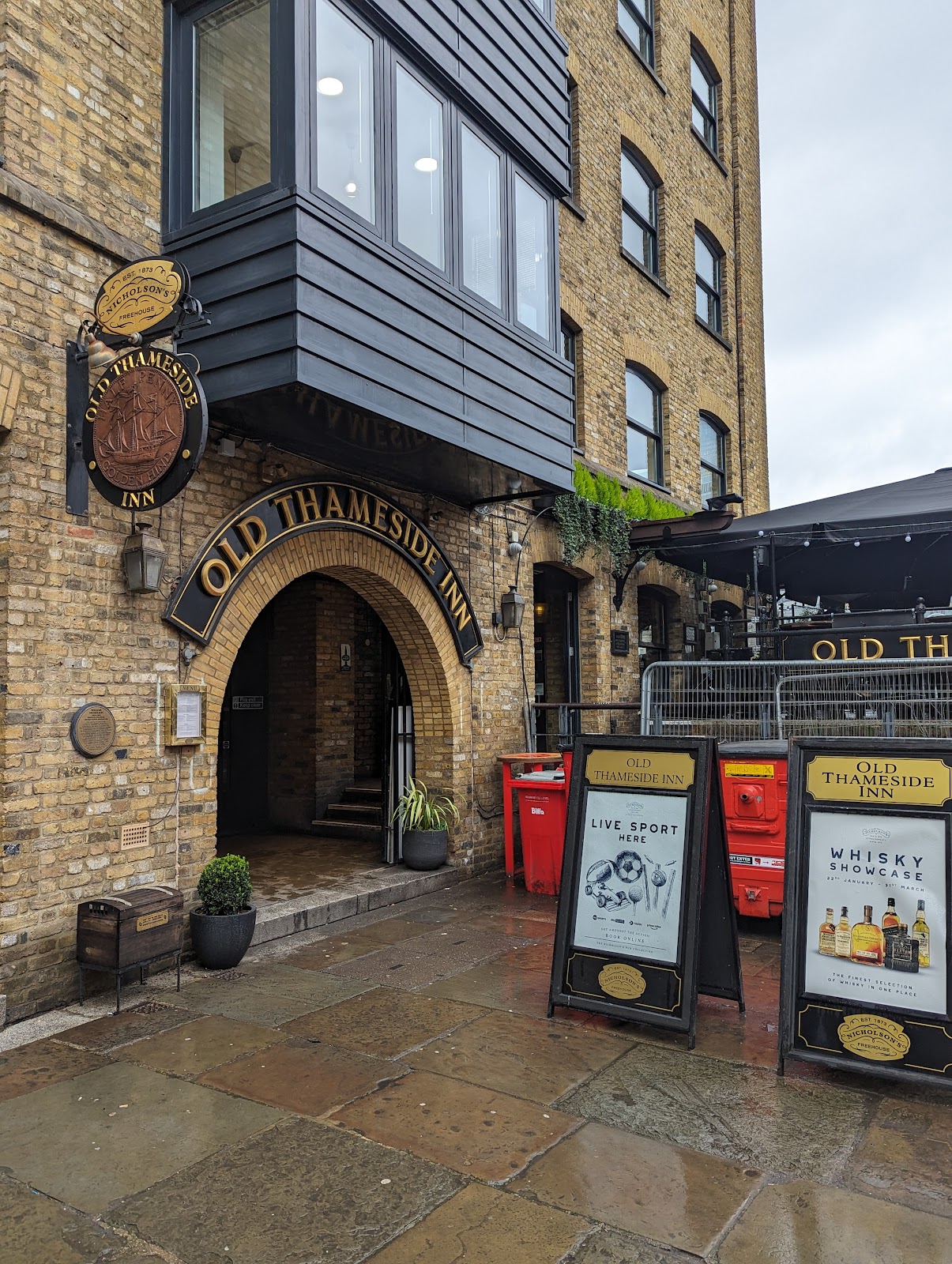
A Nicholson's pub, the Olde Thameside Inn is located in an old warehouse by St. Saviour's Dock, with an excellent view right over the Thames. A replica of the Golden Hinde ship is immediately outside the pub. Inside, there is one main bar that stretches almost the whole length of the room. Tables and chairs are arranged between the bar and windows that overlook the river. An area to the rear is reserved specifically for dining, with the toilers located between this area and the end of the bar. This would be the first of two Nicholson's pub on our radar for the day. An impressive 12 handpulls are on the bar here, although these tend to be multiples. During our visit, the choices were Fuller's London Pride (x3), Nicholson' Pale Ale (x3), Sharp's Doom Bar (x2), St. Austell Tribute (x2) and Titanic Plum Porter (x2). We are both massive fans of the Plum Porter so our choice here was a no-brainer and we took our halves (totalling £6.40) to a round table at the end of the bar. By and large I've always enjoyed the character of Nicholson's pubs. They have a certain charm that really helps you settle into the venue. They also know how to keep beer rather well and the Plum Porter was no exception. It was exactly as it's meant to be: sweet, dark and moreish.
The next venue on our list was another absolute must-do. A bonafide beer destination pub that just so happened to be very close to our current location. Leaving the Olde Thameside in our wake, we turned right, slightly retraced our steps and then turned left after the Winchester Palace ruins. We were now heading towards Borough Market, which itself is a mere stone's throw from the south bank of the Thames. Reaching the end of the road, we turned left onto Winchester Walk and then we saw it: The Rake.

This tiny pub is legendary. Appearing in the 2024 Good Beer Guide, it has a significant reputation for excellent beer and once had messages from more than 200 visiting brewers written on its walls, until these were painted over in a 2017 refurbishment. Inside, there is one small room with the bar to the rear. The rest of the space is given over to furniture, featuring low tables and converted barrel seating. To the side is a covered beer garden, used solely for drinking. The pub's proximity to the world famous Borough Market is just as well as it boasts 18 craft beer taps and 4 handpulls. Light food is provided but customers are also able to bring in food from the market itself, provided they ask first. What was on those 4 handpulls? I shall tell all. Our options here were interesting and varied with RedWillow Breakfast Stout, Fell Atlantic Crossings, Anspach & Hobday English Session IPA and Good Chemistry Time Lapse all available. Amy and I were both instantly drawn to the Breakfast Stout (5.6%) from RedWillow in Macclesfield. This turned out to quite possibly be the best beer-related decision that we've ever made. Brewed with Vietnamese coffee, it starts out with a roasty bitterness which ultimately leads to a smooth, rich dark chocolate and hazelnut finish. This was bloody gorgeous. I can very much take or leave coffee stouts but I could have drunk this by the pint! We sat in the outside area to enjoy our halves (£5.50) and agreed that it was absolutely delicious. A fantastic beer in a fantastic little pub! What more could you ask for?
We were hoping for more of the same at our next stop. Sadly having to depart The Rake, we turned right, heading directly towards Southwark Cathedral which sits right on the very edge of Borough Market. There would be more from the market shortly but for now, we turned left and headed a short distance to the second Nicholson's pub of that day: The Mudlark.
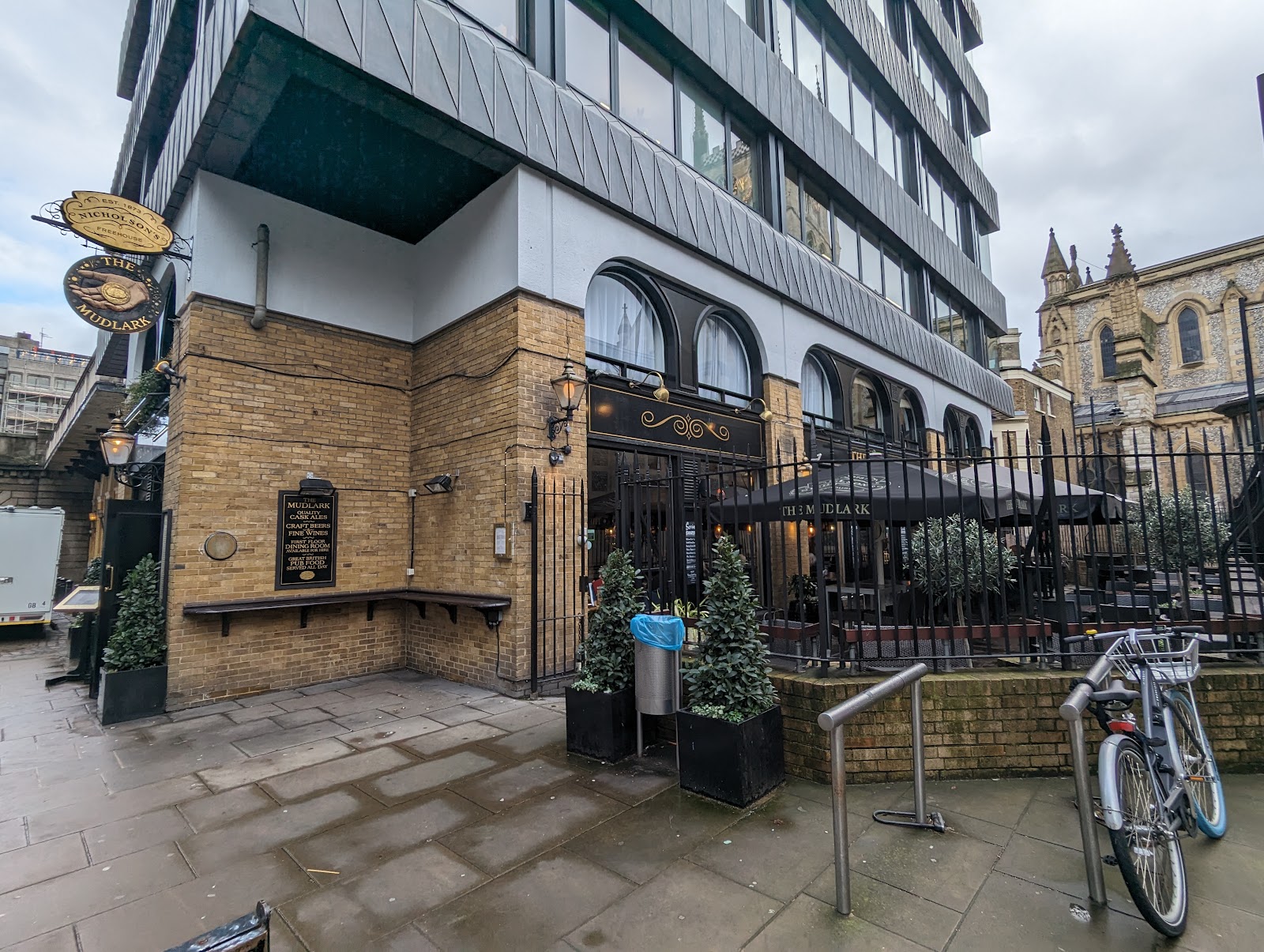
Taking its name from the aforementioned 18th century scavenging practice, The Mudlark sits on Montague Close, in the shadow of Southwark Cathedral. Inside, it's a fair bit smaller than its sister pub down the road but no less comfortable and welcoming. The bar occupies the left hand side of the downstairs room with seating throughout used for drinking and dining. An outside area to one side is equipped for unsettled weather with branded parasols and there is a restaurant upstairs. The bar features 8 handpulls, of which 6 were in use during our visit. Once again, these were doubled up and this time featured Theakston Old Peculier (x2), Adnams Ghost Ship (x2) and Nicholson's Pale Ale (x2). It was unusual to see Theakston's this far south so I plumped for the Old Peculier, Amy went for the Ghost Ship (both halves, total cost £6.45) and we pulled up chairs at a small table directly opposite the bar. It had been some time since I'd had Old Peculier on cask but it had been worth the wait. It was as tasty and powerful as ever. We toyed with the idea of having some food here, particularly when I noticed a chicken and chorizo pie on the menu but, in the end, we decided to wait a little bit longer and just stick to liquid sustenance for now.
It was time now for us to head into Borough Market in search of yet another iconic destination pub. The market, as always, was very busy and hectic and we didn't even manage to have a proper look around. However, after a few minutes of confusion and wayfinding and the help of two security guards, we finally found what we were looking for: The Market Porter.

This classic pub is located on Stoney Street, right next to Borough Market. Listed in the 2024 Good Beer Guide, it still retains traditional early morning market opening hours from 6-9am, but only Monday-Friday. There is a covered drinking area to the front of the pub. Inside, the pub has retained many of its traditional features. One bar sits at the centre of the room, with seating to either side on wooden tables and chairs. When we arrived, the pub was very busy, which I imagine is often the case in such close proximity to the market. Luckily, we were able to get served fairly quickly, which gave us just enough time to peruse our choice from the available 8 (out of 12) handpumps. As well as Weston's Old Rosie cider, the choices were Timothy Taylor Landlord, Fuller's London Pride, Harvey's Sussex Best Bitter (x2), Dark Star American Pale Ale, Portobello Market Porter and Hobgoblin Ruby. I thought it was only fair to give the Harvey's a go. Amy went for Neck Oil and we decided to head upstairs, where the restaurant area is located, accessed up a spiral staircase. The total cost for our halves here was £5.95. The Market Porter is certainly a pub worth visiting for the nostalgia of what a market pub once was. The downstairs room has all the traditional trappings, and features a small, air-conditioned seating area at the rear. Just a note that payments are by card only. The pub also has cinematic heritage and has appeared in such diverse productions as Lock, Stock and Two Smoking Barrels, Bridget Jones' Diary and The French Lieutenant's Woman. Part of the exterior of the pub was turned into the Third Hand Book Emporium for the film adaptation of Harry Potter and the Prisoner of Azkaban. We were definitely hoping to get food here and we were in luck. The upstairs restaurant was virtually empty which meant we were served in no time at all. We both chose the Pie of the Day, which turned out to be steak and ale. What can I say other than that it was fantastic! Perfectly cooked, homemade pie, encased in flaky pastry with creamy mash and slightly al dente cabbage. Absolutely wonderful. I make no exaggeration when I say that it was the best pie I've ever had. It was even better washed down with the Sussex Best Bitter (4%) from Harvey's in Lewes, East Sussex. Well balanced and with prominent hop character, it's an utterly delicious beer. We sat for a while in the restaurant, consumed our pies, ordered another round of drinks and took the opportunity to have a bit of a chill. We had a handful of pubs left to go. We unfortunately wouldn't have time to properly explore Borough Market but, based on what we'd already seen, heard and smelled, it's a definite addition to our itinerary for our next London trip, whenever that may be. It's easy to imagine how eerie the local area must be at night, when the market is done for the day and there is naught but silence in the streets. Eerie tales are told of The Market Porter in the darker hours. People walking past the pub after closing time have reported the sight of figures standing at the bar, barely visible through the windows. The till in the bar area has been heard ringing up totals even after it has been emptied. On other occasions, cutlery has been moved around and the tap turned on overnight, leaving the pub floor covered in water the following day. The rhyme or reason for these phenomena has yet to be established.
The next location on the list was another pub with a bit of a film legacy and it was also not far away. Having consigned our empty glasses to the glasswash tray of fate, we retraced our steps through the market, taking a right on our way through. Reaching Bedale Street, our next stop would be the Globe.

Our mini movie tour over and done with, it was time for another iconic pub and another that makes Borough Market worth a visit. Leaving the Globe, we continued onto Borough High Street where a small alleyway named King's Head Yard beckons. Down this alleyway, perhaps unsurprisingly, is the Old King's Head.
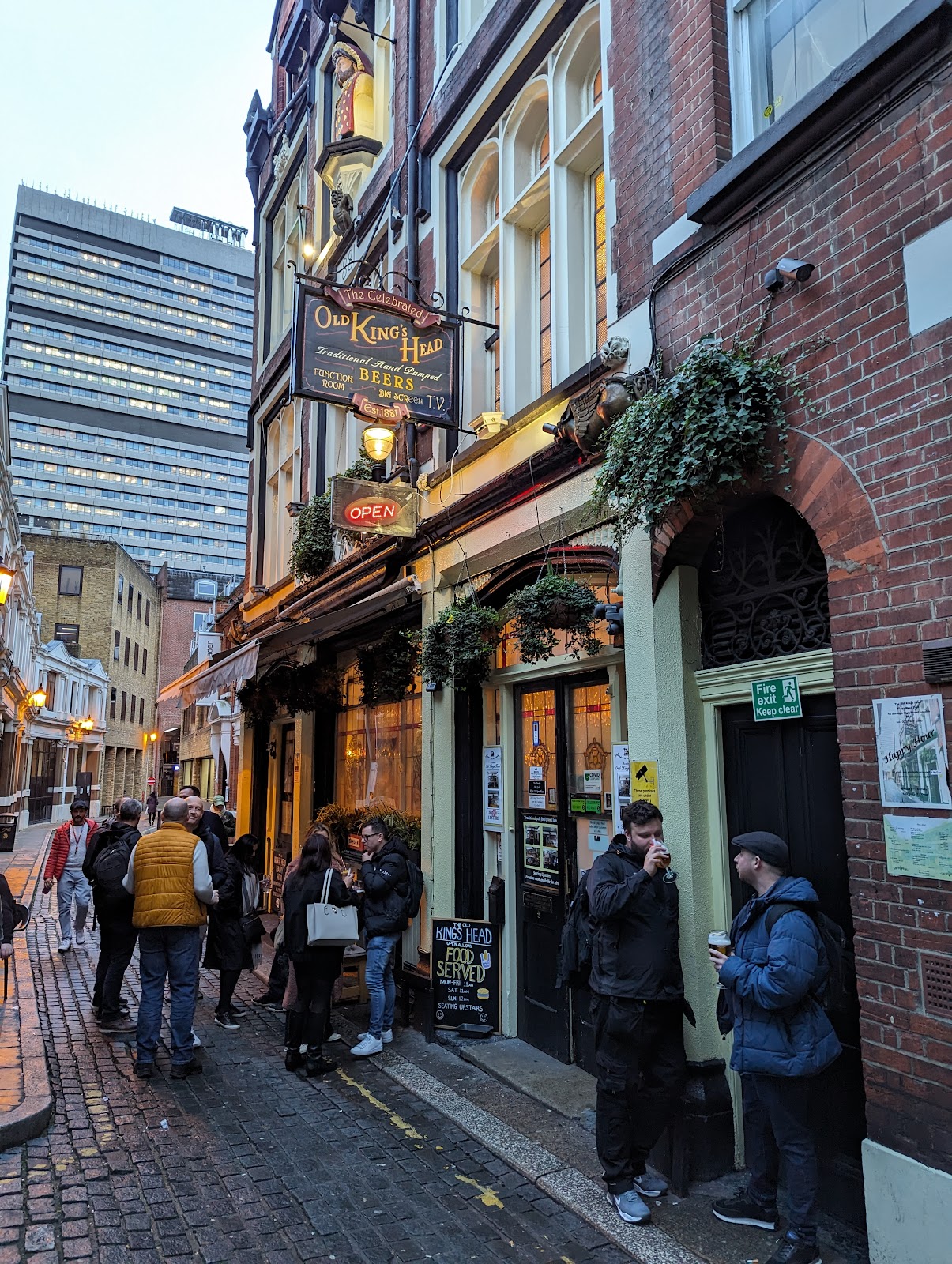
This traditional pub lies down a cobbled street and is a perfect example of a pub from a bygone era. The stained glass windows and the large murals adorning the walls inside reflect the rich history of the area. The Old King's Head has a good beer reputation, reflected in its inclusion in the 2024 Good Beer Guide. The inside layout is very simple. An L-shaped bar that serves a large bare-boarded space. Various artefacts and bric-a-brac are displayed on shelves above the bar. The bar itself features 4 handpulls. After squeezing our way into what was a very busy pub on the day, we were able to observe the options: St. Austell Proper Job, Harvey's Sussex Best Bitter, Sharp's Doom Bar and St. Austell Tribute. Proper Job on cask is usually a winner so that was my choice. Amy chose Doom Bar and we negotiated our way to a space by the door, where there was thankfully a space to stand, even if it was right next to the toilets. The total cost of our round was £5.95. The Proper Job was definitely a good choice. It was very very nice indeed. The Old King's Head is yet another pub that has more than backed up its reputation.
Time was ticking on now. Not that we were flagging. We still had a trio of pubs to visit and the sun was beginning to set, which added an extra layer of ambience to proceedings. Having vacated the Old King's Head, we re-emerged onto Borough High Street and turned right. A short distance away, on St. Thomas Street, we decamped to the Bunch of Grapes.
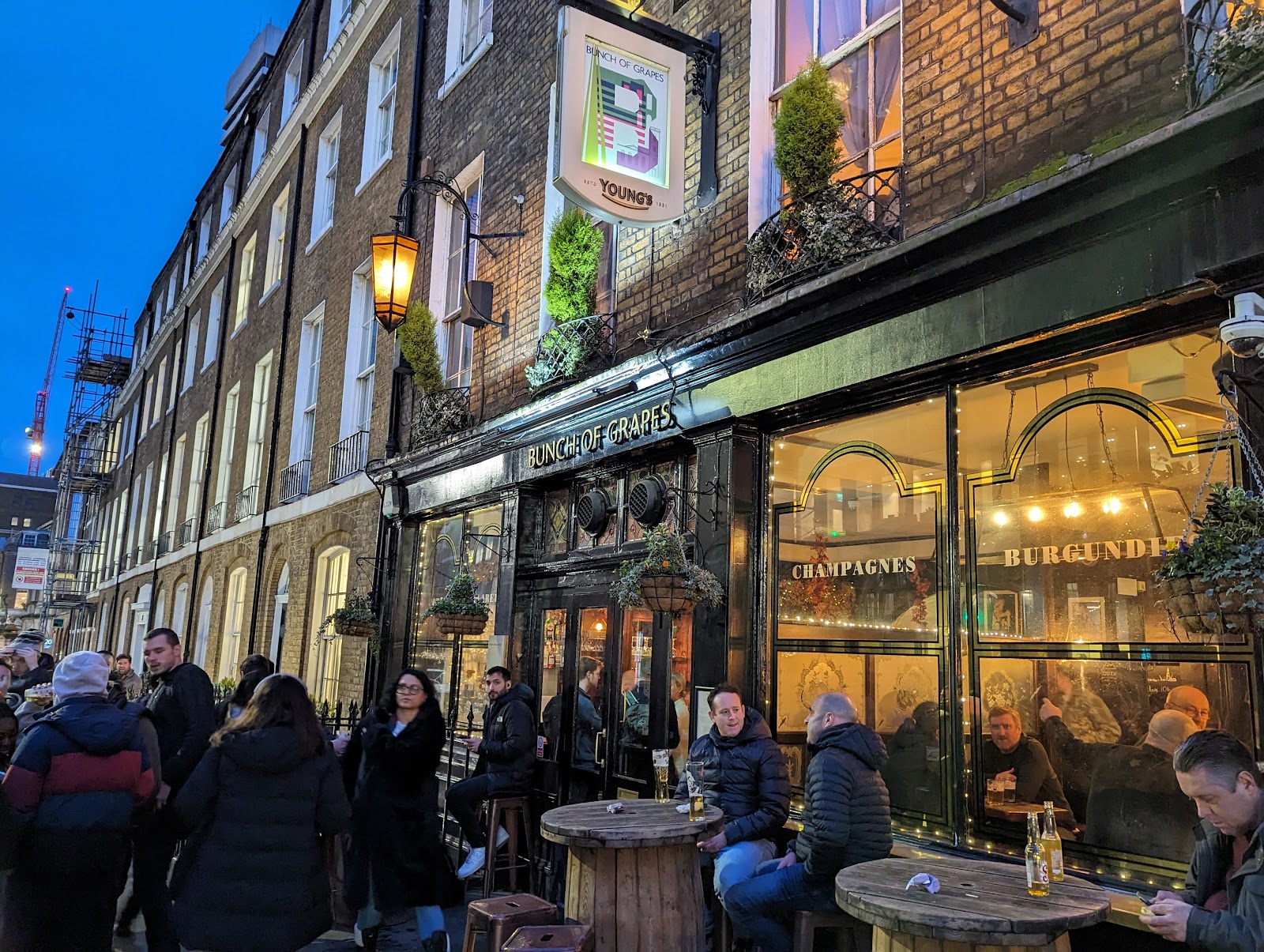
This Young's pub is located round the corner from London Bridge station and sits in the shadow of The Shard, which towers, impressively it must be said, over everything in the immediate vicinity. The ground floor bar is divided up by partitions to make it feel more intimate, with the bar itself to the left of the entrance. Seating is a combination of scrubbed wooden tables and chairs, as well as stools and drinking ledges. Some of the partitions feature mirrors for observation of the surroundings. A large dining room, complete with real fire, can be found upstairs, along with the toilets whilst there is a multi-level enclosed and partially covered patio to the rear. Young's beers are the showcase here. 4 handpulls are available and they featured Young's London Original (x2) and London Special. The final handpull was occupied by Adnams Ghost Ship as a guest beer. On this occasion, Amy and I both went for the Ghost Ship (2 halves for £6.95) and managed to find some spare stools at one of the drinking ledges. The Ghost Ship was as good as we'd expected. I still view it as an underrated cask beer. Perhaps not surprising for a Friday evening, every pub from the Old King's Head onwards would be very busy. The Bunch of Grapes certainly was and it came with an added dose of menace. Whilst we were close to finishing our drinks, we heard one of the bar staff out on the floor mention to another member staff that somebody had tried to steal her phone from behind the bar. The attempt was thwarted but this is always a good reminder to be on your guard, especially in London.
Night had fallen by the time we ventured back outside. Our penultimate location was a short walk away, back on Borough High Street. Heading right out of St. Thomas Street and then turning left, we finally found the Barrowboy & Banker.
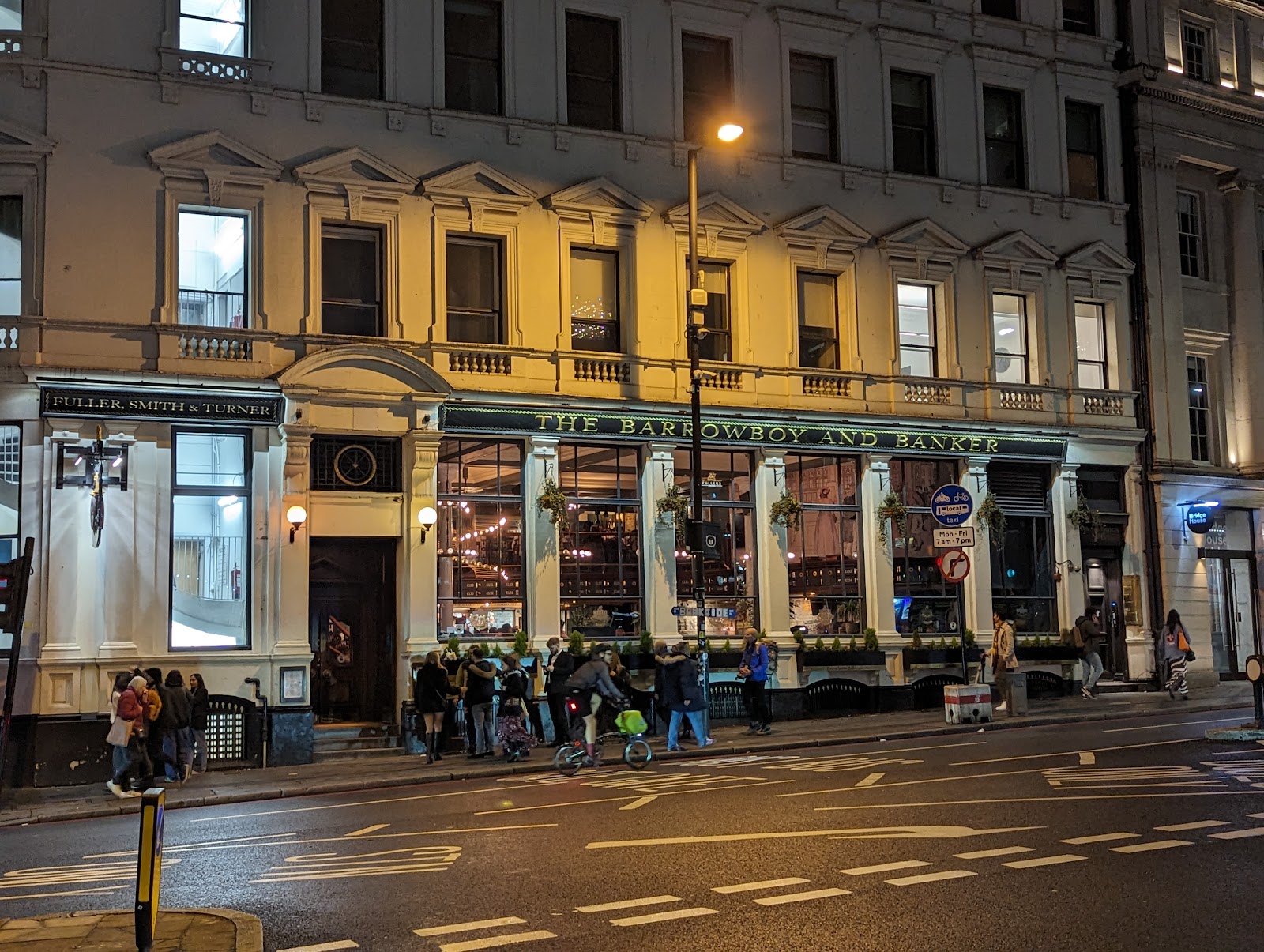
Why 'finally'? Well, we had actually attempted to find this pub earlier in the route but for whatever reason we were unable to do so. Either the pub isn't where Google Maps thinks it is, we weren't where Google Maps thought we were or the pub only appears to thirsty drinkers in their time of need. I like to think it's the latter. Either way, we had now located this massive Fuller's Ale & Pie House, which opened in 1996, after conversion from a branch of Natwest Bank. This is a very impressive building with very tall ground floor windows, marble columns, a very high ceiling with gold plasterwork and wrought-iron railings on the sweeping staircase that leads up to a curved gallery. There is a mix of seating and the walls are decorated with portraits of old bankers (with a 'b', not a 'w') and three enlarged cartoons, in Hogarth style depicting the 'idle barrowboy' and 'industrious banker', the origin of the pub's name. The bar is large and occupies a significant quantity of the far wall of the room. 8 handpulls can be found upon it. Fuller's products take up the majority but there are also some guest ales. During our stay, the options were Fuller's ESB, Fuller's Local Hero People's Captain, Fuller's Grand Slam, Fuller's London Pride (x2), Twickenham Summer Down Under, Tiny Rebel Yippe Try-yay and Dark Star American Pale Ale. Tiny Rebel get what I personally view as unnecessary hatred and it's always nice to see their cask beers on a bar, especially one with such a pun-tastic name. Amy and I both went for a half of the Yippee Try-yay (£6.90 total) and perched at the end of the bar, near a handy water station. There were no spare tables but we at least managed to stay out of the way. The beer was great. Yippee Try-yay (4.2%) is a (obviously rugby themed) slightly hazy pale ale, hopped with Citra and Ekuanot. It's a good combination of floral sweetness and rich maltiness. I've mentioned before about my love for Fuller's pubs. I love the way they adapt and convert buildings without managing to sacrifice the charm of the original. This pub is a great example of that.
Our excursion was almost at it's end. We had one more pub to go to complete the route. Leaving the Barrowboy, we headed straight across the road and kept going, onto Tooley Street. A few yards further on, our final stop loomed into view. Our evening would end at The Shipwrights Arms.
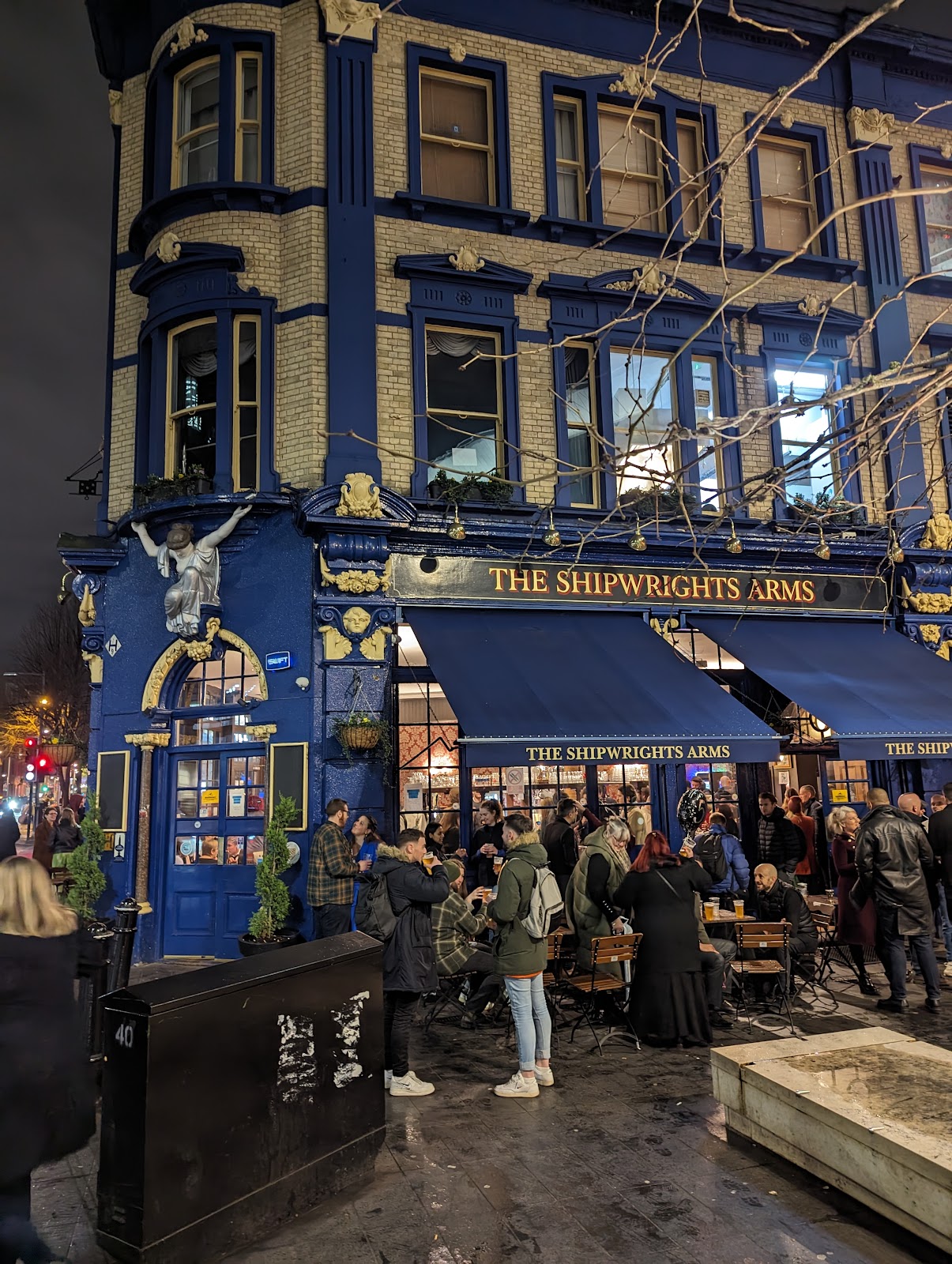
Built in 1884, this Grade II listed pub has retained much of its traditional layout and features. As well as the impressive exterior, there is an original tiled mural of shipwrights at work, which can be seen inside the pub. The central island bar is original and rare for this style of pub. Seating is clustered along the walls inside the room. There is a heavily rock themed jukebox on the wall, which was unexpected but an excellent surprise, and the pub is located close to the London Bridge transport hub and Tower Bridge, as well as the London Bridge Experience, which was the former home of the London Dungeon. Another very busy pub when we arrived, I was amazed to see 6 handpulls present, all but one of which was in use. These were offering Southwark LPA (x2), Sharp's Doom Bar (x2) and St. Austell Tribute. Having managed to grab a table that was simultaneously close to the bar and jukebox, we decided that, as this was to be our last pub of the night, that we'd finish off on pints. I was intrigued by the Southwark LPA (4%) and decided that would be my choice to round off the night. Amy went for a pint of Camden Pale. The total for this round came to £12.10. We sat at our table and enjoyed the randomness of the jukebox (Tina Turner, Guns N Roses, Aerosmith, Kings of Leon (Sex on Fire, twice, for some reason)) and how pleasantly surprised we were by this pub. The beer turned out to be decent too, and was probably the most reasonably priced we'd had all week by that point. The LPA (London Pale Ale) is light and citrusy and bursting with Citra hop flavour. It's no wonder I liked it so much! We had another round here and then off we went, down Tooley Street to Tower Bridge Road and our hotel, via the local Co-Op for snacks.
And that's all she wrote. The following day saw us do nothing more than check out, make our way to Victoria and chill at the Traveller's Tavern opposite the coach station until it was our time to depart. It's always sad to leave London.
What a few days it had been. Say what you like about London but there's always something going on and always things to see and do. Our longest every trip to the capital had certainly been rewarding. I experienced the best theatre show I've ever seen and the best pie I've ever eaten, not to mention the best pint of London Pride I've ever had. We also ticked off some fantastic London beer pubs and found some that have a bit more work to do. London pubs are something of an enigma. In my mind, they fall into three categories: the traditional drinkers pubs, with their history and their old buildings who serve cracking beer; the modern, new-build industrial style pubs that prioritise craft beer and appeal to the younger, trendier crowd; and the third category that falls somewhere in between, be they traditional pubs with modern elements, or newer pubs with a more traditional focus. Whatever style of pub you prefer, it's no understatement to say that London has something for everyone. If you can cope with the crowds and the prices and you're prepared to give yourself the time to settle, you can really have a good time exploring London's pubs. I know we do. This is the second time that London has featured in these pages and it definitely won't be the last. Even with 23 pubs on this trip and close to 20 on the last, we're not even close to saying that London is complete. In fact, we're just getting started.
Pub of the trip: Lamb & Flag, Covent Garden. Atmospheric, historic, comfortable and cracking beer
Beer of the trip: Without a doubt RedWillow's Breakfast Stout. We'd have drunk the barrel dry if we hadn't had plans.
Biggest surprise: The Shipwrights Arms just edges Victoria Taps by virtue of its awesome jukebox and prices