Saturday, July 19, 2025

The Yorkshire Chronicles Part 2: The Wonders of Whitby

Greetings! If you're discovering this page for the first time, I urge you to read part one, purely to provide some context for what's to come. Otherwise, if you're already up to speed, you left us retiring to bed after a day exploring the east coast town of Bridlington on the first day of a Yorkshire road trip. Following a particularly bad night's sleep, the consequence of high temperatures and a less than comfortable bed, we rose groggily to greet the day, accompanied by the soundtrack of seagulls outside the windows of the B&B. A rousing shower put us in the mood for breakfast and, following a full English in what may well have been the world's hottest dining room, we packed up our belongings and prepared to depart for our onward journey. The second location on our tour was somewhere I'd been wanting to return to ever since I first visited, several years ago. On that occasion, I'd been in said location for only a few hours and it seemed long overdue to correct that. For Amy's part, she'd never been to the place in question and I was really hoping that she was going to enjoy it as much as I'd hoped. If you've read the title of this blog, then you will be well aware of where we were headed. Our next stop would be the legend haunted town of Whitby. 

Whitby is a seaside town, port and civil parish in North Yorkshire. It is on the Yorkshire Coast at the mouth of the River Esk and has a maritime, mineral and tourist economy.

From the Middle Ages, Whitby had significant herring and whaling fleets, and was where Captain Cook learned seamanship. He first explored the southern ocean in HMS Endeavour, built in Whitby.

Alum was mined locally, and Whitby jet jewellery was fashionable during the 19th century.

Tourism started in Whitby during the Georgian period and developed with the arrival of the railway in 1839. The abbey ruin at the top of the East Cliff is the town's oldest and most prominent landmark. Other significant features include the swing bridge, which crosses the River Esk and the harbour sheltered by grade II listed east and west piers. There are statues of Captain Cook and William Scoresby, and a whalebone arch on the West Cliff. Whitby featured in literary works including Bram Stoker's novel Dracula.

Whitby is 47 miles (76 km) from York and 22 miles (35 km) from Middlesbrough. Whitby was known in the Anglo-Saxon period as Streoneshalh, meaning "Streon's nook of land". The modern name, which first appears in the Domesday Book, means "Hvíta's farmstead", from Old Norse Hvítabýr.

A monastery was founded at Streoneshalh in 657 AD by King Oswiu or Oswy of Northumbria, as an act of thanksgiving, after defeating Penda, the pagan king of Mercia. At its foundation, the abbey was an Anglo-Saxon "double monastery" for men and women. Its first abbess, the royal princess Hild, was later venerated as a saint. The abbey became a centre of learning, and here Cædmon the cowherd was "miraculously" transformed into an inspired poet whose poetry is an example of Anglo-Saxon literature. The abbey became the leading royal nunnery of the kingdom of Deira, and the burial-place of its royal family. The Synod of Whitby, in 664, established the Roman date of Easter in Northumbria at the expense of the Celtic one.

The monastery was destroyed between 867 and 870 in a series of raids by Vikings from Denmark under their leaders Ingwar and Ubba. Its site remained desolate for more than 200 years until after the Norman Conquest of England in 1066. After the Conquest, the area was granted to William de Percy who, in 1078 donated land to found a Benedictine monastery dedicated to St Peter and St Hilda. William de Percy's gift included land for the monastery, the town and port of Whitby and St Mary's Church and dependent chapels at Fyling, Hawsker, Sneaton, Ugglebarnby, Dunsley, and Aislaby, five mills including Ruswarp, Hackness with two mills and two churches.

When the Domesday Book was compiled in 1086, Whitby was recorded being partially waste and a small settlement lying within the Langbaurgh Wapentake of Yorkshire. Further details reveal the state of Whitby's economic and agricultural decline (when compared with its pre-Conquest state under Earl Siward) which were due to the depredations of William the Conqueror's army during the Harrying of the North in 1069–70.

In about 1128 Henry I granted the abbey burgage in Whitby and permission to hold a fair at the feast of St Hilda on 25 August. A second fair was held close to St Hilda's winter feast at Martinmas. Market rights were granted to the abbey and descended with the liberty. Whitby Abbey surrendered in December 1539 when Henry VIII dissolved the monasteries. By 1540 the town had between 20 and 30 houses and a population of about 200. The burgesses, who had little independence under the abbey, tried to obtain self-government after the dissolution of the monasteries. The king ordered Letters Patent to be drawn up granting their requests, but it was not implemented. In 1550 the Liberty of Whitby Strand, except for Hackness, was granted to the Earl of Warwick who in 1551 conveyed it to Sir John York and his wife Anne who sold the lease to the Cholmleys. In the reign of Elizabeth I, Whitby was a small fishing port. In 1635 the owners of the liberty governed the port and town where 24 burgesses had the privilege of buying and selling goods brought in by sea. Burgage tenure continued until the Whitby (Yorkshire) Improvement Act 1837 (7 Will. 4 & 1 Vict. c. x) entrusted government of the town to a board of improvement commissioners, elected by the ratepayers.

At the end of the 16th century Thomas Chaloner visited alum works in the Papal States, where he observed that the rock being processed was similar to that under his Guisborough estate. At that time alum was important for medicinal uses, in curing leather and for fixing dyed cloths and the Papal States and Spain maintained monopolies on its production and sale. Chaloner secretly brought workmen to develop the industry in Yorkshire, and alum was produced near Sandsend Ness 3 miles (5 km) from Whitby in the reign of James I. Once the industry was established, imports were banned and although the methods in its production were laborious, England became self-sufficient. Whitby grew significantly as a port as a result of the alum trade and by importing coal from the Durham coalfield to process it.

Whitby grew in size and wealth, extending its activities to include shipbuilding using local oak timber. In 1790–91 Whitby built 11,754 tons of shipping, making it the third largest shipbuilder in England, after London and Newcastle. Taxes on imports entering the port raised money to improve and extend the town's twin piers, improving the harbour and permitting further increases in trade. In 1753 the first whaling ship set sail to Greenland and by 1795 Whitby had become a major whaling port. The most successful year was 1814 when eight ships caught 172 whales, and the whaler, the Resolution's catch produced 230 tons of oil. The carcases yielded 42 tons of whale bone used for 'stays' which were used in the corsetry trade until changes in fashion made them redundant. Blubber was boiled to produce oil for use in lamps in four oil houses on the harbourside. Oil was used for street lighting until the spread of gas lighting reduced demand and the Whitby Whale Oil and Gas Company changed into the Whitby Coal and Gas Company. As the market for whale products fell, catches became too small to be economic and by 1831 only one whaling ship, the Phoenix, remained. Whitby benefited from trade between the Newcastle coalfield and London, both by shipbuilding and supplying transport. In his youth the explorer James Cook learned his trade on colliers, shipping coal from the port. HMS Endeavour, the ship commanded by Cook on his voyage to Australia and New Zealand, was built in Whitby in 1764 by Tomas Fishburn as a coal carrier named Earl of Pembroke. She was bought by the Royal Navy 1768, refitted and renamed.

Whitby developed as a spa town in Georgian times when three chalybeate springs were in demand for their medicinal and tonic qualities. Visitors were attracted to the town leading to the building of "lodging-houses" and hotels, particularly on the West Cliff. In 1839, the Whitby and Pickering Railway connecting Whitby to Pickering and eventually to York was built, and played a part in the town's development as a tourism destination. George Hudson, who promoted the link to York, was responsible for the development of the Royal Crescent which was partly completed. For 12 years from 1847, Robert Stephenson, son of George Stephenson, engineer to the Whitby and Pickering Railway, was the Conservative MP for the town promoted by Hudson as a fellow protectionist. The black mineraloid jet, the compressed remains of ancestors of the monkey-puzzle tree, is found in the cliffs and on the moors and has been used since the Bronze Age to make beads. The Romans are known to have mined it in the area. In Victorian times jet was brought to Whitby by pack pony to be made into decorative items. It was at the peak of its popularity in the mid-19th century when it was favoured for mourning jewellery by Queen Victoria after the death of Prince Albert. The advent of iron ships in the late 19th century and the development of port facilities on the River Tees led to the decline of smaller Yorkshire harbours. The Monks-haven launched in 1871 was the last wooden ship built in Whitby, and a year later the harbour was silted up.

 On 30 October 1914, the hospital ship Rohilla was sunk, hitting the rocks within sight of shore just off Whitby at Saltwick Bay. Of the 220 people on board, 74 died in the disaster, with 33 of those being buried in Whitby Cemetery. In a raid on Scarborough, Hartlepool and Whitby in December 1914, the town was shelled by the German battlecruisers Von der Tann and Derfflinger. In the final assault on the Yorkshire coast, the ships aimed their guns at the signal post on the end of the headland. Whitby Abbey sustained considerable damage in the attack, which lasted ten minutes. The German squadron responsible for the strike escaped despite attempts made by the Royal Navy. During the early 20th century the fishing fleet kept the harbour busy, and few cargo boats used the port. It was revitalised as a result of a strike at Hull docks in 1955, when six ships were diverted and unloaded their cargoes on the fish quay. Endeavour Wharf, near the railway station, was opened in 1964 by the local council. The number of vessels using the port in 1972 was 291, increased from 64 in 1964. Timber, paper and chemicals are imported, while exports include steel, furnace-bricks and doors. The port is owned and managed by Scarborough Borough Council since the Harbour Commissioners relinquished responsibility in 1905. A marina was started in 1979 by dredging the upper harbour and laying pontoons. Light industry and car parks occupy the adjacent land. More pontoons were completed in 1991 and 1995. The Whitby Marina Facilities Centre was opened in June 2010.

Whitby had made a significant impression on me after my first visit and I'd been hoping for a chance to come back ever since. I was looking forward to introducing Amy to the town and also finally having the opportunity to spend some considerable time there and explore it as thoroughly as possible. First though, we had to get there. One of the factors to consider when touring Yorkshire is that, at some point, you will have to tackle proper Yorkshire roads. It would not be long after leaving Bridlington that we would find ourselves dealing with just such an obstacle. Our route to Whitby took us through some of the areas of Bridlington that we'd covered the previous day, past the edge of the old town and then out of the town in the direction of Scarborough. Briefly entering, and then skirting the edge of, said town, we continued up the east coast. Before long, the dual carriageways, roundabouts and urban housing gave way to single carriageways, open countryside, dry stone walls and lots of hills. For the last third of our roughly 90 minute journey, we tackled changes in elevation, peaks and troughs and sharp turns, handled primarily in second gear. Eventually however, the road dropped down into a valley and the town of Whitby was revealed before us, the ruined abbey prominent on the clifftop, with the town and harbour below. A short delay caused by temporary lights and roadworks, and then some slight confusion as to the location of our B&B, later and we pulled up outside our base for the next couple of days. We had officially arrived in Whitby! We would be staying at the Arches Guest House, located on the western side of the town and a short walk from the harbour and all of the associated attractions. This particular B&B operates a self check-in system. We entered the code we'd been given for the front door and collected an envelope containing our room keys and parking permit. Parking permit filled in, and placed in clear view on the dashboard, we unloaded the car and made our way to our room, which was one of two located at the top of the building, in a converted attic space. This would prove to be both a blessing and a curse. One of the challenges of our time in Whitby would be the weather. The time of our trip away coincided with a heatwave in the UK. Day one, in Bridlington, had been hot. Our first day in Whitby was forecast to be even warmer, although the following day would see things cool down slightly. 

Having freshened up and de-stressed from the drive up the coast, we made our way out. Our intention was to tick off a couple of the traditional tourist activities, do a little bit of shopping and, obviously, throw ourselves wholeheartedly into the many pubs in the town. The location of our B&B put us a short walk from the West Cliff. Our first stop was the whalebone arch, situated on the cliff above the harbour. This is a whale's jawbone, mounted vertically in the ground, adjacent to a statue of Captain Cook and erected to celebrate the town's whaling heritage. A few photos later and we were making our way downhill to the harbour area. Whitby is synonymous with the world's most famous vampire, Dracula himself. For those not familiar with the source material, a significant portion of Bram Stoker's 1897 novel is set in the town and was heavily inspired by it. Stoker was staying in the town at the time he wrote the novel and Whitby, understandably, has leaned heavily into this loftiest of literary connections. In fact, the building in which he wrote the passages in question, then known as the Captain's Reading Rooms, is now an exhibit dedicated to the novel. It was only natural that we had this on our list to visit. It already felt warm and it wasn't even midday. Any opportunity to spend as much time inside as possible would certainly be welcomed. We made our way to The Dracula Experience, located on the harbourside and instantly recognisable by its blood red and jet black facade and vampiric imagery. We paid £7 each for the privilege of entering what we assumed was a museum that explored the history of the novel and the town's influence on Stoker's narrative. How wrong we were. It turned out that the experience is a small, but intense, scare maze, complete with grotesque animatronics that jump out. The theming does at least reflect key moments from the novel and the visit ends with a film detailing the specific events that take place in the town as described by Stoker and the locations mentioned in the text itself. All-in-all, we were in and out within 15 minutes. 

Hearts racing, and daylights well and truly frightened out of us, we needed some recovery time. It seemed like the perfect opportunity to visit a local pub. If nothing else, we'd be able to acquire shade, calm down and lament the loss of the £14 that we'd never see again. Conveniently, not only does Whitby have the benefit of many pubs, they are, by and large, clustered fairly closely together. Whilst I had, of course, compiled a list of drinking establishments for our time in Whitby, the nature of the town's pubs would see this change several times over the course of the next 48 hours. Our first stop was not a pub that was on the original list but was chosen specifically due to its proximity to the Dracula Experience. Our first encounter with a Whitby pub would be at The Pier. 


This large pub is operated by Hartlepool based Cameron's Brewery. Behind the brick and whitewash wall, you will find an open plan interior. The bar is directly opposite the entrance, with traditional furniture located throughout. There is a slightly raised area to one side. Outside, there is seating to the front as well as a staircase leading up to a roof terrace. The decor includes much nautical memorabilia alongside photos of the town. The unseasonably warm weather, coupled with the fact that it was a Saturday, meant that the vast majority of beer gardens were very busy during our stay. On the plus side, this quite often meant that there was plenty of seating inside for us to take advantage of. Upon entering, we made our way to the bar, which is blessed with 6 handpulls, although just the 3 were in use at the time. Unsurprisingly for a Cameron's house, their beers are prominent. The choices here were Cameron's Strongarm and Road Crew as well as Kirkstall Three Swords. It's not often that I get the chance to give Strongarm a go. A half of this and a Diet Coke for Amy came to £6.20, and we headed over to the slightly raised area to better peruse our surroundings. It was clear, based on how busy this pub already was, that Whitby was going to be very busy over the course of our time there. We would find out quite how busy in due course. The Pier was a welcome respite from the heat and the sun, and clearly a lot of other people had had the same idea. Luckily, we were able to find a table and, at one point, were almost presented with food that was actually meant for an older couple sat nearby. As first stops go, this hadn't been too bad. Strongarm (4%) is Cameron's flagship beer. It's a ruby ale with a distinctive creaminess in the head. There is a good balance between the hops and malt. It's a good beer on which to begin the day but without being outstanding. I feel that sums up this place overall. Considering that there were a lot of staff on shift, and the majority of the clientele were outside, the table that we sat at, and indeed some others nearby, were in need of a wipe. Still, despite the rather lacklustre approach to cleanliness, The Pier isn't too bad in the grand scheme of things. 

With our first drinks of the day down the hatch, we turned to my pre-prepared list for our next stop. Heading out of The Pier, we went right and then right again, heading back uphill, in the direction of the quieter side streets of the town. This part of Whitby has a distinct Victorian feel, reflected in the collection of independent shops, historic buildings, and pubs that we would encounter. Making our way to Skinner Street, our attention now turned to the first of several micropubs that we would be visiting on the day: Arch & Abbey.

What was formerly a china and glassware shop that was once owned by the owner of the Whitby Gazette, the Arch & Abbey is a Good Beer Guide 2025 listed micropub, now in its 6th year of operation. The current licensees were made jobless and homeless by the PubCo that they previously worked for and were able to raise money through Crowdfunding to open their own premises. The pub occupies a street that also features Sandringham House, and a former ladies' dress shop, once known as Atkinson's. Inside, the layout is one of a single L-shaped room. The bar occupies space opposite the door with seating scattered throughout. This consists of low tables and chairs, with some stools thrown in for good measure. Adjacent to the bar are shelves consisting of canned and bottled beers, alongside gift sets of local spirits. The decor is minimalist and contemporary with bare wood floors, subtle lighting and light blue walls. The toilets are located at one end of the bar. An original Victorian clock is mounted on the wall outside. The Arch & Abbey's beer reputation was about to be put to the test. A bank of 4 occupies the bar here. The options were interesting and varied and all came from within Yorkshire. We were tasked with choosing between Abbeydale Summer, Bingley Centennial, Bosun's Brew Maiden Voyage, and Wensleydale Black Dub. Being unfamiliar with Bingley Brewery, I opted for their Centennial (4.4%) whilst Amy chose a can of Brew York's Rhubarbra Streisand. All told, this combo set us back £7.20 and we stowed ourselves on a table opposite the bar. The Arch & Abbey certainly fits the established micropub aesthetic, both with its welcome and with its reliance on core values of good beer and good conversation in a cosy and comfortable environment. The pub is also dog friendly, which no doubt came as a great relief to Eric the Border Terrier and his family. Beer-wise, the Bingley offering was great. The Centennial is a showcase for the eponymous hop. This delivers delicate floral aromas and a slightly tangy aftertaste. Rye and crystal malts are used in the brew, giving a subtle, malty backbone. I do love discovering beers from breweries I know little about, particularly when the discovery happens in a pub or location that has gone previously unvisited. 

Back out into the afternoon sun we went now, with our next destination a short walk away, back in the direction we had previously come. Around the corner from our previous stop, on Flowergate, we next visited The Elsinore. 

This pub has the distinction of being the only premises of this name in the entire country. The name itself comes from that of a sailing ship. Recently refurbished, the pub boasts a single, square room with the bar in one corner. The toilets are to the rear. The decoration is simple but welcoming, with much marine memorabilia in evidence. The seating is simple and primarily consists of traditional wooden tables and chairs, with the addition of banquette seating under both windows. The Elsinore is the original home of the famous Whitby Goths, making it especially busy during the Goth weekends, and the pub is also popular during Whitby Folk Week. On the bar here you will find three hand pumps. These consist primarily of better known national brands. At the time of our visit, these brands were Timothy Taylor Landlord, Wainwright Gold and Black Sheep Best. Amy switched back to Diet Coke here, whilst I took the plunge on a half of Landlord (total cost £4.45) and we took a seat at a table roughly in the centre of the room. This very much feels like a locals pub. That's not to say that we weren't made welcome. We just got the impression that a lot of the customers frequent this place a lot. And why wouldn't they? It's a nice little place and exactly the sort of pub you'd expect to find in a seaside town. It helps that the beer is well kept too. The Landlord was in good condition and went down easily. 

As well as having many great pubs, Whitby also has an array of quirky, independent shops. We took some time between stops to peruse some of these and made a fair few purchases, both for ourselves and as presents for family. Following this shopping spree, it was back to pubs, with the next location being a short distance away. Across the road from The Elsinore was our next stop, the highly regarded Little Angel. 

Grade II listed and featured in the 2025 edition of the Good Beer Guide, the Little Angel is one of the more historic pubs in Whitby. Built in the 19th century, the pub features an 18th century well and part of the former Whitby Castle incorporated into the structure. A well worn mounting block, used to help riders mount their horses, can still be seen at the front of the building. A three sided, central bar serves three rooms. The largest room is front and centre. A smaller lounge is to one side and a snug-like space is further back. TVs, often showing sport, can be found throughout and there is an outside beer terrace to the rear. The landlord operates his own microbrewery, Lady Luck, which provides the majority of the pub's real ale, although guests feature heavily too. The Little Angel was fairly busy when we arrived and it would soon become clear as to why. We made our way to the bar to run our eyes over the beer choices, spread as they were across 9 handpulls. One of these was dedicated to Westons Old Rosie cider, with the remaining 8 offering beer, including a trio from Lady Luck, namely Black Cat, Zombie and Kraken. Also present were Bass, Bradfield Farmers Blonde, Theakston Old Peculier, Tiny Rebel Cwtch and Theakston Light Foot. Intrigued by the offerings from the in-house brewery, Amy and I both opted for beers from Lady Luck. I went for the Zombie (4%) whilst Amy went for the Kraken. We clutched our respective halves (£5.00 in total) and retreated to a table in the snug. What a pub this is. From the moment we entered, we felt at home. The atmosphere was relaxed and, despite the amount of customers, nobody seemed uncomfortable or out of place. It's not difficult to see why the Little Angel is so highly regarded. Especially when beer quality comes up. The Lady Luck beers are excellent. The Zombie is blonde ale, hopped with Huell Melon. This produces citrusy and fruity notes, with a crisp, clean finish. It's really no surprise that the Little Angel was voted CAMRA local Pub of the Year for three consecutive years. Thus far, this had been my favourite pub, but we still had plenty more to go. If the pubs and beers to come were going to be as good as the Zombie at the Little Angel, then we would be in safe hands. No pressure. 

Another very short walk would be required to convey us to our next destination. Even though leaving the Little Angel was a tough task in and of itself, we were determined to persevere. Don't ever say we're not thorough! A short journey down the hill would take us to another micropub which we had deemed worthy of our scrutiny. Appropriately enough, it was indeed Beer O' Clock.


The local CAMRA Pub of the Year for 2024, this little place was, until very recently, Mason's greengrocer's, although it now functions as a relatively new addition to the drinking circuit in this part of the town. Good Beer Guide 2025 listed, this is the only Beer O' Clock in the country. The interior is contemporary with modern fixtures and fittings and a mix of both traditional and booth seating, with high stools also available at the bar. The bar is to one side of the room and there is a snug and 'dog station' located towards the rear, where the toilets can also be found. The large windows to the front ensure lots of light. There are 4 handpulls available here. All of these were being utilised when we popped in, with choices between Timothy Taylor Landlord, Titanic Plum Porter, Kirkstall Blonde and Fell Tinderbox. Amy and I both decided on a half of the latter (£6.00 in total) and mosied over to a table at the end of the bar. I've come across Tinderbox before but opted against it in favour of something else so I was grateful for the opportunity to give it a go again. This is a West Coast style IPA that comes in at a hefty 6.3% (hence the price). It's dry and bitter with resinous and piney notes and a hint of pith. It certainly drinks far too easily for such a strong beer. Needless to say, as delicious as it was, having more than one might have been a chore. 

The day had very much warmed up by the time we departed Beer O' Clock. It was noticeably busier too, with a mix of families, day trippers and large groups seemingly out enjoying the sun. Our further beer explorations would take us somewhere a bit different. Finally reaching the end of Flowergate, we emerged back on the harbourside, on New Quay Road. We immediately turned right and followed the road around. This took us in the direction of Whitby train station, where we would find a duo of drinking dens to explore. The first of these was also the first pub so far that day that I'd visited previously. It was several years ago however, so I was eager to see whether it was as good as I remembered it. Next up, The Station Inn. 

This regular Good Beer Guide entry (including for 2025) is now owned by Stonegate and is nicknamed 'Platform 3' due to its proximity to the railway station over the road. The Station Inn was a previous winner of Cleveland Pub of the Year (2011) and Pub of the Season for Spring 2010. The layout is multi-roomed. The front entrance leads into the main bar. Opposite this is a snug. Seating is arranged around the bar, in the form of high stools and drinking ledges but there is also a preponderance of traditional seating throughout, along with more comfortable furnishings in the snug. A larger area to the rear is often used for dining but drinkers are equally welcome. Amongst the various bar offerings are 8 handpulls, 4 of which were in use during our visit. The choice was certainly less varied than expected, with the available beers being Courage Directors, Timothy Taylor Landlord, Wainwright Gold and Theakston Best. Happily, I've got a soft spot for Directors so went for a half of that. Amy selected Diet Coke and we also bought a bag of crisps. Our total round came to £5.45. We just about managed to find some spare stools and perched on these a short distance from the bar. The Station Inn was very busy at this time, and filled with clientele that seemed to a bit of a spillover from the Spoons down the street. Their beer garden was filled to bursting when we past it so that logically explained it. The Directors was well kept but, to tell the truth, I was disappointed. My last visit here had revealed this place to me as some kind of real ale haven. This time I was confronted with generic beer choice. Admittedly, the pub do tend to have more ales, and a wider range, available in busier seasons but you would expect this to have included one of the hottest weekends of the year so far. Wouldn't you? It was also here that we began to notice a peculiar trend. We overheard a gentleman at the bar talking to a member of staff and explaining that he'd come over on the train from Middlesbrough and was hoping to find a vacant room somewhere. He clearly hadn't planned ahead, as evidenced by the fact that his only belongings seemed to be his phone, some tobacco and a can of deodorant. We would continue to randomly encounter Middlesbrough natives throughout the remainder of the day. At the time it seemed odd until you realise that Middlesbrough is only about 20 miles or so from Whitby. 

On we went again now, and I was determined to put the disappointment of The Station behind us. Thankfully, I had high hopes for our next stop. Crossing over the road, we climbed some steps and entered the Whitby station buildings, where you can find a pub, so named The Waiting Room.


Yet another micropub, and the first to be opened in Whitby, the Good Beer Guide listed 2025 Waiting Room is located directly on the platform used by the steam trains that serve the North York Moors Railway. This is a micropub in its truest form, focusing on cask ale and virtually nothing else. The ownership recently changed hands and it is now run by the same team behind the Arch & Abbey. As well as adhering to the micropub ethos, it also very much fits in with the 'micro' side of things. The entire interior of the pub is only six yards square. In keeping with its location, much of the theme is of a railway and locomotive variety. The small bar is tucked into one corner with the remainder of the space given over to tables and chairs.
 The pub's location and name has allegedly, and perhaps apocryphally, bemused many a foreign tourist who have subsequently dumped their luggage inside and disappeared for the day.  Our arrival here had been fortuitously timed. Whilst the pub was busy, there was still a table available, which we quickly claimed right before a decent sized group came in. Result! It was now time to peruse the beer options. There are 6 handpulls here and they were all occupied, with a choice between Bosun's Brew King Neptune, Abbeydale Through the Hopback Citra, 3 Brewers of St. Albans Special, Abbeydale Daily Bread, Linfit Blackmoorfoot and Abbeydale Voyager. Amy immediately decided on the Voyager whilst I eventually went for the King Neptune (4.3%) from Bosun's Brew, based in Wetherby (total cost £4.95). This is a light, golden beer with grapefruit, fruit and citrus in the profile. The body is medium and it drinks very easily indeed. Gorgeous! So far the micropubs of Whitby had been decent. This was definitely the busiest, and had the added advantage of the barman's two very tired, but friendly, dogs chilling out next to the bar and trying to stay cool. A bonus disadvantage was a non-paying customer who got very upset indeed when the barman recommended that she use the public toilets over the road instead of the one in the pub. I suspect that she didn't want to pay to pee. 

Food was very much required by this stage. I had a plan in mind but, sometimes, the universe is not conducive to plans. The original idea was to cross the swing bridge into the other half of town and stop at The Dolphin, a pub I knew from my previous visit, that I knew sold good beer and would be selling food. We crossed the bridge. Success. We entered the pub. Second success. However, our hopes were dashed. There was no real ale available and, even worse, the kitchen was closed. This was despite this information not being displayed anywhere, their website indicating that the kitchen should be open, and the fact that the beer garden to the front was absolutely rammed. Luckily, we found a solution in a takeaway fish and chip shop over the road, and we were very glad we did. The fish and chips were sensational. The batter was crispy and not greasy or soggy, and the chips were perfectly fried. We had the presence of mind to enjoy our food in a nearby side street so as to avoid the unwanted attention of any nearby seagulls. Refuelled and rejuvenated, we were just about ready to press on. Conveniently enough, our chosen location for our food break was a stone's throw from the next duo of pubs that we had in our sights. The first of these was the White Horse & Griffin.


This Grade II listed pub is believed to have been built in 1691 and was the first ever coaching inn on the road between Whitby and York and London. It operated as an inn until 1939 when it closed and was allowed to fall into dereliction, and was used to store nets and pots for local fishermen. A local builder acquired and extended the building in 1983, beginning a restoration that took 11 years to complete. The pub officially reopened in 1993. Charles Dickens is believed to have been a patron here during the Victorian era. More recent guests have included Sir Michael Caine, Bryan Ferry, Viscount Linley and comedian Micky Flanagan. The building's age can be clearly seen inside. The main entrance is narrow, leading through to a seating area of traditional wooden tables and chairs. The tiny bar is located at the back of this room, tucked into a corner. A doorway behind this leads down into the separate restaurant, at the back of which the toilets are located. A separate dining room, located upstairs, is used to cater for overnight guests. The former carriage entranceway still remains to the left of the entrance. This is a wonderful, atmospheric place in which to enter. Imagine our surprise when we were virtually the only customers. The lack of a beer garden in a heatwave does not help places like this. Still, we were about to have an excellent time here. The duo of handpulls on the bar were offering Timothy Taylor beers, specifically Landlord and Boltmaker. I opted for a half of the latter, with Amy going for a J20. After parting with £5.40 for our drinks, we grabbed a table right by the door and immersed ourselves in the history of the pub, which is handily displayed on a chalkboard by the door. This is a truly historic inn that conveys the weight of its many years of history. It's hard not to wonder what it would have been like rushing through the door here on a dark and windy night, with the moon high and the highwaymen abroad. Pubs like this are always places that feel a bit different and unusual. Perhaps there is something less than natural about the atmosphere here. As well as its award-winning restaurant, which has hosted such culinary luminaries as Ainsley Harriot and the late Gary Rhodes, the White Horse & Griffin has another, darker reputation. Spirits walk here. The most fearsome is that of Mrs. Bowler, a former landlady and, by all accounts not a woman to be trifled with. Her untimely demise came when she slipped on the steps below the pub and cracked her head. Being alone at the time, no aid came and she bled to death. She makes herself known with feelings, either making someone very welcome or very very unwelcome and uncomfortable when they enter the building. Another lingering presence is believed to be a girl named Sarah. She is alleged to have fallen pregnant by a former landlord's son. Unwilling to let the pregnancy be revealed, he threw her down the beer hatch to her death. The cellar is where she remains, where she likes to give visitors and staff a good squeeze on the shoulder. In the 1980s a challenge was set that anyone who could sleep in the pub overnight would receive a £50 reward. The money remained unclaimed. The pub now offers B&B accommodation. Good luck with that. We enjoyed our time at one of Whitby's most atmospheric venues and the Boltmaker went down a treat!

We only had to nip a couple of doors down for what would turn out to be our penultimate stop of the evening. Our next destination was the Good Beer Guide 2025 listed Black Horse. 


Dating from the 1600s, The Black Horse is a Grade II listed, three storey building, recognised for having an historically important interior. Upon approaching the door, the doorman on duty (the only one we encountered all day) asked us if it was just the two of us. We confirmed that it was and made our way inside. This is a very intimate, two bar pub. The front bar almost resembles a shop style setup with old panelling, fittings and bench seating dating back to a Victorian era refurbishment. A hatch behind this was likely the old off-sales hatch. A corridor from the front bar leads to the vaults at the rear, with another bar, bench seating and a slightly raised area. The toilets are also in this section. Bric-a-brac and equine themed memorabilia are located throughout. The leaded windows, the product of a 1986 refit, were installed by Tetley, who once owned the pub and designated it one of their heritage inns. As well as the front entrance, there is a second entrance to the side of the pub, accessed down an alleyway. The reason for the doorman's question would soon become clear. Due to the pub's small size, they do not allow groups as there physically isn't the space to accommodate them. The doorman tried in vain to explain this to a group of Middlesbrough supporters who had taken up residence in the rear bar area. Speaking of the bar, let's get to it. 6 handpulls are present here. At the time of our visit, 4 of them were in use, offering Adnams Southwold Bitter, Kirkstall Three Swords, Theakston x Hairy Bikers Triple Hop and Black Dog Rhatas, On this occasion, I went for the Three Swords, with a half of that and a Diet Coke for Amy coming to £4.95. We retreated from the bar and managed to get a table towards the rear, near the toilets. The Black Horse had surprised me. I hadn't expected it to be so traditional and historic inside. It's beer reputation had attracted me to begin with and this proved to be as good as I'd hoped. They keep a cracking drop of Three Swords. For all the pub's cosy, jovial atmosphere, you do get a sense that something else lurks under the surface. Before becoming an inn, The Black Horse spent time both as a funeral directors and as a brothel, although you'd like to think that these weren't going on at the same time. The ghost of a small girl has been sighted at the top of the stairs on several occasions. Who she is or why she is here is unknown but you would hope that she has no connection to either of the pub's previous incarnations. 

We were starting to flag a little after leaving The Black Horse. The heat, combined with the long day and the poor night's sleep the previous night, was starting to wear us down. We resolved to visit one more pub before making our weary way back to the B&B. Heading back down Church Street the way we'd come, we headed towards the Dolphin, but this time turned left onto a narrow street nearby. This is Grape Lane. The street itself was formerly known as Grope Lane before its much more savoury renaming. Depending on who you talk to, the origin of the name Grope Lane either stems from having to grope around to find your way when it was dark or, more ominously, a reference to the activities that used to go on there. Either way, two things aren't in dispute: Grape Lane is where Captain Cook served his apprenticeship, and there are a couple of pubs there too. One of these would be our final stop: The Green Dragon Ale House.

Opened in 2016 by two brothers, the Green Dragon operates primarily as a bottleshop but also sells real ale and craft beer on draft. There are two doors. The right hand one leads directly into the bar area, whilst the left leads into an area of additional seating. The two areas are linked by a doorway. The bar is nestled at the back of the right hand room, with the left hand side hosting the craft beer fridges. Amongst the 12 craft lines are two lines that are permanently used for imperial stouts. 4 handpulls are also present. The decoration is pump clips, quirky artefacts and branded merch. The soundtrack is rock and metal. This place is bloody great! I was instantly hooked before I'd even properly taken in what beer was available. Once I'd cleared my head and focused, it revealed the following: one of the 4 handpulls houses cider, on this occasion Pulp Mango & Lime. The other 3 lines are all real ale: Brew York Duality, Green Dragon Whitby Stout and Green Dragon Best on this occasion. I wasn't about to pass up Brew York on cask. At 4.6%, Duality is a pale ale hopped with Citra and Strata. It's hazy, hoppy, fruity and bloody delicious! This wouldn't be the last time I'd have said beer during our time away. A half of that, and a third of craft for Amy amounted to £4.60 and we took our drinks into the other room to enjoy them. I hadn't expected the Green Dragon to be such a standout. It's a gem of a place. The beer was superb, the ambience is great and the music is wonderful. We were very much finishing our first day in Whitby on a high. Leaving the Green Dragon almost felt like committing a cardinal sin, like stealing someone's chips or shouting at a puppy. It's honestly a fantastic place. Understated in its brilliance. 

The last of our drinks disappeared, and with some takeaway beer goodies purchased, we decided to head back to the B&B. The heat and tiredness had taken its toll. Not to worry. We had another full day and night in Whitby and we intended to make the most of it. Such was our success in doing so, that this is merely part one of our exploits in this fine town. I've split the Whitby days into two separate blogs so as to be as in-depth as possible in both, and also to avoid an overly long entry. Rest assured, there's so much more to come!

Next time: Day 2 in Whitby, featuring ruins, weird pubs and a ghostly oysterman

Pub of the Day: Green Dragon. Absolutely brilliant

Honourable mention: Little Angel. Cracking pub, excellent beer.

Biggest surprise: The White Horse & Griffin. Historic, atmospheric, haunted.

Beer of the day: Lady Luck Zombie at Little Angel. Superb!

Tuesday, July 8, 2025

The Yorkshire Chronicles Part 1: Fair to Bridling

At the end of my last blog, I promised something a bit different. I'm not one who is known for reneging on promises made so something different this way comes! Over the last few days of June, and into early July, Amy and I were able to enjoy a trip away. It had been a while since we'd been properly away from home for any real length of time so we took it upon ourselves to arrange a road trip to a specific part of the UK, where we would spend a few days escaping from reality and recovering from what has been a very stressful and emotional few weeks. Without going into too much of the finer detail, it was a break that was well-earned, much-deserved and very much needed. If the title of this entry hasn't already given the game away, allow me to clarify. Our destination was to be the fair county of Yorkshire. Or, that should really be, counties plural as our itinerary would take us to the east, north and west of Yorkshire, visiting 4 very different locations, relaxing, spending some much-needed time together and generally not caring about, or thinking about, work. This did of course mean that there were many pubs in our sights. As well as being a break from the norm, the trip would provide several entries worth of blog content, allowing me to give you all an insight into the drinking scene across our 4 locations. I'll be bringing the entries to you in stages, with 5 parts in all, showcasing the pubs we visited, the beers we drank and the other activities we got up to during our time away. I hope, by the end of this series, you will feel enlightened, and perhaps feel the urge to visit some of these locations yourself. 

Without further ado, let's begin. A change of plan a few days before our scheduled departure meant we made a last minute alteration to our original itinerary. Instead of a planned day of exploring various locations around the North York Moors, we instead focused our attentions on a nearby seaside town. This would mean that we wouldn't deviate too much from our planned route and would also put us in a good position as far as our onward travel was concerned. That place was Bridlington. We'd visited the town once before, many years ago, for a wedding, but given that the majority of the marital related activity was taking place outside of the town, we hadn't had the opportunity to explore the place properly. We managed to get a last minute B&B booking, snapping up what was apparently the last available room in town, at least on booking.com. The reasons for this would become clear shortly after our arrival. Whilst it hadn't been our plan to visit the town initially, I was interested to see what it would offer, particularly given that it has several pubs listed in the Good Beer Guide (2025). With our accommodation booked and our 'out of office' on (metaphorically in my case), we loaded the car on a fine Friday morning and headed up north. The journey to Bridlington would take around 2 and a half hours. There was somewhere else we wanted to visit before we immersed ourselves in the delights of Brid though. This would mean a short diversion about 10 minutes north of the town. Bridlington is located a short drive from Flamborough Head which, as well as being a spectacular location with amazing sea views, also boasts puffin nesting sites and the occasional seal and porpoise. With the opportunity to stop off for a short visit, we couldn't resist the chance to see some wildlife that we wouldn't normally encounter in an urban setting. We arrived shortly after 11am, paid for our parking and took a wander along the cliff edge, where we did indeed witness the sight of hundreds of puffins, alongside kittiwakes and seagulls, nesting along the cliff faces. The puffins are visible from mid-April to mid-July and it was a real treat to see, and certainly hear, them. Interestingly, out of breeding season, the puffins bills are much duller than the bright colours normally associated with the species. We enjoyed a good hour watching the birds and soaking in the sea air, although we sadly didn't witness any seals or porpoises. It was soon time to head to the B&B. 

A 10 minute drive back towards the town soon saw us arriving at our destination, the Jasmine Guest House, located a short distance from the seafront. The B&B was nothing special but it would do for the night as a place to get some sleep and somewhere to break our fast in the morning before our onward journey. After checking in, and refreshing from our journey, it was time to explore this traditional seaside town. But, what is there to know about Bridlington?, I hear some of you cry, possibly from the very back. Allow me to elaborate. Bridlington (previously known as Burlington) is a seaside town and civil parish in the East Riding of Yorkshire. It is on the Holderness part (Flamborough Head to the Humber estuary) of the Yorkshire Coast by the North Sea. The town is about 28 miles (45 km) north of Hull and 34 miles (55 km) east of York. The stream called Gypsey Race flows through the town and enters the North Sea at the harbour.

The Priory Church of St Mary and associated Bayle (or gate) are Grade I listed buildings on the site of an Augustinian Priory. As a sea-fishing port, the town is known for shellfish, and is the largest lobster port in Europe, with over 300 tonnes of the crustaceans landed there each year. It has been termed the "Lobster Capital of Europe". Alongside manufacturing, retail and service firms, its main trade is summer tourism. It holds one of the UK's coastal weather stations. Archaeological evidence shows habitation of the area around the Bronze Age and Roman Britain era. The date of earliest habitation at Bridlington is unknown, but the 2.5-mile (4 km) man-made Danes Dyke at nearby Flamborough Head goes back to the Bronze Age.

A Roman road from York, now Woldgate, can be traced across the Yorkshire Wolds into the town. Roman coins have been found: two hoards in the harbour area, along with two Greek coins from the second century BC — suggesting the port was in use long before the Roman conquest of Britain.

In the fourth century AD, Count Theodosius set up signal stations on the North Yorkshire coast to warn of Saxon raids. It has been suggested that the current town was built near the site of a Roman maritime station called Gabrantovicorum. In the early second-century, Ptolemy described what was possibly Bridlington Bay in his Geography as Γαβραντουικων Ευλίμενος κόλπος "Gabrantwikone bay suitable for a harbour". No sheltered ancient harbour has been found, coastal erosion will have destroyed traces of any Roman installation near the harbour.

Another station at Flamborough Head is also believed to have had one – probably on Beacon Hill (now a gravel quarry) from where Filey, Scarborough Castle and the Whitby promontory can be seen. Another suggestion has been a line of signal stations stretching south round Bridlington Bay. A fort at Bridlington would have made a centre of operations for these. This counterpart to the northern chain would have guarded a huge accessible anchorage from barbarian piracy. Near Dukes Park are two bowl barrows known as Butt Hills, designated ancient monuments in the National Heritage List for England of Historic England. Nearby are remains of an Anglo-Saxon cemetery on a farm outside Sewerby. The several suggested origins all trace the name to the Anglo-Saxon custom of matching a personal name with a settlement type. Here the personal names advanced include Bretel, Bridla and Berhtel, attached to -ingtūn, an Old English term for a small farming community. In 1072 the area was given to Gilbert de Gant, uncle of the later king King Stephen; it was inherited by his son Walter and thereafter appears to follow the normal descent of that family.

The 1086 Domesday Book contains the earliest known reference to Bridlington being record as Bretlinton: the settlement has since been called Berlington, Brellington and Britlington before gaining its present name in the 19th century. The Domesday Book records that Bretlinton was the Hunthow Wapentake's meeting point (the wapentake later merged with neighbouring wapentakes to form the Dickering Wapentake). The wapentake was held by Earl Morcar; it later passed to William the Conqueror by forfeiture. It also records the effect of the Harrying of the North: the annual value of the land had fallen from £32 in the time of Edward the Confessor to eight shillings (£0.40) at the time of the survey, comprising two villeins and one socman with one and a half of a carucate, the rest being waste.

Walter de Gant founded an Augustinian priory on the land in 1133, confirmed by Henry I in a charter. Several succeeding kings confirmed and extended Walter de Gant's gift: King Stephen granted an additional right to have a port, King John in 1200 gave permission for a weekly market and an annual fair, and Henry VI allowed three annual fairs, on the Nativity of Mary and the Deposition and Translation of St John of Bridlington in 1446. In 1415 Henry V visited the Priory to give thanks for victory at the Battle of Agincourt.

After the Dissolution of the Monasteries, the manor of Bridlington remained with the Crown until 1624, when Charles I passed it to Sir John Ramsey, who had recently been created Earl of Holderness. In 1633, Sir George Ramsey sold the manor to 13 inhabitants of the town, on behalf of all the manor tenants. In May 1636, a deed was drawn up empowering the 13 men as Lords Feoffees or trust holders of the Manor of Bridlington.

The town began to grow in importance and size around the site of the dispersed priory. In 1643 Queen Henrietta Maria of France landed there with troops to support the Royalist cause in the English Civil War, before moving on to York, which became her headquarters. The town was originally two settlements: the Old Town about one mile (1.6 km) inland and the Quay area where the modern harbour lies. The Bridlington Piers and Harbour Act 1837 (7 Will. 4 & 1 Vict. c. cx) enabled the wooden piers to be replaced with two stone piers to the north and south. Apart from landing fish, the port was used to transport corn: the 1826 Corn Exchange can still be seen in Market Place. There used to be mills in the town for grinding it, which led to some breweries starting up locally. In the Second World War, Bridlington suffered several air raids that caused deaths and much bomb damage. The Royal Air Force had training schools in the town collectively known as RAF Bridlington, with one unit, No. 1104 Marine Craft Unit, continuing until 1980. Like most industry, these had petered out by the late 20th century.

The decline in the popularity of British seaside tourism in the 1960s reduced the number of pleasure steamers working from the harbour. By the end of the decade, just three were operating.

The story of Bridlington is very much a story of England, with peaks of success followed by troughs of decline. How has this affected the town and its pubs? Would the signs of the town's ricocheting fortunes be visible in its drinking establishments? Would we be mugged by an enormous seagull? There was only one way to find out. We didn't necessarily have much of a plan for our time in Bridlington. We decided to begin with a walk down to the seafront, seeing as we were only a few minutes away and the sea was visible at the end of the road on which we were staying. We made our way down to the sea, past several more B&Bs, all of which were displaying their lack of vacancies. Upon reaching the sea and the associated marina, we also saw that the tide was out, so we did the traditional British thing of walking along the beach. During said walk, I was filled with joy when I was able to return a tennis ball that a group were playing football with. One touch to control, another to pass it back and I didn't hurt myself. Result. We followed one British tradition up with another by treating ourselves to an ice cream. At £3 each for a classic 99, it seemed a bit steep. It was enjoyable though, not least for the fact that neither of us could remember the last time we'd had one. We retraced our steps, this time back along the promenade, with a rough plan beginning to form. I had a list of pubs that I'd hastily compiled once I'd booked the B&B. It made sense to investigate the ones in close proximity to the high street and seafront and, if we felt up to it, work our way towards the Old Town, stopping off at other pubs as we went. Reaching the end of the promenade, we took a right and headed into the town. Our first destination is located on Manor Street, overlooking a road junction. Our deep dive into Bridlington's pubs was about to begin at The Brunswick Hotel.


I had high hopes for this place. It's listed in the Good Beer Guide 2025 so, if nothing else, we would be assured of a good beverage. Things were about to get interesting. This popular hotel, known locally as the 'Brunnie' is open to non-residents. Beyond the cream exterior you will find a central entrance that leads both left and right. The public bar, to the left, features two recently refurbished rooms, opened out to allow for more space. To the right, a separate games room hosts pool tables, dartboards and TVs. The overall decor is minimalist, with good use of space. The furniture is traditional and consists primarily of wooden tables and chairs with a few longer benches. The hotel hosts karaoke several times a week, including most lunchtimes, as it was when we arrived. From previous experience, karaoke can attract a mixed clientele, which in itself is fine. What we didn't expect, upon entering, was that we would lower the average age of those present by about 30 years. Karaoke was in full swing, with the attendees mostly of an older age bracket. If this wasn't awkward enough, the route to the bar meant walking through some poor woman's performance as we had to cross between her and the TV that the lyrics were displayed upon. Thankfully, there was plenty of space at the bar, which is situated at the end of the room and serves both sides. There is a connecting corridor between both areas, where the toilets are also located. A staircase in one corner leads up to the bedrooms. The welcoming sight of handpulls on the bar lured us in. There are 8 in total, spread across both bars in 2 banks of 4, and 6 of these were in use during our visit, all offering beers from Wold Top. Our options were Night Watchman, Wold Gold and Scarborough Fair IPA, all of which were doubled up. We opted for the Wold Gold. A half for each of us totalled £4. We would soon learn that Bridlington's prices are very reasonable indeed. We clutched our halves and moved to an empty table adjacent to the bar, out of the way but looking down the room towards the karaoke. The Brunswick Hotel certainly hadn't been the introduction we'd expected. Luckily, the beer was excellent. Wold Gold (4.8%) is a blonde ale with hints of stone fruit and lightly spiced notes. It's billed as a Yorkshire twist on a wheat beer and it certainly lives up to that description. It's delicious and completely vindicates the hotel's inclusion in the Good Beer Guide. We swallowed our pride and quaffed our halves whilst trying to work out what any of the karaoke songs were. During our short stay here, we recognised one, specifically Herman's Hermits and their 1960s number one 'I'm Into Something Good'. Whether we were into something good with regards to Bridlington's pubs would remain to be seen. 

Our first stop had been something of a surprise and definitely not quite what we'd been expecting. I was hopeful that the day would improve and that the pubs would do likewise. That's not to say that there was anything innately wrong with the Brunswick Hotel. The beer was good and it was busy so clearly it's doing something right. We were only a short walk away from our next location and this one is a bit of a local legend, despite only being open for a relatively short time. Located on Marshall Avenue, we now arrived at the Good Beer Guide 2025 listed Three B's Micropub.


This is a pub whose reputation very much precedes it. Opened in 2020, two weeks before lockdown no less, this micropub is run by enthusiastic CAMRA members and has won multiple awards, including being voted Yorkshire Pub of the Year for 2024 and subsequently becoming a finalist for National Pub of the Year. This former shop premises operates over two floors, with the bar on the ground floor and an upper mezzanine level providing additional seating. The ground floor also features traditional seating, spread around the room. The bar occupies one rear corner, with the other rear corner hosting a single toilet, as well as access to upstairs. Since opening, the pub has proudly sold more than 800 real ales. It is also renowned for its cider, with 12 available at any one time, an impressive range that saw it win local Cider Pub of the Year in 2023. On the aforementioned bar, there are 4 handpulls, offering Acorn Barnsley Bitter (the only permanent beer) alongside 3 ever changing guests. At the time of our visit, these guests were North Riding US Pale, Chin Chin Yakima Sunset and Three Brothers Raspberry Ripple Ice Cream Porter. After some deliberation, aided by a taster, we both opted for the Yakima Sunset (4.2%) from Pontefract-based Chin Chin Brewery, and headed to a table against one wall. This beer turned out to be a good choice. For the pleasure of parting with £4.20 for a half each, we enjoyed a hoppy amber ale with good citrus and stone fruit notes, courtesy of the eponymous US hop. During our stay, the landlord had a chat with us about our plans for the weekend and recommended some pubs that he likes to drink in. He made an, not incorrect, assessment that some of the best pubs are often not GBG listed. Thankfully, most of his suggestions were already on the list. I'm nothing if not thorough. He also expressed his fondness for the pubs of Nottingham and said that he's visited Castle Rock pubs regularly (he's originally from Birmingham) and always enjoys them. For my part, I kept shtum and chose not to reveal my allegiances. He also made us privy to the reason why it had been so difficult to find a B&B. A northern soul weekend was taking place at Bridlington Spa during our trip. By all accounts, we'd been lucky to find anything still available. Amongst his other words of wisdom was the slightly confusing comment that he doesn't like rock music despite the radio playing a rock song when we entered (Hoobastank's 'The Reason'), and the fact that his prices are more expensive than a lot of the others in the town. At £4.20 a pint, I doubt many people are complaining. The Three B's is deserving of its reputation. The beer and welcome had been excellent. As I write this, the business is moving to a bigger premises a short walk away. It's been delayed by several months due to issues with contractors but, all being well, should be completed soon enough. I'd heartily recommend a visit. The hype is justified and you won't be disappointed. 

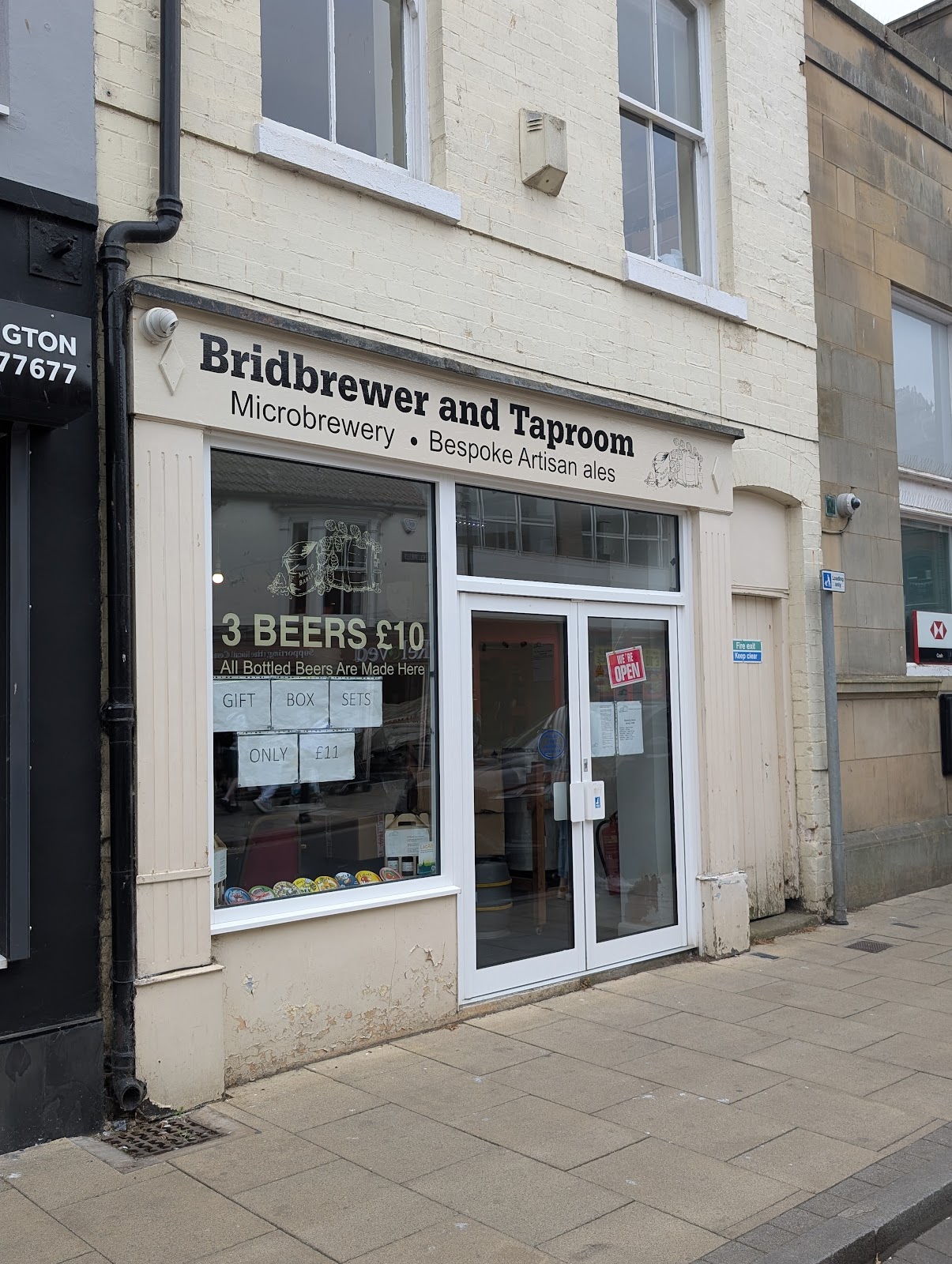
Before long, we were on our merry way again. Our next stop would be a location that hadn't been on the original agenda but that we'd noticed in passing. Retracing our steps slightly, we tried our luck at Bridbrewer & Taproom. 


Converted from a shop, this microbrewery and pub is sandwiched between King Street and Chapel Street, with entrances on both sides. Inside, the layout is simple. A 50L brewery kit can be found at one end of a single room. Tables and chairs occupy the wall space throughout, with a bar positioned at the opposite end. The bar itself is a low counter, with casks positioned behind and connected to handpulls on the bar front. All the beer served is brewed on site, and is dispensed through 4 handpulls. Upon entering, a regular gave a shout to the landlord/brewer on duty, who soon appeared and introduced us to his range. Our choices here were Savanna's Roasted Coffee, a spiced rum and coffee stout; Dougie & Daisy's Hop Along, a golden ale; Strawberry Milkshake Max, a milkshake pale; and King Street IPA, an IPA. Amy and I both opted for a half of the latter, at the cost of £3.80 for both (!). We were offered extra seating so that we could sit outside and were duly presented with a folding table and a couple of chairs, which the landlord was kind enough to set up for us. We sat outside, next to a table occupied by a couple and their lovely Labrador, Luna, who soon came over for a fuss (the dog, not the humans). This is a unique little place. There aren't as many brewpubs of this size around any more and it's a shame. You can't get more local than drinking in the same building where it was made! And what of the beer? At 4.8%, it's on the weaker side for an IPA but doesn't suffer any loss of flavour or body as a result. It's nicely balanced with a good bitterness that holds up well against the hoppier notes. In short, it's a great beer. Everything sold here is brewed on the premises and they do great deals in multipacks of bottles to take away, although we didn't partake on this occasion. The weather was growing warmer now. It had been mild all day but the temperature was starting to creep up, although the day remained overcast for now. Bidding goodbye to the last of our beers, and Luna and her parents, and avoiding the gaze of a particularly angry looking seagull, we ventured on.

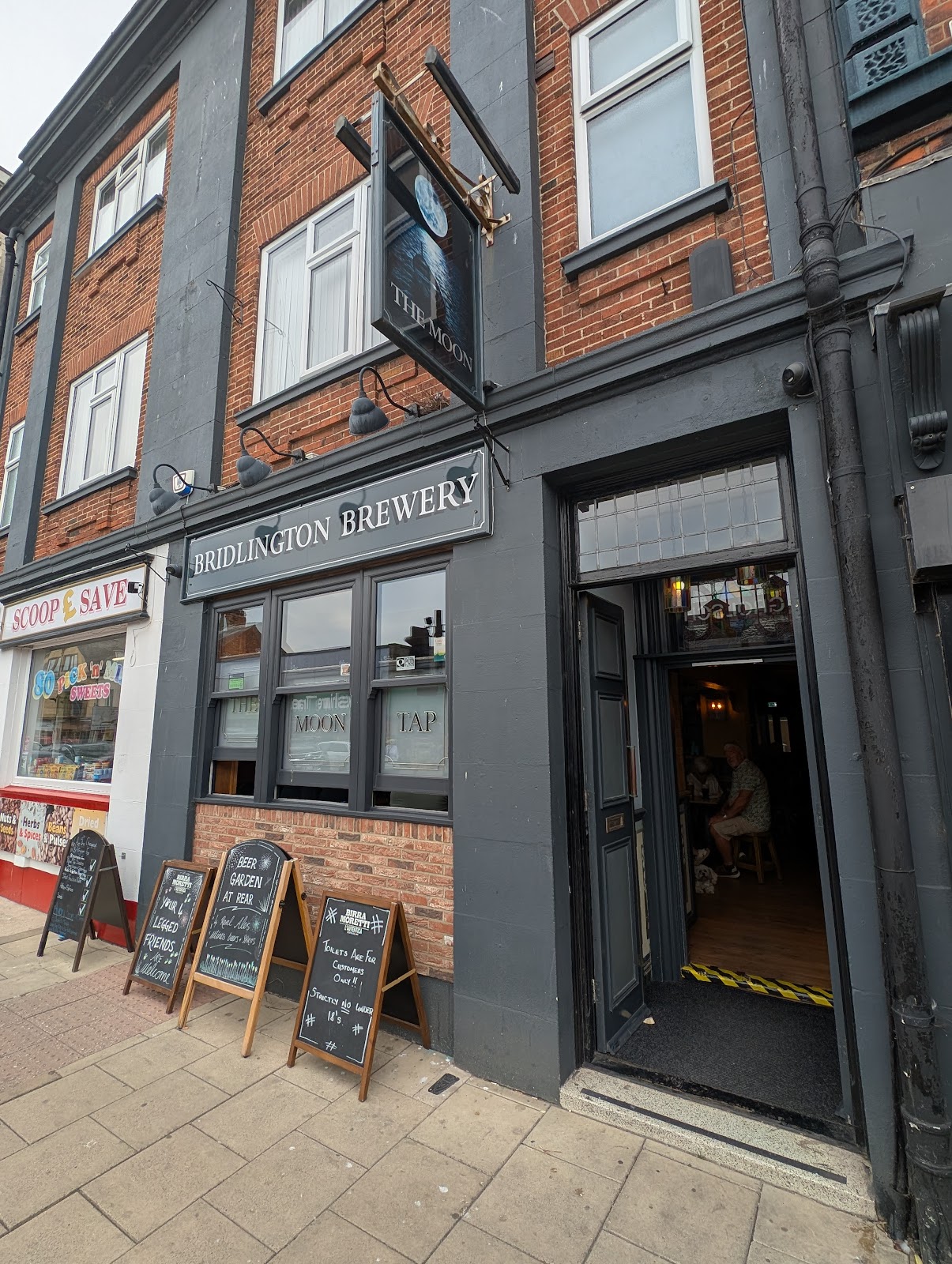
It was back to the scheduled itinerary now, following our brief diversion. We didn't have too far to go for our next stop. Continuing on, we made our way down Prospect Street, where the next pub soon appeared on our right. Next up, The Moon Tap.


Two brewpubs back to back wasn't our intention but that's how things played out. Newly refurbished, this is the tap for Bridlington Brewery, which can be viewed at the rear of the premises. Inside, the layout is one of several smaller areas, divided up by the creative use of internal partitions. The bar is located towards the back and over to one side, with lots of seating throughout. A door at the rear leads to a beer garden, accessible down a flight of steps. The aesthetic is one of bare floorboards, exposed brickwork, subtle lighting and lots of modern, contemporary touches. This was by far the busiest pub of the day so far. The pub was packed. Luckily, we were able to make our way to the bar easily enough. 5 handpulls are lined up on the back bar. One of these was given over to Lilley's Pina Colada cider, with the remaining 4 reserved for beer. Unsurprisingly, some of Bridlington Brewery's products were available, namely their Black Jack and Tutti Frutti. The remaining two pumps offered guest beer, in the form of Aitcheson's American IPA and Alnwick Alnwick Gold. I opted for a half of the Black Jack whilst Amy went for the same quantity of the Aitcheson's (total price £3.90) and we ventured outside in search of a table. We were lucky enough to locate one at which to enjoy our beers without being at risk of getting caught in direct sunlight. The atmosphere at The Moon was excellent. It was relaxed and jovial and everybody seemed to be having a rather good afternoon. We certainly enjoyed ourselves here. This was the best pub of the day so far, certainly enhanced by the quality of the beer. The Black Jack (4%) turned out to be a liquorice porter and it's an absolute belter. Equal parts roasted and sweet, it's very very drinkable indeed. The liquorice is subtle but rounds the whole thing out very nicely. I wasn't expecting a porter to be my favourite beer of the day so far but it had already been a day full of surprises. I couldn't help but think back to Three B's and our host's remark that the best pubs sometimes can't be found in the Good Beer Guide. The Moon isn't listed at the moment but the beer is so good that I doubt it's absence will continue for much longer. It does have the distinction of being voted Yorkshire Wolds Pub of the Year for 2025, so its excellence is clearly being noted. The surprises continued when somebody openly, and rather loudly, broke wind, reducing the other residents of the beer garden to fits of laughter. This was then amplified when a garage door nearby made a random rumbling noise which led to somebody else issuing a faux apology for the non-existent flatulence. It was all getting rather silly but in the best possible way. 

Reluctant as we were to leave the Moon, it was time to move on. Both our beers had been delicious. We were hoping the theme would continue as we journeyed to our next stop. We had a little bit more walking to do now. Our route would continue in the direction of the Old Town as we headed away from the hustle and bustle of the town centre proper and the associated seaside vibes. The sun had also well and truly emerged now and it was rather warm as we continued on. Making our way down Quay Road, almost retracing the route we'd driven into the town earlier that day, we realised that we recognised where we were. We were in the vicinity of Bridlington Town Hall, the location for the ceremony part of the wedding we had attended during our last visit to the town. A short distance from this landmark we would find our next stop, at The Telegraph. 


This Good Beer Guide 2025 pub is now a free house that was saved from closure and lovingly refurbished by the former owners. As the livery above indicates, this is a former Tetley's house that features a single roomed interior, divided up into three distinct sections. One area features a pool table and sports TVs. The main bar area features plentiful seating and there is a comfortable lounge area beyond. The bar is horseshoe-shaped and serves the two central areas. Outside is a very well appointed, walled beer garden, with a chimenea, covered smoking shelter, an abundance of comfortable furniture and lots of brewery related memorabilia on display. The bar itself features 4 handpulls. When we popped in, these were all offering beers from the paler end of the spectrum with our options as follows: Ossett White Rat, Rudgate Viking, Wensleydale Both Ends Burning and Bradfield Farmers Blonde. This was my first time encountering Wensleydale Brewery, so no prizes for guessing what I chose. Amy followed suit, with a half each costing us £3.60. The inside of the pub was pretty much standing room only so we retreated to the garden, where there was still plenty of room, and plonked ourselves down on a picnic bench. We took our time to take in the surroundings of what is a very nice beer garden, which included the obligatory topless man, now that the temperature had risen north of 20 degrees, albeit barely. The garden also houses a defibrillator, installed in tribute to a regular who died suddenly. At first glance you'd be forgiven for thinking that The Telegraph wouldn't necessarily be worth a visit but I can assure you that it is. For one thing, the beer is cracking. Both Ends Burning (4.6%) is a blonde ale, brewed with Harlequin and Cashmere hops. The end result produces flavours of lemon, lime and peach with an additional hint of marmalade. It's a perfect beer for a summer's day. Our afternoon had definitely perked up as the day had progressed. We were now halfway through our itinerary and eager to see what else we would encounter. 

The second half of our Bridlington adventure would see us immersed into the historic Old Town, which has many unique pubs, all with interesting tales to tell. Would their beer options be as interesting? We shall see. Leaving the Telegraph, we turned right and continued on. After a few minutes of walking, we arrived on St. John Street, whereupon we would find our next stop: the Old Ship Inn.


Good Beer Guide 2025 listed and Cask Marque accredited, the Old Ship is believed to have been built in 1860. Located on a main road, it occupies a prominent location on the edge of the Old Town and would serve as a good place to begin our exploration of the historic area. The internal layout consists of three rooms, with comfortable furnishings throughout. Photographs by Frank Sutcliffe, depicting Whitby in times gone by, are displayed throughout, alongside a whole host of quirky memorabilia. Brewery signs and adverts share space with jovial slogans and catchphrases. To the rear, there is a large, fully enclosed beer garden, with a designated, fully decked smoking area. The pub welcomes dogs but not children (the dream) and has built itself a sturdy reputation for its welcome and live music, as well as for its beer quality. We would be able to put one of these to the test at least. The bar is situated roughly in the middle of the three rooms and is L-shaped. A bank of 6 handpulls occupies one side and 5 of these happened to be in use during our visit. The choice here was an interesting variety of national and smaller brands, with our options being Three Brothers Emergency IPA, Butcombe Original, Theakston Quencher and two beers from Wilde Child, namely Clique Fiesta and Opulent Macrocosm. The latter of these took our eye and we went for half each (totalling £4.00). We were greeted, rather brusquely it must be said, by the landlord and, beers in hand, made our way out to the garden where we made sure to sit undercover so as to avoid the sun. The garden at the Old Ship is definitely a place where it seems almost mandatory to enjoy a good beer. And good beer is what we found! Leeds-based Wilde Child have made it a habit to give their beers preposterous, and often baffling, names but their beer is usually very good. Opulent Macrocosm (4.3%) is a case in point. Billed as a New Zealand session IPA, it's hopped with Motueka and Wakatu hops, which impart flavours of gooseberry as well as a light fruitiness. A mixed grain bill of both oats and wheat ensure a mouthfeel above what you'd expect from a beer of such a low ABV. It's certainly a punchy, fruity number and it was in great condition here. 

We were doing our best to take our time around Bridlington, particularly as we had now reached the Old Town, the more picturesque and historic side of the town. This area is a mishmash of medieval streets and later Georgian houses, adding a feeling of quaint opulence that is much at odds with the impression conveyed by the newer areas down by the seafront. We were looking forward to seeing whether the history and age of this part of town would be reflected in the remainder of the premises that we were planning to visit, and also what traces of this history had survived into the present day. Leaving the Old Ship, we immediately turned right and continued, slightly uphill, to the junction of Kirkgate and Baylegate. Our next destination was on the right hand side, adjacent to the Bayle Museum and Priory Gate. We would now be visiting the Bull & Sun.


Confession time. I suspected that the Bull & Sun would likely not serve real ale. WhatPub and other enquiries suggested as much. However, I live in hope of being proven wrong in situations like this. The Bull & Sun is a family run pub and restaurant, although it began life as a private house, dating back to the 1800s. The brick exterior gives way to two rooms situated around a J shaped bar in the centre. To the right, the bar area is furnished traditionally with added quirky touches and old photos. To the left is another, slightly larger area, used as the restaurant with tables set for dining. The overall feel is of an old school, traditional pub but with some more modern trappings. Upon entering, for one brief moment, my heart leapt with joy at the sight of a duo of handpulls. However, any faint hope I may have had that they would be providing delicious cask beer was swiftly dashed. Neither handpull was in use. Perusing the bar for alternatives didn't leave me with much. Normally in this situation, my go to alternative would be Guinness. Unluckily for me, the pub don't appear to sell that either, unless I just missed it. That left me with one option and that option would be John Smith's. I went for a pint, although I don't really know why. Amy, for her part, swapped to a soft drink and ordered a pint of Diet Coke. After parting with £6.60, which still isn't unreasonable, we decided to give the beer garden a go. It's a decent enough garden, accessed down some steps at the rear of the pub. It's a good size, with some tables, a little bit of cover, trees either side and a play area for children. We discussed our misfortune at the lack of decent beer, although the John Smith's, in and of itself, was at least passable. There had been another reason for coming here though. The Bull & Sun is allegedly haunted. Numerous incidents of strange activity have been reported down the years. The most prominent story linked to the site is that of a ghostly young girl, believed to be from the Victorian era, who is alleged to slide down a banister on the second floor. She is alleged to have died on the site and the banister in question is always suspiciously shiny, despite not being cleaned particularly frequently (which raises different questions about the place). Perhaps the unfortunate child is a member of the family that once lived here and are buried in the nearby churchyard. Other reports include sightings of a white silhouette, a male apparition seen in the corners of certain rooms, clothing being tugged, the sounds of children whispering, and objects being thrown by unseen hands or seen to mysteriously levitate. Whether all, or any of this phenomena, are linked is unclear, although at least one local ghost hunting group has investigated in person, with varying results.

Back in the mortal realm and our time at the Bull & Sun had come to an end. Leaving the pub, we turned left and continued on, where we crossed the road. We now entered High Street, the central artery of the Old Town proper, and the remaining trio of pubs can be found here or hereabouts. We would soon find that this part of Bridlington is worth a visit, not just for the pubs, but for the general ambience conveyed by its setting. The Georgian houses and surviving medieval features seem a world away from the arcades, ice cream vans and chip shops of the harbour area. A short walk further down this road would take us to our next destination, somewhere that we'd been recommended earlier as a good place for both beer and food. Next up, The Board Inn.


This Grade II listed pub has been recognised for its heritage interior. It's a haven of dark wood and is spread across several levels, all decorated in a similar style. Exposed wood and bare walls are the order of the day, with photos of the town, and portraits of several individuals, found throughout. The bar is on the ground floor, with traditional wooden furniture situated opposite. The entrance is to one side of the central room. Next to the bar, a staircase leads up to further rooms beyond, with an open fireplace in the first. Subsequent floors are variations on the theme, and there has been considerable effort to maintain the aesthetic throughout. Approaching the bar when we entered, we were immediately greeted by the landlord, who took our order and advised us to explore all of the floors. His reasons for doing so will be become abundantly clear. But first, the beer! The bar at the Board has plenty of the stuff. 7 handpulls are in situ. Two of these offer cider, on this occasion those being Ty Gwyn Medium Perry and Ty Gwyn Festival Ferret. The remaining 5 hand pumps all offer beer, in a good range of styles. For our delectation and enjoyment, we had a choice between Rudgate Viking, Brains Rev James and a trio from North Riding, specifically, Toasted Marshmallow Stout, Mosaic, and Citra. I went for half of the Mosaic, Amy went for a Diet Coke (£3.50 in total) and we followed our host's instructions. We were very glad that we did. The Board Inn has very much leaned into its spooky feel. The upstairs rooms have been decorated like a haunted house. One room is laid out like a seance room, with a central round table surrounded by multiple, red leather chairs. Another, on the top floor, has one long table under the eaves, with wall mounted candles and no other furniture. Its neighbour is done up like a Victorian bedchamber and comes complete with a jump scare, namely a red wigged mannequin peeking out from under the covers. To say it made us jump when we saw it doesn't quite cover it. Taxidermy birds and animal heads can be found in every room. You might be wondering why the pub has gone out of its way to decorate like this. In a nutshell, it's embracing its darker side. Strange tales are told of this place. As recently as last year, two ladies, visiting the pub for the first time, filmed a short video as they toured the rooms. Upon playing the footage back, they were understandably shaken to hear what sounded like the grumbling voice of a disgruntled old man. The same room in which the sounds were captured is also the location where the ghost of a little girl has been seen on multiple occasions. The room in question was primarily used for storage but was dressed up for Halloween last year for the first time. Previous attempts to use it for normal seating have failed due to uncomfortable feelings and cold spots felt by customers. Has the unusual decor enhanced any activity? Who knows? What is for certain is that the ownership have done a superb job at creating a atmosphere like no other. Following our fearful encounter, we returned downstairs and gave our beers a go. The Mosaic (4.3%) turned out to be a delicious pale ale showcasing that specific hop. This means blueberry and citrus flavours and a great big juice punch. It was very very tasty! Speaking of tasty, we were ready for some food by this stage. Luckily, The Board Inn happens to be well known for that as well. Specifically, they offer meat and cheese platters by way of sustenance. That sounded right up our street and, a short while later, another member of staff came to take our order. A few minutes later, our platter arrived. There's no way to describe it without using superlatives. It was enormous! Neither of us were expecting the sheer quantity of cheese, meats, crackers, and associated accoutrements that was placed before us. The quality was equally astounding. It was absolutely delicious. We were fully expecting to pay a hefty whack for a portion of food that size but, in the end it came to............£9.95. That's less than a tenner for enough cheese and meat to have started our own farmers market. Worth every penny. The Board Inn had been an excellent choice. No wonder it was recommended to us!

Suitably full of cheese and assorted meats, we pressed on. Our penultimate stop is only a few doors down and just over the road. Next on the list is another nicely atmospheric pub, The Black Lion. 


The Grade II listed Black Lion dates from the 18th century. Located at the junction of Market Street and High Street, it became the town Corn Exchange when the area became the centre of the local corn trade in the 1870s. Its other former guises include as an inland revenue office, and a posting house, which was a location that offered services for travellers, including accommodation and changes of horse. The building once had stabling for 40 horses, primarily to aid with this later purpose. In the late 19th-early 20th century, the rear of the building was converted to a music hall. Features from this usage are still present, with stepped seating and pews leading down to a performance area with a small stage. In 2014, the pub was temporarily redressed and used as the Royal Oak in the film adaptation of Dad's Army. This pub turned out to be another location which would leave us pleasantly surprised. The entrance leads directly through to the bar, which curves around to one side. The top level of the pub is occupied by traditional seating, together with leather high back chairs, surrounded by exposed brickwork, bare floorboards, and sash windows with velvet curtains. An original open fireplace is still extant and there are wall mounted TVs. Beyond this, the aforementioned music hall layout dominates, with regal portraits, theatre style curtains and union flags throughout. The rear section benefits from a high ceiling. As well as the numerous rows of pews between the bar and stage, there are a small number of more traditional tables on the lower level too. Conveniently, the bar has real ale. 6 handpulls are present here, with 2 being in use at the time of our visit. The options were Aitcheson's Kiwi IPA and Wold Top Angler's Reward. With Amy's previous experience of Aitcheson's being a good one, we both opted for a half of the Kiwi IPA (£3.80 in total) and chose to make our way down to the bottom section to better inspect the old music hall. This really is an interesting place. There's a strange, almost ethereal vibe to the Black Lion. The contrast between traditional pub and turn of the last century music hall is a stark one but one that still manages to blend quite well. It's easy to imagine the throngs of people that would have come in for a show a hundred or more years ago. It's completely understandable that the pub would keep it looking the same. That's not the only historic feature that remains, if you believe the stories. The Black Lion is another pub with its fair share of strange happenings. Figures have been seen sitting in the old pews when nobody is known to be in the area. Strange feelings have been reported in the same area. In the cellar, which still retains lots of original features, uneasy feelings and strange sounds have been witnessed. A lesser known story connects the pub with the spirit of an alleged Jack the Ripper suspect, who is claimed to have died on the premises after being injured at sea. Whether this unknown suspect is responsible for the other manifestations is not known at this time. What is known however, is that the Black Lion do a decent job of looking after their beer. As you'd expect from a such named beer, the Kiwi IPA (5%) is packed full of Nectaron hops, leading to a big citrus hit and flavours of grapefruit and orange. What better way to enjoy yourself than with a fruity beer, bathed in the light of decorative dragonfly lampshades, under the ceiling of an old music hall? I can't think of many.

Putting the Black Lion behind us, figuratively and literally, we turned our attention to the last pub of the day. Situated just around the corner, on Market Place, was a location that I had high hopes for. The final Good Beer Guide 2025 listing of the day, and our last stop of the evening, was the Pack Horse.


Originating from the 17th century, the Pack Horse has been restored to well beyond its former glory. An original set of stocks remain on the street outside and there is a restored brewery dray in the yard. Inside, a central bar is surrounded by three separate areas, all with a mix of seating. There is an extensive courtyard to the rear, featuring picnic benches, and a pizza kitchen, housed in the old stables. Entrance to the Pack Horse is under the archway to the left, where the main entrance door can be found. The pub was bustling and very busy when we arrived, a quirk of it being Friday evening and the weather being excellent. Inside, the well stocked bar beamed in front of us, its 5 hand pumps standing proud. How would we end our day? Bridlington Brewery was formerly based here so its beers often feature, alongside guests. On the day in question, we found ourselves with the following choices: Bridlington Brewery Tutti Frutti, Milestone Sherwood, Bridlington Hazelnut Porter, Little Critters Chameleon and Timothy Taylor Knowle Spring. Having thoroughly enjoyed my last encounter with Bridlington Brewery earlier in the day, I opted for the Tutti Frutti whilst Amy chose the Chameleon from Sheffield-based Little Critters. The combined price for a half of each was £3.50. Beers successfully acquired, we headed outside where we were fortunate enough to find a spare picnic table on which to sequester ourselves. I was already thoroughly enjoying the Pack Horse. The atmosphere was superb. Both inside and outside were very busy but not overly loud and everybody seemed to be having a whale of a time. The soundtrack wasn't bad either. It seemed to consist primarily of 80s and 90s one hit wonders, as it segued between 'What's Goin' On?' by 4 Non-Blondes, Cutting Crew's 'I Died in Your Arms Tonight' and then onto 'Mmm Mmm Mmm Mmm', the 1994 smash hit by Canadian rock band Crash Test Dummies. Amy didn't recognise the song but I apparently know much more about it than I should when you consider that I was 7 years old when it came out. I also seem to know some of the words. I can tell you it peaked at number two in the UK chart, kept from the top spot by Prince (then going by a symbol) with 'The Most Beautiful Girl in the World'. But you didn't come here for a music history lesson. Back to the beer. Tutti Frutti (4%) is a pale ale that does pretty much what it says on the pump clip, and very effectively too. It's fruity and citrusy with a dry finish and a refreshing mouthfeel. It's definitely very drinkable and went down a treat! As did this pub. The Pack Horse was a perfect place to end our excursion around Bridlington's drinking establishments. The temptation to stay for longer after the last drop was strong but we were hot and tired so a retreat to the B&B seemed like a much more sensible option. 

During our half an hour stroll back to our digs, and the ensuring hours back at the B&B watching Glastonbury coverage, I mulled over the success of our day and my overall thoughts regarding Bridlington as a whole. In general, I think I'm impressed. On paper, Bridlington is the kind of place you associate with sticks of rock, sandcastles, and overpriced ice creams, without giving a thought to what its pubs might be like. There's certainly something for everyone. The traditional seaside town boozers are here. The micropubs and brewpubs sit nicely amongst the souvenir shops and takeaways. The historic old town pubs are going strong. If I had to summarise, I feel that Bridlington's drinking scene can be split into two halves. The Old Town certainly has the best pubs. The history and tradition go hand in hand and it's a lovely part of the town to enjoy over a beer or two of an evening. The 'newer' side of town is better suited to its micropubs and less traditional places and it certainly has plenty of both. As much as I appreciate a good micro and how they've rejuvenated and reimagined what a pub can and should be, traditional pubs will always have my heart. In a town like Bridlington, where the glare of the funfair and the clatter of the arcades is front and centre, it's important to appreciate the places that sometimes go under appreciated. If you're after a warm welcome, delicious beer and, frankly, some ridiculously reasonable prices, you're in luck. If you go to Bridlington for nothing else, go for the pubs.


Next time: We travel to Whitby, where many excellent pubs, historic ruins and literary icons await!


Pub of the day: The Board Inn. Excellent beer, enormous cheeseboards, terrifying mannequin

Honourable mention: The Pack Horse. Cracking pub with an excellent garden

Biggest surprise: The Black Lion. Didn't expect to find a Victorian music hall at the back of a pub

Beer of the day: Bridlington Brewery, Black Jack. A bloody great porter, even on a summer's day