Friday, May 6, 2016

Brave New World

It's been almost 3 years since Newark last made appearance in this blog, following a trip to the Newark Beer Festival on May Bank Holiday weekend. After all that time, I'd been hearing that Newark has since become something of a real ale haven so I could think of no better reason to head out there on my day off to give it a thorough going over.

Newark-on-Trent or Newark  is a market town in Nottinghamshire. It stands on the River Trent, the A1 (on the route of the ancient Great North Road), and the East Coast Main Line railway. The origins of the town are possibly Roman as it lies on an important Roman road, the Fosse Way. The town grew around Newark Castle, now ruined, and a large marketplace, now lined with historic buildings, and was a centre for the wool and cloth trade. In the English Civil War, it was besieged by Parliamentary forces and had to be relieved by Prince Rupert in a battle known as the Relief of Newark.
The estimated population in 2007 was 26,330, increasing to 27,700 at the 2011 census.

The origins of the town are possibly Roman due to its position on an important Roman road, the Fosse Way. In a document which purports to be a charter of 664, Newark is mentioned as having been granted to the Abbey of Peterborough by Wulfhere. An Anglo-Saxon pagan cemetery, used from the early 5th to the early 7th centuries, has been found in Millgate, in Newark, close to both the Fosse Way and the River Trent in which cremated remains were buried in pottery urns.
In the reign of Edward the Confessor Newark belonged to Godiva and her husband Leofric, Earl of Mercia, who granted it to the monastery of Stow in 1055, who retained its incomes even after the Norman Conquest when it came under the control of the Norman Bishop Remigius de Fécamp. After his death it changed to, and remained in the hands of, the Bishops of Lincoln from 1092 until the reign of Edward VI. There were burgesses in Newark at the time of the Domesday survey, and in the reign of Edward III, there is evidence that it had long been a borough by prescription. The Newark wapentake in the east of Nottinghamshire was established during the period of Anglo-Saxon rule (10th to 11th centuries AD).
Newark Castle "was originally a Saxon fortified manor house, founded by King Edward the Elder. In 1073, Robert Bloet, bishop of Lincoln founded an earthwork motte and bailey fortress on the site. From 1123–33, Bishop Alexander the Magnificent completely rebuilt the castle, when founding a prominent stone structure of ornate construction." The river bridge was built about the same time under charter from Henry I, also St. Leonard's Hospital. He also gained from the king a charter to hold a five-day fair at the castle each year. He gained a charter under King Stephen to establish a mint in the town.
The town became a local centre for the wool and cloth trade, certainly by the time of Henry II a major market was established. Wednesday and Saturday markets in the town were established during the period 1156–1329 when a series of charters granted to the Bishop of Lincoln made them possible. King John died of dysentery in Newark in 1216. Following his death as Henry III tried to bring order to the country the mercenary Robert de Gaugy refused to yield Newark Castle to the Bishop of Lincoln, its rightful owner, leading to the Dauphin of France (later King Louis VIII of France) laying an eight-day siege on behalf of the king, ended by an agreement to pay the mercenary to leave. Around the time of Edward III's death, and excluding beggars and clergy, in "1377 – Poll tax records show adult population of 1,178 making Newark one of the biggest 25 or so towns in England".
In 1457 a flood swept away the bridge over the Trent and, although there was no legal requirement for anyone to replace it, the Bishop of Lincoln, John Chaworth, financed the building of a new bridge, built of oak with stone defensive towers at either end.
Following the break with Rome in the 16th century, the subsequent establishment of the independent Church of England, and the Dissolution of the Monasteries, Henry VIII had the Vicar of Newark, Henry Lytherland executed when he refused to acknowledge the king as head of the Church. The dissolution affected Newark's political landscape heavily, and even more radical changes came in 1547 when the Bishop of Lincoln exchanged ownership of the town with the Crown. Newark was incorporated under an alderman and twelve assistants in 1549, and the charter was confirmed and extended by Elizabeth I.
Charles I, owing to the increasing commercial prosperity of the town, reincorporated it under a mayor and aldermen, and this charter, except for a temporary surrender under James II, continued to be the governing charter of the corporation until the Municipal Corporations Act 1835.

During the English Civil War, Newark was a mainstay of the royalist cause, Charles I having raised his standard in nearby Nottingham. It was attacked in February 1643 by two troops of horsemen, but beat them back. The town fielded at times as many as 600 soldiers, and raided Nottingham, Grantham, Northampton, Gainsborough, and others with mixed success, but enough to cause it to rise to national notice. At the end of 1644 it was besieged by forces from Nottingham, Lincoln and Derby, the siege was only relieved in March by Prince Rupert.
Parliament commenced a new siege towards the end of January 1645 following more raiding, but this was relieved by Sir Marmaduke Langdale after about a month. Newark cavalry fought with the king's forces which were decisively defeated in the Battle of Naseby, near Leicester in June 1645.
The final siege began in November 1645, by which time the town's defences had been greatly strengthened. Two major forts had been constructed just outside the town, one, called the Queen's Sconce, to the south-west and another, the King's Sconce to the north-east, both close to the river, together with defensive walls and a water filled ditch 2¼ miles in length, around the town. In May 1646 the town was ordered to surrender by Charles I, which was still only accepted under protest by the town's garrison. After the surrender most of the defences were destroyed, including the castle which was left in essentially the state it can be seen today.
Around 1770 the Great North Road around Newark (now the A1) was raised on a long series of arches to ensure it remained clear of the regular floods it experienced. A special Act of Parliament in 1773 allowed the creation of a town hall next to the Market Place. Designed by John Carr of York and completed in 1776, Newark Town Hall is now a Grade I listed building. In 1775 the Duke of Newcastle, at the time the Lord of the Manor and a major landowner of the area, built a new brick bridge with stone facing to replace the dilapidated one next to the castle. This is still one of the major thoroughfares in the town today.
A noted advocate of reform in the late 18th century at Newark was the local-born printer and newspaper owner Daniel Holt (1766–1799). He was imprisoned for printing a leaflet advocating parliamentary reform and selling a Thomas Paine pamphlet.
In the milieu of parliamentary reform the duke of Newcastle evicted over a hundred tenants at Newark whom he believed supported directly or indirectly the Liberal/Radical candidate (Wilde) rather than his candidate (Michael Sadler, a progressive Conservative)at the 1829 elections. See the report in Cornelius BROWN 1907, ii, 243 following; and the report in the Times for 7 October 1829. A report in the Times of 10 September 1832 lists ten of the evicted people by name and address.
J.S. Baxter, who was a schoolboy in Newark from 1830 to 1840, contributed to The hungry forties: life under the bread tax (London, 1904), a book about the Corn Laws: "Chartists and rioters came from Nottingham into Newark, parading the streets with penny loaves dripped in blood carried on pikes, crying 'Bread or blood.'"

During the Victorian era a lot of new buildings and industry were established, such as Independent Chapel (1822), Holy Trinity (1836–37), Christ Church (1837), Castle Railway Station (1846), Wesleyan Chapel (1846), the Corn Exchange (1848), Methodist New Connexion Chapel (1848), W.N. Nicholson Trent Ironworks (1840s), Northgate Railway Station (1851), North End Wesleyan Chapel (1868), St. Leonard's Anglican Church (1873), Baptist Chapel (1876), Primitive Methodist Chapel (1878), Newark Hospital (1881), Ossington Coffee Palace (1882), Gilstrap Free Library (1883), Market Hall (1884), Unitarian Chapel (1884), the Fire Station (1889), Waterworks (1898) and the School of Science and Art (1900). These changes and the other industrial expansion that went with them saw the population of the town grow from under 7,000 in 1800 to over 15,000 by the end of the century.
During the Second World War there were a number of RAF stations within a few miles of Newark, from many of which operated squadrons of the Polish Air Force. A special plot was set aside in Newark Cemetery for RAF burials and this is now the war graves plot, where all but ten of the ninety Commonwealth and all of the 397 Polish burials were made. The cemetery also contains 49 scattered burials from the First World War. A memorial cross to the Polish airmen buried here was erected in the plot and was unveiled in 1941 by President Raczkiewicz, ex-President of the Polish Republic and head of the wartime Polish Government in London, supported by General Sikorski, head of the Polish Armed Forces and wartime Polish Prime Minister. When both men subsequently died, General Sikorski in 1943 and President Raczkiewicz in 1947, they were buried at the foot of the memorial. General Sikorski's remains were returned to Poland in 1993, but there is still a memorial to him at Newark.
The clothing, bearings, pumps, agricultural machinery, pine furniture making and sugar refining were the main industries in Newark in the last 100 years or so. British Sugar still has one of its sugar beet processing factories to the north of the town near the A616 (Great North Road). There have been several factory closures, especially since the 1950s. Breweries in the town in the 20th century included James Hole and Warwicks-and-Richardsons.
Estimated population (mid-2007, via NSDC Stats & Info) is 26,330 for the Newark Parish. Newark is 93 per cent white British, according to the 2011 census. It is also prosperous: 77 per cent of people are employed, according to the latest ONS data, compared with the national average of 72 per cent, and earnings are 7 per cent above those in the surrounding East Midlands.

Newark's history makes it a great place to visit and I was very keen to see what it had to offer the seasoned ale drinker. It was a beautiful Wednesday when I got the train from Nottingham and arrived in Newark roughly half an hour later. I'd visited the town a couple of times before so knew my way around the periphery of the train station and market place area. Upon leaving Newark Castle station, I knew that my first stop wasn't far away. I crossed the bridge over the River Trent and immediately spotted it, moored on the river itself, the Castle Barge.


Originally a Spillers grain barge plying its trade from Hull to Gainsborough, it was converted into a pub in 1980 and is now moored in the shadow of Newark's famous ruined castle where it is a mainstay of the local pub scene. The outside area includes an outdoor drinking area with a gangplank that allows access to the barge itself. The upper floor is a seating area with the bar down a flight of stairs. As well as the bar, the lower deck still contains many original features from its previous life including the ship's wheel. The bar is tucked into a corner of the long narrow room and this features 4 handpulls, 3 of which are in use during my visit. My first beer choice of the day is between Milestone American Pale Ale, Milestone Hop & Glory and Full Mash Planchette Porter. I opted for the Hop & Glory (4.2%), a delicious light golden ale brewed with New World hops. It's crisp, delicious and an excellent start to the day. I took a seat on a low bench next to the bar and perused the surroundings, which also features a lot of old brewery memorabilia. The soundtrack also caught my attention here as I was treated to Dire Straits 'Sultans of Swing' followed by Eagles 'Hotel California'. Not a bad start at all!

I was determined to do my best to make the most of the spring weather and so I decided to head on to my next destination. Originally, I had intended to make the Royal Oak my next stop however, upon entering, the not-unfriendly Northern Irish landlord informed me that he no longer sold real ale. He was nice enough to direct me to the pub next door, where he said that they usually had 'about 7 on'. That was how I ended up at The Ram.


Standing on the site once occupied by a 15th century coaching inn, the building that is now The Ram is a Georgian structure dating to the 18th century. The premises stood empty for many years but has recently been refurbished and rejuvenated, retaining the Georgian elegance with a bespoke and upmarket twist to the interior. The hard work has clearly paid off as pub is very nice indeed. Original Georgian features have been given a modern update in lots of elegant leather furniture, a long well-stocked bar and a large outside area kitted out with round picnic tables. The landlord at the Royal Oak is certainly no liar as I was greeted by 8 handpulls. 2 of these featured real ciders in the form of Thatcher's Big Apple and Barnstormer Pickled Pig. The ale choice is good and I'm left to decide between Flipside Random Toss, Flipside Flipping Best, London Pride, Newark Phoenix, Newark Winter Gold and Cathedral Heights Churchill's Pride Bitter. Unfamiliar with Newark Brewery, I decided on a pint of the Phoenix (4.8%). This is an amber/russet coloured beer with mountains of hops that lift up a deep malt sweetness without being overly bitter. I went and sat outside to enjoy this beer, basking in the warm spring sunshine on what was a lovely day. Summer is definitely in the air and I'm very much looking forward to more time spent in beer gardens with a pint or 6.

My next destination wasn't too much further away and I was excited to get there as it was one of the pubs that I'd highlighted as a must visit whilst I was in the area. Situated down a side street and tucked between some shops, is the Prince Rupert.


Named after the reliever of the siege of Newark, the Prince Rupert was originally built in 1452 and still stands strong on its original timber frame following an 18 month renovation by KNEAD Pubs, who now operate the property. The results of this excellent restoration are impressive, with an internal conservatory, half a dozen dining areas, separated by partition walls, a terraced beer garden, a beautifully decked out bar and a hidden venue upstairs that can be hired out. The aforementioned bar is well stocked for ale drinkers too, as it includes 6 handpulls offering a wide variety: Brain's Reverend James, North Yorkshire Flying Herbert, Cathedral Gold, Oakham JHB, Oldershaw Grantham Dark and Bridestone's Whirley Gig. I went for a pint of Flying Herbert (4.7%), a traditional bitter with a slight toffee aroma and roast malt taste but balanced with fruity berries and hops to balance the strong fruitiness. I found a table in the conservatory at which to enjoy this tasty pint, which was recommended by a very helpful and knowledgeable barman. The atmosphere and feel of the pub is fantastic and it's worth every penny that has no doubt been spent on it. Well done to all those at the Prince Rupert for keeping an important part of Newark's heritage alive and kicking!

It was back out onto the main road now and my next destination was just a little bit further along and one of the few pubs in Newark that I've visited in the past. Yet another pub to benefit substantially from a refurbishment, I had arrived at the Flying Circus.


Reopened in 2014, the Flying Circus has risen from the ashes of the building's previous incarnation as the Crown & Mitre. This is the only pub I've ever seen that is Monty Python themed (hence the name) and the walls are adorned with Python quotes and memorabilia, including a fake stuffed Norwegian Blue parrot. The pub has a strong local reputation for craft beer, including Brewdog, and the bar features 8 handpulls, 4 of which are in use when I'm there. Amongst the 4 are some interesting choices namely Falstaff DNA, Twickenham Grandstand, Abstract Casual and Great Newsome Hops in Spring. I wasn't over familiar with any of these beers so it was very much pot luck. DNA eventually won me over and it proved a good choice. At 4.2% and brewed by Falstaff of Derby, this is a pale amber beer with fruity herbal aromas, rich fruit and hop flavours and a long, well-hopped aftertaste. Pulling up a stool at one of the nearby high tables, I was having a very good day so far and I was excited for it to continue. The music at this pub was decent too as I finally got to hear the new Radiohead single and I can confirm that it's very good indeed!

Speaking of very good indeed, I knew what to expect from my next stop and I was aware that it would be excellent. Opposite the Flying Circus, down a pathway, lies the local micropub, simply known as Just Beer.


Concentrating on real ale, ciders and perries, Just Beer opened in 2010 and prides itself on serving interesting ales from local breweries and breweries all over the world. Awarded CAMRA Newark Pub of the Year in 2012, 2013, 2014 and 2016, it reached the milestone of 3000 beers from 1000 different breweries in February this year. This is a small, uncomplicated pub situated in an old warehouse near the river. They offer good conversation, traditional pub games and 3 annual beer festivals! On the small bar in the back corner of the room are 8 handpulls, 7 of which were in use offering a great variety: Milestone Southern Cross, Driftwood Spars Forest Blond, 4Ts English Stout, Bradford Alphin's Black IPA and 3 real ciders (Lilley's Apples and Pears, Lilley's Lemon and Lime, Thatcher's Cheddar Valley). I'm always intrigued by black IPAs so it didn't take me long to decide which beer I wanted. At 5.6%, Alphin's Black IPA packs a hell of a punch, with complex malts and heady aromas combining to produce a big, hoppy finish. The name comes from that of the head brewer's son. Whilst I can't pretend to understand what a black IPA is or how it works, I can easily see why the style has such an appeal. There are big flavours here. Not for the faint hearted!

Leaving this wonderful place seemed a shame but there were other treats in store and my next location gave me a rare opportunity to complete the itinerary of every one of a specific company's pubs. The company in question is Blue Monkey and I completed the set with my visit to Newark's own Organ Grinder.


Previously known as the Horse & Gears, this pub was reopened by Blue Monkey in 2014 as another addition to its portfolio. This is very much a no-nonsense beer drinking pub, which is fine with me, and I'm a big fan of Blue Monkey beers as I'm sure I've mentioned in previous entries. Of the 7 handpulls, 5 were in use and, as expected, they all featured Blue Monkey beers, namely Mild Monkey, Guerrilla, Bonobo, Right Turn Clyde and Infinity. I went for the Right Turn Clyde which was, as always, in excellent condition. These are the kinds of pubs that I will come to again and again. There isn't really any reason not too!

I did get slightly lost upon leaving the Organ Grinder but, after half an hour of catching my bearings, I was back on the right track and on my way to my next stop which, to my surprise, turned out to be a Castle Rock pub. I was happy to have found the Fox and Crown.


Standing on the site of what was originally two shops, the Fox and Crown is Castle Rock's resurrection of the previously closed down Fox & Crown. Now open for 16 years, the pub offers great beer and great service in a friendly and comfortable environment. The bar is located in the left hand corner of the main room and boasts 10 handpulls, 8 of which were in use. Amongst the Castle Rock offerings of Midnight Owl, Harvest Pale and Elsie Mo, were a number of guests, specifically Abbeydale Double Brimstone, Sunny Republic Dune Raider, Oldershaw Ascalon, Abstract Casual and Lincoln Green Archer. I was won over by the Dune Raider (5%), a bitter sweet paradox of sweet malts and punchy American hops. This beer is certainly a mixture of styles being part Vienna amber lager, part English brown and part American brown ale. It's an interesting mix but it definitely works!

I had time for one more pub before it was time to get the train home so it was an opportunity for the somewhat obligatory trip to a local Wetherspoons, this one being the Sir John Arderne.


Named after the first 'true English surgeon' who lived in Newark during 1349-1370, this is an imposing looking building. Arderne himself became particularly adept at treating haemorrhoids, a condition commonly affecting Medieval knights due to long hours spent on horseback in heavy armour. He had achieved the status of 'master surgeon' by the end of his life. The bar is situated at the back of the room and there is ample seating throughout as well as the standard issue upstairs toilets. 10 handpulls reside on the bar, during my visit featuring, Abbot Ale (x2), Ruddles (x2), London Pride, Doom Bar, Old Rosie cider, Nottingham Old Special, Brakspear Oxford Gold and Milestone IPA. For my last beer of the day, I went for a pint of the Old Special, accompanied by a burger as I decided it was finally time to eat. The beer was very nice indeed, smooth and well balanced with a dry finish. It complimented the burger very well and both went down very easily indeed.

I was tired and full now and the day was drawing to a close. All that was needed was to make my way to the nearby train station for the journey. This turned out to be more easily said than done as my train was subject to unspecified delay which meant that it was nearly half an hour late arriving. Still, I made it home eventually happy that it was a job well done for the day. Newark did not disappoint. My suspicions about its real ale credentials were well founded as there wasn't a single pub on my trip that let me down. I cannot recommend a visit here enough, especially given all of the pubs that I did not get time to visit. Newark looks set to be a place to watch, where the real ale revival is very much in full swing. A place where much now exists from where little stood before. Things in this town are moving in a wonderful direction.
 

Wednesday, April 20, 2016

Village Pride

I've always had a soft spot for village pubs, not just for their appearance and their atmosphere but their immense sense of community values and their emphasis on looking after their own and benefiting the people they serve. To that end, last week, I decided to more closely investigate two villages that are very close to where I live. Considering the beautiful spring weather that I had been granted on this particular day off, I honestly didn't think I could have picked a better day to explore the neighbouring villages of Gotham and East Leake.
The easiest way to reach my intended destination was by bus, which I can conveniently catch from a bus stop a few minutes work from home. After a few minutes wait and a few confusing moments over the fare, I was on my way to the first stop, in the closer village of Gotham, whose name may ring bells with some of you.

Gotham is a village in Nottinghamshire, England, with a population of about 1,600, measured at 1,563 in the 2011 census. It is in the borough of Rushcliffe, and has a parish council.
The name Gotham comes from the Old English for "goat home". The village has a 12th-century church dedicated to the Roman martyr Saint Lawrence.
The village is most famed for the stories of the "Wise Men of Gotham". These depict the people of the village as being stupid. However, the reason for the behaviour is believed to be that the villagers wished to feign madness in order to avoid a Royal Highway being built through the village, as they would then be expected to build and maintain this route. Madness was believed at the time to be highly contagious, and when King John's knights saw the villagers behaving as if insane, the knights swiftly withdrew and the King's road was re-routed to avoid the village.
One of the mad deeds seen by the knights was a group of villagers fencing off a small tree in order to keep a cuckoo captive from the Sheriff of Nottingham. One of the three pubs in the village is known as the "Cuckoo Bush Inn". They were also observed attempting to fish a reflection of the moon from the bottom of a pond, painting green apples red and trying to drown eels.
Reminded of the foolish ingenuity of Gotham's residents, Washington Irving gave the name "Gotham" to New York City in his Salmagundi Papers (1807). In turn, Bill Finger named the pastiche New York home of Batman, Gotham City. The existence of Gotham, Nottinghamshire in the DC Universe was recently acknowledged in Batman: Legends of the Dark Knight No. 206 (and again in 52 No. 27), although the connection between two names within the DCU has not been fully explained. In a story titled 'Cityscape' in Batman Chronicles No. 6 it is revealed that Gotham was initially built for the purpose of housing the criminally insane, and Robin reads a journal that tells of how Gotham got its name; "I even have a name for it. We could call it 'Gotham' after a village in England – where, according to common belief, all are bereft of their wits."
Responding to the connection between the Gotham in Nottinghamshire and Gotham for New York City, former New York mayor Rudolph Giuliani wrote that it was "a pleasure to have this opportunity to acknowledge the cultural and historical link" between the two places.

The Batman connection has always intrigued me ever since I heard the story so I was very much looking forward to what the pubs in the village potentially had to offer. The bus journey to Gotham is a short one and the first pub has a bus stop nearby making it very easy to determine where I needed to get off. My first stop in this historic village was The Star Inn.


This is a deceptively spacious three storey building on the main road through the village. The narrow entrance gives way to an open plan layout with lots of original features including wooden flooring and exposed beams. This layout is broken up by pillars and leads backwards to a patio and a large garden. The bar is to the right of the door and has 5 handpulls. The choice is interesting offering on this occasion Marston's Pedigree, Wadworth 6X, Star Inn St. George's, Doom Bar and Sharp's Atlantic. There is also a dart board, a TV and a pool table in the pub and I was very impressed to see that the TV was showing Scuzz! Always a good start to the day! I decided to start with something quite light and opted for the Atlantic. It was bright, summery and fresh, definitely reflecting the weather outside and tasted superb! I took a seat on a bench facing the door, with the bar on my left. It was quiet in the pub and I was one of only two customers in the pub at the time. I didn't mind though as I was hoping for a nice relaxing afternoon. The Star certainly has the feel of a traditional village pub and despite the lack of people in the pub, I felt very welcomed by the staff and happy to be here. My pint went down a tad too easily so I was ready to head down to my next destination.

Further into the village, not too far from the Church of St. Lawrence, was the next stop on the day's itinerary, the aforementioned Cuckoo Bush Inn.


This large, brick building was built in 1858 and takes its name from the story of the 'Wise Fools of Gotham' who built a fence around a bush to prevent a cuckoo from flying away. It was recorded in 1876 as a public house under publican Joseph Talbot. Inside, the pub is separated into 3 separate rooms: a lounge bar, a snug and a lounge/dining area. There is a low ceiling with traditional wooden beams still evident. I entered the pub from the entrance on the main road which leads directly into the main lounge area. The Cuckoo Bush is much busier than my previous stop as it is full with local residents enjoying their lunch. I took a seat on a stool at one side of the bar that serves both the dining area and the smaller bar and snug, with a dividing wall in between. The bar I'm sat at features 3 handpulls, offering Bass, Castle Rock Harvest Pale and Fuller's London Pride. I decided to try the London Pride, which was very well kept. I took my time here as I enjoyed my beer, to soak up the atmosphere of the pub. There was a friendly hustle and bustle around me and everybody seemed to be enjoying the food. I noticed something quite unusual behind the bar. I think this is the only village pub I've ever been in to sell spirits in 35ml measures as opposed to the standard 25ml. I also noticed that there were labels stuck to every spirit bottle and every fridge with prices on each one. I assume that this is because the till was an older model and, presumably, somebody got a label maker for Christmas. The Cuckoo Bush is certainly a very comfortable pub in which to while away some time in this particular part of the world.

There was one pub left to visit in Gotham before my journey continued in neighbouring East Leake. That pub is tucked just around the corner and is one that I've heard an awful lot of positive reports about. I made my way now to The Sun Inn.


This traditional two-roomed pub is opposite St. Lawrence's Church with a main entrance leading to smaller entrances to each side of the pub. The origin of the name is uncertain but it is thought to stem from an episode in the story of the 'Wise Men of Gotham' where wagons were dragged over wood in a barn to protect it from the sun. The public bar offers darts and dominoes whilst the lounge bar, where I ended up, houses the dining area. The pub holds regular Locale beer festivals and was a runner up in a national cellar competition in 2013. The Sun is owned and operated by Everards brewery so it's no surprise to see the quantity of good beer on offer. Across 9 handpulls, the pub offers the following on my visit: Everards Beacon (x 2), Ascalon, Tiger (x 2), Sunchaser and Original as well as Weston's Old Rosie (x 2). Having never had it before, I thought the Ascalon was worthy of a try. This 4% chestnut ale is named after the sword of St. George and brewed in honour of St. George's Day. Brewed with Admiral and Challenger hops, the ale is zesty with orange flavours complimented with chocolate, earthy aromas leaving a well rounded finish. It's definitely a delicious brew and enjoyed even more in my surroundings, which features many more artefacts and articles from the village's past, including the infamous Wise Men. Soon enough, however, it was time to venture onwards and continue my trip. First, a quick toilet stop was needed. This was interesting in itself as it meant leaving the lounge bar through the rear, crossing the car park and entering the other side of building with the gents situated off of the public bar. The trip was worth it for the Batman comic memorabilia on the toilet wall though.

Following a walk through the village to kill time until the bus arrived, I was finally on my way to East Leake, determined to see the contrast between two villages in such close proximity.
East Leake  is a large village and civil parish in the Rushcliffe district of Nottinghamshire, England, although its closest town and postal address is Loughborough across the border in Leicestershire. It has a population of around 7,000, measured in the 2011 Census as 6,337. The original village was located on the Sheepwash Brook. Kingston Brook also runs through the village. Near the centre of the village is the historic St. Mary's Church, which dates back to the 11th century. The church has six bells.
One of the earliest mentions of East Leake is in the Domesday book recorded as 'Leche.' The name comes from the Anglo-Saxon word meaning wet land, since the village lies on the Kingston Brook, a tributary of the River Soar.
British Gypsum, a plasterboard manufacturer, has its headquarters in the village. The manufacturing of plasterboard began in this area in about 1880.
The origin of Leake appears to be Laeke (Old Norse — brook or stream), and is consistent with East Leake's position in the heart of the Danelaw, which had various forms over time before becoming "Leake".

Disembarking the bus at the centre of the village, I had already identified my final destination which didn't open until later in the day, so my task was locating the other pubs on my list as per my plan for the afternoon. To begin with, I went left down the main street through the village where, after a short walk I found the first pub was looking for, on the opposite side of the road. Having the appearance of being recently refurbished, I had high hopes for the Bull's Head.


Recorded as a public house in 1855 under T. Hallam, the Bull's Head has retained many interesting features throughout its two rooms, particularly in the lounge which features exposed timber, low beams and a well decorated interior, with lots of pub memorabilia. Entering through the main door, I almost went left until I spotted a group of people dressed in black and a buffet table, which suggested a wake was taking place. I then went right into the other room, which was deserted apart from one member of staff. A perusal of the bar didn't take long. Located in the centre so as to serve both sides of the pub, the bar holds 6 handpulls, although just 2 of these are in use during my visit, both featuring Theakston's Best. This is very well kept despite my initial reservations and goes down very easily indeed.

Next up, I retraced my steps and headed deeper into this very picturesque village, eventually arriving at the next pub on my list, the Nag's Head.


Recorded as a public house under B. Hutchinson in 1855, the Nag's Head is now operated by Punch Taverns. Internally, there is a pool table in one room and more comfortable seating in another multi-level room. There is an attractive rear garden and the staff were very helpful and friendly whilst I was there. The bar runs along the wall opposite the main entrance and boasts 5 handpulls, 2 of which were in use. Given a choice between Pedigree and Harvest Pale, I opted for the stronger Pedigree which was very nice indeed. This is a very quiet, village pub which is no bad thing at all on a Wednesday afternoon and I was thoroughly enjoying my day thus far.

My next destination was situated at the far end of the village and included crossing the Kingston Brook over a small road bridge. Another recently refurbished premises in the area, I had now reached the Three Horseshoes.
Image result for the three horseshoes east leake

The pub was built in 1963-4 for Home Brewery on the site of an earlier pub of the same name, which could be dated back to 1832 under licensed victualler John Hardy. The name apparently derives from an even earlier use of the site as a smithy. Refurbished in late 2015, this updating of the premises has sadly destroyed a significant amount of a largely 1960's interior which CAMRA rated as a being an Historic Interior of some Regional Importance on its Regional Inventory. The opening-up of the pub has replaced the original three-room layout, which had a lobby and toilets area, leading onto a large Public Bar, whilst to the rear there was a Small Lounge to the centre left and a Large Lounge to the rear. The smaller lounge was known as the "Penny Lounge" because beer was originally a penny more here than in the Public Bar, whilst beer in the larger lounge was tuppence a pint more. The Public Bar had an original bar front and back and some original fixed seating, the Penny Lounge some original panelling, counter fronts and fixed seating, with a three part door through to the Large Lounge, which also had original panelling, counter fronts and a Tudor style fireplace, possibly from elsewhere. As a result of the 2015 refurbishment, the Three Horseshoes no longer has an historic interior and CAMRA has removed the Three Horseshoes from its Regional Inventory. Whilst I can't say I agree with the removal of an historic pub interior in an era when a lot of historic, traditional pubs are falling by the wayside, the Three Horseshoes has at least retained some character without being completely soulless. The bar is L shaped and features 4 handpulls, all in use and offering Harvest Pale and Theakston's XB, both doubled up. The XB is very smooth and tasty and an excellent choice at this stage of the day. I took a seat near the bar, taking advantage of the light coming through the large front windows and let my beer go down. I can't help but wonder how this would have tasted in the surroundings of a 1960s interior but hindsight is a wonderful thing and effectively useless now.

I had one pub left to go and it was one that I'd been looking forward to all day. This is the destination that I mentioned getting off the bus near and which I had had no choice but to leave until last due it not opening until 5. Once again retracing my steps, I arrived, 10 minutes after opening, at the Round RobINN.


Opened in October 2015, this wonderful micropub occupies what was once a betting office roughly in the centre of the village. The seating is a mixture of chairs, cushioned benches and high stools, accommodating a total of 45 patrons at any one time. The pub was recently crowned CAMRA Village Pub of the Year 2016 for Nottingham, a cracking achievement for a premises that's been open for only a few months. It's clear to see that the title is deserved though. 8 beers, served direct from the cask by gravity, are racked behind the small bar. 5 of these are ready and available when I visit, giving me a choice of Blue Monkey 99 Red Baboons, Blue Monkey Guerrilla, Shiny Cathedral Ale, Exit 33 Club 33 #5 and Raw Amarillo. There are also 5 real ciders served directly from the box available too! I opted for the Club 33 #5, brewed by Sheffield based Exit 33. This is a delicious golden ale at 5% and is part of the Club 33 program, a series of small batch brews concocted by this up and coming brewery. It's a welcome way to end the day and I am joined in the pub by a number of smartly dressed people, apparently from another wake, although I quickly determined that this may be the same as the one at the Bull's Head as the pubs are only a short distance apart.

With my final pint now finished, it was now time to cross the road back to the bus stop for the short trip back home. What had I learned from my visit to Gotham and East Leake? I learned the importance of well run, community driven village pubs and the reasons why these must be protected. I learned that good pubs are about more than good beer but also about the sense of community and belonging that they create. I learned that village buses aren't cheap! But, most importantly, I learned that good ale can be found in places outside of cities and large towns. Villages can boast some excellent pubs. Don't just let the words in these blog entries convince you. Get off the beaten track and see for yourself!


Wednesday, March 30, 2016

An Ale-way Station

In the rare position of having a Bank Holiday Saturday off work, due to returning from a wedding down south, I decided to make the most of a free afternoon to return to a place that still ranks amongst the best locations ever visited for this blog. Derby is still flying the flag for real ale in the East Midlands so a return trip was overdue. On this occasion, instead of a general venture around the city centre and the better known pubs, I aimed for pubs in a specific area, this time focusing my search around the train station. The ease of the location and the close proximity of some interesting sounding premises cemented my decision to see what was on offer. Having made it safely to Nottingham Station and purchasing my ticket, I boarded the next train and, a swift 20 minutes later, arrived in the neighbouring city tinged with excitement and anticipation.

It was mid-afternoon when I arrived and the weather was unsettled but I wasn't about to let Spring showers upset my day. Conveniently, my first location on this week's itinerary, was directly opposite the main exit from the station. Located in a grand Victorian building, which is part of Railway Terrace, is the Waterfall.


This massive building benefits significantly from an open plan layout, with a central horseshoe-shaped bar and a number of seating areas throughout the room. A door to the rear leads to an American-style pool lounge and there is a large function room that is regularly used for wedding receptions and the like. The interior is a mix of the original features and modern additions, giving it an impressive and imposing feel. The bar includes 4 handpulls, half of which are in use during my visit, both featuring Doom Bar. I broke with tradition slightly here when I noticed that the bar also included a range of bottled beers namely: Jennings Cumberland, Shepherd Neame Spitfire, Shepherd Neame Master Brew, Wychwood Hobgoblin and 3 from the range produced by the Guinness Brewers Project, specifically Guinness Pale Ale, Dublin Porter and West Indies Porter. I wouldn't normally buy bottled ale from a pub but I'm a firm believer in giving it a go so I opted for a bottle of Spitfire. I moved over to a small, raised area with some leather bucket chairs and took a seat, occasionally glancing at the televised coverage of the epic clash between Burton and Oldham. The Spitfire was as good as I'd come to expect from the bottled version so I was relatively pleased with my decision.

The handy thing about the route I had planned for the day was the close proximity between the different venues that I'd earmarked for a visit. My next such stop was just around the corner and I was very excited to experience it as I'd heard many excellent things and I knew that I was unlikely to be disappointed. Renowned locally and recently named CAMRA Derby Pub of the Year for 2016, is the Brunswick Inn.


Situated at the apex of what is known as the 'railway triangle', the Brunswick Inn was built in 1841 by the North Midland Railway Company, along with 80 cottages and a local store. Designed by Francis Thompson, it the form of a 4 storey triangular building with 2 of the floors being underground. Georgian in its design, it is one of, if not the earliest example of a purpose built commercial inn in the country. The area was designed as a self-contained community and the Inn traded continually as well as a public house, as well as offering accommodation, until April 1974. It was shut and left to fall into disrepair and, along with the cottages, was marked for demolition. Yet public outcry at the planned demolition forced the council to reconsider and, after protracted negotiations, the Derby Historic Buildings Trust convinced the local council to sell the buildings to the Trust for renovation. The shell renovations were completed in 1982, where upon the Historic Building Trust ran out of funding and the work on the interior could not be completed. The building again hung in the balance, until in 1987 local businessmen saw the potential for The Brunswick and purchased it from the Trust. Work on the building began straight away and, on the 3rd October 1987, The Brunswick reopened as a public house and has remained so ever since. The Inn and the cottages are now protected under Grade II listed status. In 2001, the Inn was purchased by Everards Brewery, who still own it, and is currently leased to Alan Pickersgill and Phillippe Larroche, both of whom are award winning licensees.  
Early in 1990 construction was started on an extension to give the Brunswick Inn back its original capacity to produce its own beer.
A traditional tower style brewery built over three levels, great care was taken to keep the brewery in keeping with the history of the Inn, with lines of windows and stonework following through into the extension.
The plant itself was installed in April 1991, and on the 11th June 1991 production of Brunswick Brewing Company beer began. The brewery has a brew length of 10 imperial barrels (16.36Hl), and a maximum production of approximately 1000 imperial barrels per year.
The brewery produces beer not only for The Brunswick Inn, but also for Everards, as well as the local free trade and beer festivals. Over the years the Brunswick Brewing Company has established itself up and down the country, and has collected many awards for its ale, from local festival awards to national recognition.
The brewery is currently under the stewardship of long-time head brewer James Salmon, who along with the pubs tenants, are working to maintain the Brunswick Inn and Brewing Company as one of the premier brew pubs in the country.

The outward charm of the pub is maintained inside with lots period features, photos of the local area and lots of old brewery and beer memorabilia. The bar is relatively small and tucked into a corner of a small lounge, divided from the dining area by a number of glass and wood partition walls. The pub is brimming with a wonderful, chilled atmosphere. The bar has a massive 16 handpulls, 15 of which are in use whilst I'm there. There is certainly a lot of choice from amongst the following: Winning Post Twyford Sleeper, Winning Post Tully Bitter, Gold Course Hoptical Illusion, Oakham JHB, Stratford Stratford Gold, Everards Old Original, Everards Beacon, Everards Tiger and Brunswick's own Platform 2B, Rocket, Black Sabbath, Railway Porter, The Usual, White Feather and Triple Hop. I decided, after much deliberation, that I would go for a pint of Rocket (4.7%). This is a pale, IPA style beer, heavily dry hopped with a multitude of New World hops to give pleasant citrus and apricot flavours. It's a very delicious beer indeed and it's easy to see that The Brunswick's Pub of the Year title is well deserved. The beer is wonderfully kept and perfectly brewed, which is not surprising given that Brunswick is Derby's oldest surviving brewery. I could easily have stayed here all afternoon but there were more pubs to visit and more beers to drink so it was, sadly, time to move on.

A bit further down the road, and slightly round the corner, was my next destination. Opposite the railway line is Castle Rock's only pub in Derby, The Alexandra Hotel.


The Alexandra was built around 1890 and is named after the Danish princess who married the then Prince of Wales (later Edward VII) in 1863. The bar is now adorned with railway memorabilia (including an old station digital clock) and the lounge with breweriana as a reminder of the local heritage. The pub was the birthplace of Derby CAMRA in 1974 and has won awards in previous years, being crowned Pub of the Year in 2015 and runner-up in 2011. Inside, the pub has the traditional atmosphere and ambience of a Castle Rock venue with 9 handpulls, 8 of which are in use at the time that I'm there. One of these is given over to Old Rosie cider whilst the others all offer ale, specifically Mallinson's Chinook, Holden's Black Country Mild and the rest all being Castle Rock, namely Pilot's Wings, Harvest Pale, Midnight Owl, Screech Owl and Trent Vale Reserve. I opted for Pilot's Wings, a special edition brew made to commemorate the centenary of the First World War. This particular one is the 6th in the series and has been brewed in memory of Albert Ball, a Nottingham-born fighter pilot who became the first man during the Great War to be awarded 3 Distinguished Services Awards. He was awarded the Victoria Cross one month after his death at the age of 20. The beer itself is a hoppy pale ale with aromas of citrus and pine and an upfront bitterness, wrapped in an ABV of 5%. It's a very good beer and fitting tribute to a local legend.

My next stop was a little bit further away but still not too much of a walk and a stone's throw from the Derby Intu shopping centre. It was time for the almost obligatory trip to a Wetherspoons, if for no other reason than to use up some of my CAMRA vouchers. This particular one is the Babington Arms.


The site now occupied by the Babington Arms was once part of the gardens immediately behind the long-demolished Babbington House. This 17th Century mansion was once home to the Babbington family, whose coat of arms depicted two baboons on a large beer or wine cask. Inside, the layout is standard Wetherspoons with a long bar down one side of the room, a myriad of seating and toilets (as per usual) on a separate floor. My visit has handily coincided with the Wetherspoons ale festival, running until the end of the month. This means even more of a range than normal, which is always a massive plus. The Babington Arms boasts 18 handpulls, all but one of which is in use. Alongside the standard Spoons offerings of Pedigree, Abbot Ale, Ruddles and Doom Bar, is a varied choice that throws up the following: Sandford Orchards Pear Shaped, No. 18 Yard Hog Island, Small World Thunderbridge Stout, Small World Twin Falls, Small World Long Moor Pale, Devil's Backbone Bravo Four Point, Rudgate Ruby Mild, Otter Otter Fusion, Inveralmond Amber Bead, Orkney Norseman, Falstaff Bluebird, Mordue Wheat and Pheasantry Best Bitter. This was again a place where deliberation was required but I finally decided upon a pint of Norseman, a lovely summer ale, brewed with Maris Otter hops, giving a lively beer with a refreshing grapefruit and floral character. At only 4.4%, it's also very drinkable. The pub is very busy, this being a Saturday, so I end up leaning on one of the small drinking shelves situated opposite the bar. This isn't a bad thing as it means I can people watch and take in the atmosphere.

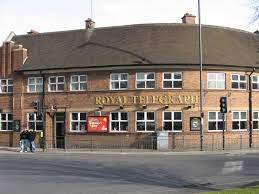
The Babington Arms is the furthest pub from my starting point so I now began my journey back in the direction of the station. The next pub on my agenda is in more or less a straight line from here, opposite the corner of the aforementioned a shopping centre. Sat astride the corner of a busy traffic junction is the Royal Telegraph.


Originally quite a small pub, it was built in the 1820s and named after a stage coach that ran from London to Manchester. The 'Royal' was soon dropped from the name and it was known as the Telegraph for many years. A road widening scheme took place in 1936 and the owners of the pub expanded the premises, buying out the neighbouring pub, the Prince of Wales, and two shops. The pub was then rebuilt with a long, curving frontage and an entrance at either end, a design that it still retains. It was reopened in 1937. Further internal alterations were carried out in the 1980s by Mansfield Breweries and it was renamed St. Trinian's but the name only lasted for 3 years. In 1986, the name was changed to Strutt's a name it retained until fairly recently when Marston's took the premises over and reverted to the original name. Internally, the long bar curves around the front of the pub and the space is broken up into smaller spaces for more intimate dining and drinking. One end is primarily for eating, with the far end given over to pool tables, fruit machines and darts. The middle section is a more traditional lounge bar style area. The bar includes 4 handpulls featuring Pedigree, Marston's Longer Days, Hobgoblin and Ringwood Boondoggle. I always feel a certain sentimentality for Ringwood beers so it was an easy choice for me when I selected Boondoggle, which was in excellent condition. I took some time, whilst I was enjoying my beer, to watch some of the England v Sri Lanka T20 cricket and simultaneously trying not to engage in conversation with the cricket fan on the neighbouring table.

I had 2 more pubs left on my route for the day and these were within easy walking distance of both the Royal Telegraph and the train station itself. Next up, was the aptly named Station Inn.


Situated on the busy Midland Road, the pub is approximately 250 metres from the train station. The large front room has a traditional bar and there is a pool room/function room to the rear. 2 of the 4 handpulls are in use, providing a choice between Draught Bass and Marston's New World. I decided to give the Bass a go and was then asked a question that I've never been asked before. I was given the option of Bass from the pump or direct from a large jug behind the bar. I realised quickly that this must be a good option as I could see no reason why they would offer it otherwise. Evidently the pub is famed for this unique serving method and, if I'm honest, the taste difference from the jug was noticeable and certainly added a rather tasty flavour to the beer. It's definitely something worth trying.

One pub left now and it was almost exactly back to where my journey had begun. Adjacent to the Waterfall is a pub that comes with an excellent reputation for live music and boasts a Cask Marque accreditation plaque outside the door. This boded well on first glance as I entered the Victoria Inn.


The Victoria Inn has a bar tucked into one corner of a lounge like layout with a couple of round tables and benches in two separate areas with a performance area and toilets to the rear. The bar holds 6 handpulls. How many of them were in use? None. Nada. Zip. Zero. I can only assume that the lines were being cleaned or that the pub doesn't serve real ale when there is music on through some misplaced assumption that rock fans don't like ale. I beg to differ! The one saving grace was that they at least sold bottles of Doom Bar and Hobgoblin. I went for the latter and sat at the bar having a bit of a sulk that the Cask Marque plaque seemed misplaced. I'm prepared to be proven wrong so another investigation at a later date may be in order. I know that I'd had bottled ale earlier in the day but this was at least in a venue that had at least one real ale on draught as advertised.

Despite my disappointment in the last venue, my day had been rather productive. Derby has once again proven that, whilst not all the venues are anything to write home about, the vast majority are maintaining some excellent standards of real ale. Derby is still very much the place to beat locally for real ale and whilst it continues to fly the flag, it will be very hard to beat. The ease with which it is to get to and the range and quantity of pubs that exist in close proximity to the train station make it a must for an afternoon trip, if just to have a wander around somewhere different. Improvement needed? Some, in this particular area of the city, but there are some absolute gems here too. Well done to the Brunswick Inn and the Alexandra Hotel for their numerous awards and the effort they continue to show. Overall, Derby is the place to get some decent ale down you!


Tuesday, March 1, 2016

Hey! Ho! Shardlow!

Whilst this week's title is a more than subtle musical nod, the subject of my most expedition is perhaps less well known and certainly bordering on being one of the hidden gem locations that often make an appearance in these pages. Last week, on what turned out to be a beautiful February Wednesday, I set my sights on a place that I had passed through on occasion but never had the opportunity to properly stop and visit. What better time, then, to finally turn my attentions to the village of Shardlow.

Shardlow is a village in Derbyshire, England about 6 miles (9.7 km) southeast of Derby and 11 miles (18 km) southwest of Nottingham. Part of the civil parish of Shardlow and Great Wilne, and the district of South Derbyshire, it is also very close to the border with Leicestershire, defined by route of the River Trent which passes close to the south. Just across the Trent is the Castle Donington parish of North West Leicestershire.
An important late 18th century river port for the transshipment of goods to and from the River Trent to the Trent and Mersey Canal, during its heyday from the 1770s to the 1840s it became referred to as "Rural Rotterdam" and "Little Liverpool". Today Shardlow is considered Britains most complete surviving example of a canal village, with over 50 Grade II listed buildings and a large number of surviving public houses within the designated Shardlow Wharf Conservation Area.

Due to its location on the River Trent, which up to this point is easily navigable, there is much early evidence of human activity in the area, dating back to 1500 BC. In 1999 the 12-foot-long (3.7 m) 1300 BC Hanson Log Boat, a Bronze Age log boat was discovered at the nearby Hanson plc gravel pit. Sawn into sections so that it could be transported and conserved, the boat is now in Derby Museum and Art Gallery. Five years later, a JCB in the quarry unearthed a bronze sword imbedded in a vertical position in the gravel. There is also a stone age tumulus at Lockington, an Iron Age settlement between Shardlow/Wilne and the river, and later Roman finds at Great Wilne.
In 1009 Æþelræd Unræd (King Ethelred the Unready) signed a charter at the Great Council which recognised the position and boundaries of Westune. The land described in that charter included the lands now known as Shardlow, Great Wilne, Church Wilne, Crich, Smalley, Morley, Weston and Aston-on-Trent. Under this charter Æþelræd gave his minister a number of rights that made him free from tax and to his own rule within the manor.
The village is listed as Serdelau in the Domesday Book - translated as a settlement near a mound with a notch or indentation – but there have been up to 20 different spellings noted by historians. The oldest surviving building today in the village is believed to be the "Dog & Duck" public house, located in the upper end of the village.

The River Trent below Shardlow is navigable all the way to the Humber Estuary, as is the River Soar which joins 2 miles (3.2 km) further down stream. Resultantly Shardlow was always an important transport hub and trading point, as wide-beam ships and boats traded cargo commercially with the pack horse trails going across the region. The tariffs charged for goods proceeding through the port, enabled industrialist Leonard Fosbrooke to build Shardlow Hall, and later lead to skirmishes being fought locally during the English Civil War for control of the strategic transport hub.
The original London to Manchester road (later a turnpike designed by the Duke of Devonshire's architect James Paine, now the A6) passes through the village, having crossed the Trent at Cavendish Bridge. By 1310, a rope-hauled ferry boat had replaced the last of a series of medieval bridges that crossed the Trent at what was known as Wilden Ferry. Later archaeological investigations in the Hemington Fields quarry, revealed that the three wooden bridges were destroyed by floods between 1140 and 1309. During this period the unstable gravel bed of the Trent was affected by a succession of large floods, which meant that the river shifted its course significantly during this time, demolishing the bridges and an adjacent Norman mill weir.
The cost to cross Paine's original 1738 bridge during its years serving as a tollroad was 2s 6d (12p) for carriages. It survived in service until 1947, when the Trent swollen by a rapid thaw swept its supports away. The British Army provided a temporary Bailey Bridge, which was replaced by the present structure in 1957. Today the pediment of Paine's bridge survives as a preserved structure, with the toll charges engraved into it.

Due to the discovery in 1720 of heated flint being able to turn the North Staffordshire reddish-clay into a lusterous white-sheen ware, from the 18th Century volumes of cargo shipped through Shardlow accelerated, supplying product and shipping ware internationally from the Stoke-on-Trent potteries.
James Brindley built the Trent and Mersey Canal from 1766 to 1777. With a vision to connect all four of England's main rivers together – the Mersey, Trent, Severn and Thames – he created the only other comparative canal port to Shardlow in the town of Stourport-on-Severn. Brindley developed his canal through Shardlow in 1770, to join the River Trent at Great Wilne .5 miles (0.80 km) further down stream at the junction with the River Derwent, which was also up to that point navigable. As a result, Shardlow quickly developed as an important UK river port, a transshipment point between the broad river barges and ships, and the canal's narrow boats. Shardlow later became the head office site of the Trent and Mersey Canal.
The port outline as exists today was formed by 1816, when the 12 canal basins had been excavated. But the warehouses around them were extensively reconstructed as trade developed, so that by 1820 the larger structures with the suburst windows which exist today, had replaced the earlier buildings. The wharfs and associated warehouses each had designated functions, which included: coal; timber; iron; cheese; corn; and salt. Other business which developed alongside the port included: boat builders; ropewalks; stables; offices, including the head office site of the Trent and Mersey Canal; plus workers cottages and owner's houses. Two families particularly made their fortunes: the Soresburys with rapid horse-drawn 'fly boats' on the Trent; and the Suttons with their barges and narrow boats.
The importance and vitality of the port resulted in the town becoming referred to as "Rural Rotterdam" and "Little Liverpool", with the population rising from 200 in 1780 to a peak of 1,306 in 1841.

However, the subsequent arrival of the Midland Railway and associated railway branches to the area in the 1840s signalled the beginning of the end; by 1861 the population had fallen to 945, of whom 136 were in the workhouse. By 1886 the port was virtually abandoned, yet the end only came with the formation of the nationalised British Waterways in 1947, which quickly resulted in the removal of the formal designation of Shardlow as a port.
In 1816, a large group of parishes from Derbyshire and Nottinghamshire erected a joint workhouse to the west of Shardlow, which had required the UK Parliament to approve the "Shardlow and Wilne Poor Relief Act". But with an expanding number of poor people to cope with, the Union negotiated from 1834 to expand to 46 parishes encompassing a population of 29,812, ranging in population scale from Hopwell (23) to Castle Donington (3,182). The "Shardlow Poor Law Union" formally came into existence on 30 March 1837, governed by an elected board of 57 guardians. The building was enlarged by Derby-based architect Henry Isaac Stevens at a cost of £2,800 in 1838-9, to increase its capacity to 230.
Shardlow and Great Wilne had been included in the parish of Aston-on-Trent until 1838. But with the formation of the poor union, the combined parishes agreed to fund a parish church for the town, resulting in the opening of St James's Church designed by H.I. Stevens, so that in the following year Shardlow became a parish in its own right.
In 1905, the workhouse started its conversion to a hospital, with new buildings to its south. Post World War II under the National Health Service it formally became "The Grove" hospital, which was closed in 2005 and subsequently demolished in 2007.

The last grain-carrying narrow boat delivered its cargo to Shardlow in the early 1950s. In 1957 the stable block which had housed over 100 towing horses were demolished, latterly followed by some of the smaller warehouses and buildings over the next 20 years. A campaign led by the newly formed Trent & Mersey Canal Society resulted in the designation in 1975 of the Shardlow Wharf Conservation Area, which today encompasses over 50 Grade II listed buildings.
During the 1970s, the men-only "Pavilion Club" flourished in the old cricket club. Then uniquely owned and operated by its gay members, it burnt down in the late 1980s. The subsequent insurance payout went into a local trust, which supported LGBT causes in the area for many years.
Today the relatively small village is considered Britain's most complete surviving example of a canal village. Most of the warehouses and other port buildings have been converted to other commercial uses, or as private dwellings.

So, for such a small village, relatively unknown outside of the local area, there is a lot of historical interest and, for the purposes of my visit, quite a large number of pubs, though not quite as many as the 13 that it used to boast. My journey began, as a lot of them tend to, with a bus ride to get me as close as possible to the village. This meant getting the Skylink from Nottingham city centre and getting off at the A50 Sawley roundabout. This was followed by a short walk past some picturesque countryside as I enjoyed the pleasant sunshine and the mild temperatures for February. As mentioned I had previously passed through Shardlow but never been able to stop so I was looking forward to the prospect of further investigating this particular part of the world.
After a brief walk, I identified my first location, just past a Chinese restaurant and down a side road off the main road just before Cavendish Bridge. Following this road, I reached my first stop after a couple more minutes of walking. Tucked away in a lower part of the village, with the Trent visible just behind, is The Old Crown Inn.


This former coaching inn dates from the 17th Century and has built up a significant reputation in recent years for its excellent food and real ale. The pub survived being severely flooded twice in a number of weeks just before Christmas 2012 but kept plugging away and has built a loyal customer base amongst locals and visitors. Inside, the original oak beamed ceiling has been retained and this displays an extensive collection of old jugs with the walls adorned with pub mirrors, brewery signs and railway memorabilia which even extends into the toilets. The interior is cosy and open-plan and divided into 2 areas with a large inglenook on the right. The bar sits between these areas directly opposite the main entrance. This bar includes 7 handpulls, 6 of which are in use during my visit and the choice is interesting, offering Marston's Sunbeam, Old Empire, Pedigree and EPA, as well as Single Hop El Dorado and Wychwood Dirty Tackle. I decided to begin my day with the El Dorado (4%), which offered distinctive dried fruit aromas and a citrusy, tropical bitterness with a herbal note in the aftertaste. This was a refreshing drop after my walk so I took in a small alcove next to the door directly facing the bar and admired my surroundings. It had definitely been a good idea to seek this pub out as it put me in high spirits for what was to come later.

To reach the next stop on the day's itinerary, I retraced my steps to the main road and this time crossed Cavendish Bridge into the village proper with the Trent winding away either side and separating the counties of Derbyshire and Leicestershire. I was immediately struck by how nice this area of the country is and Shardlow marks the 4th time I have been out this way, following previous trips to the neighbouring villages of Sawley, Castle Donington and, most recently, Kegworth. With this is mind, I was hoping for similar levels of success for the remainder of the trip. My next location is situated square on to the main road, at the junction with Wilne Lane. I had arrived at the Navigation Inn.


This traditional pub has recently undergone a change in management so I was mildly apprehensive when I saw the large banners proclaiming this fact as I entered. For a long time, this was the only remaining Davenports house in the area. Inside, there is seating areas over 2 levels with the bar just to the right as you enter through the front door. There is games room with a pool table and dartboard off to one side and outside seating to both the front and rear. The bar features 4 handpulls, arranged in a bank of 3 with a standalone pump at the opposite end. The ales to choose from are Pedigree, Castle Rock Harvest Pale, Black Sheep Bitter and Thorley & Sons Pale & Interesting from out near Ilkeston way. Not quite prepared to dive in at the deep end just yet, I opted instead for trusty Harvest Pale, which was in great condition. I took a seat on a table tucked way behind part of a partition wall and enjoyed my beer. The day thus far was going well and the weather was still glorious. One odd thing I noticed about the layout of this pub is that the cellar is directly behind the bar, accessible through a normal doorway. I have to confess to being a little bit of a nerd with regards to the positioning of pub cellars so I was intrigued by this quirk.

Soon, it was time to move on again, so I made my departure and turned right out of the pub to head up Wilne Lane, which leads to The Wharf with its pleasant views and myriad of listing buildings. Crossing a canal bridge at the end of the street saw me reach my next destination and, consequently, the following one as well, as they face each other across a small courtyard. The first of these, is the New Inn.


This canal side pub welcomes both children and dogs, serves food all day and is known to get busy in the summer months with both locals and visiting boaters. It being February and midweek, this is less of an issue for me on this day so the pub is relatively quiet with one or two small groups in for lunch. I pulled up a convenient bar stool and perused the offerings of the strange shaped bar which is almost shaped like a backwards Z with service to both sides. The pub is divided into 2 long rooms, which meet at one end but are separated at the other by a dividing wall and a corridor that houses the toilets. All of the 7 handpulls are occupied, leaving me a choice between Pedigree, Sharp's Doom Bar, Burton Bridge Stairway to Heaven, Navigation Tight Head, Camerons Northern Line Stout, Exmoor Gold and a real cider in the form of Weston's Rosie's Pig. I had longer to decide than I was expecting as the bar staff appeared to have gone AWOL but a barmaid finally emerged from the kitchen, where she informed me that she'd been eating chips, to take my order. I decided on the Exmoor Gold, which I've had previously, and it was very good indeed, with an excellent smooth finish.

I was pleased that my next location was nearby, a literal stone's throw across the aforementioned courtyard. Within a minute, if not less, I was at The Malt Shovel.
 Image result for malt shovel shardlow
Dating from 1799, this hugely popular pub still retains its original beams and floors, making it a charming addition to any village. The internal layout is higgledy-piggledy with lots of smaller rooms off of the main one, at a variety of different levels. The pub started life as a malt house to the old brewery that is located behind it (the buildings remain), built by a wealthy farmer named Humphrey Moore. On one fateful day, a worker fell into a boiling vat at the malt house and died a horrible death. The traumatic events of his demise have seemingly caused him to remain at the building, as he has been seen on more than one occasion by ex-landlords and locals alike. His spirit is alleged to be most active in the cellars, particularly during any renovation work. There have been numerous instances of workers being pushed, nipped and poked by something unseen. The nearby canal also boasts a casualty of drink as a man once wandered into its waters and drowned whilst intoxicated. His body was not found until the following day and his ghost has been seen on the bank since. From spirits back to beer and the bar at the Malt Shovel. It accommodates 6 handpulls, 4 of which are in use on my visit, featuring Rosie's Pig, Hobgoblin and a doubled up Pedigree. I was expecting slightly more range if I'm honest but I suspect busier periods allow them to stock a greater variety of ales. Either way, the Hobgoblin was very well kept and this compensated more than enough.

I can imagine the Malt Shovel being rammed to the rafters on a summer evening and this would be no bad thing as it is a very pleasant place to sit and enjoy a delicious beer. A return trip may be in order I think! Leaving The Wharf, I ventured back down Wilne Lane, this time turning left at the end as I once again reached the main road through the village. My next stop was a little further on and back over the road. Upon reaching it, I passed the Old Salt Warehouse, site of a local antiques business as well as the murder of a one-legged beggar (whose ghost has been reported on the canal bank nearby) and reports of an eerie feeling and mild poltergeist activity. Sat almost opposite this is a hulking chunk of a premises known as The Clock Warehouse.


This converted mill was built in 1780 and physically straddles the Trent and Mersey Canal. As well as boasting a skittle alley with a private function room and an adjacent beer garden, the pub also benefits from the Shardlow Heritage Museum being situated in the grounds. Operated by Marston's the pub is truly enormous with an expansive interior over multiple levels and views out across the canal and the nearby fields. Having eventually located the toilets, which turned out to be on a separate floor a la Wetherspoons, I returned to the bar and perused the 5 handpulls, only 2 of which were operational. Given a choice between Pedigree and Hobgoblin, I opted for the former having just had the latter. This was as it should be and went down especially well with the burger that I felt I needed by this stage. I got the sense that the bar has more to offer during busier summer months but the staff are very friendly and welcoming and this massive place has a lot more to offer other than just its location and history.

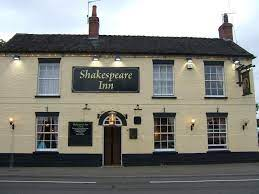
Next up, I once again found myself crossing the road in order to reach the next location on my tour. Boasting a name perhaps unfamiliar in this part of the country, next in line was The Shakespeare Inn.


This is a traditional pub with two entrances inside the main door that take you to either the bar room or the lounge. The bar sits in the middle of these 2 areas although they are both connected at the rear of bar area. The décor is traditional and adorned with memorabilia and photos from the local area. The restaurant area, where I eventually chose to sit, doubles as a function room and the car park even allows motorhomes to stay overnight. The bar, which serves both areas of the pub, contains 5 handpulls, 2 of which are Pedigree but also featuring Courage Directors, draught Bass and Doom Bar. I decided that Doom Bar would sate my thirst and I was rewarded with as good a kept pint as you'll find anywhere. I spent the time it took to drink my pint admiring the cosy atmosphere of this quaint place.

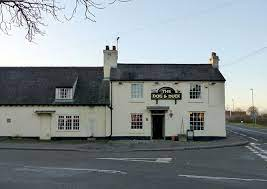
I had one destination left for the day before my stroll back to the bus stop and my journey home and it was situated at almost the very end of the village. Believed to be the oldest surviving building in Shardlow, I had now reached the Dog & Duck.


This traditional styled pub restaurant is significantly larger on the inside that it appears from the front. The building extends backwards in an almost TARDIS-like fashion to accommodate a large drinking and dining area, a long well-stocked bar and lots of other smaller rooms for eating. There is a very large car park and a children's soft play area to satisfy the younger generation. This is another pub in the village that falls under the Marston's remit and whilst can affect the range of beers on offer it at least ensures that the pub stays open and, importantly, stays a pub. There are 8 handpulls on the bar and 7 of them are in use at the time of my visit. Pedigree appears 3 times with another 2 Help for Heroes charity ale and the final 2 Wychwood Dirty Tackle. I decided that it was only appropriate to end my day with a beer from the Wychwood stable and so opted for Dirty Tackle (4.4%). With aromas of caramel malt, apple and citrus and flavours of grapefruit, this gives way to sweet fruit and sweet malt on the finish. Not as dirty as it sounds then!

It had been an interesting day in Shardlow and time was getting on so it sadly became time for the inevitable return to normality by way of public transport. Whilst the pubs in Shardlow are covered by the extensive presence of Marston's there is clear indications that they are thriving. You only have to count the number of operational premises in what is a fairly small village, to realise that this can only be a good sign. In a climate where pubs, particularly village pubs, have been hard hit by increases in prices and rent and a decrease in trade, Shardlow and, it has to be said, a few more of my recent trips to perhaps less well-trodden areas have highlighted that it is not all doom and gloom. Villages like this with their friendly locals, interesting pubs and doses of local history make it all worthwhile. It's safe to say, that I left Shardlow on a high.