Tuesday, February 14, 2023

Capital Gains

Hello again! And a very much belated happy new year! Welcome to 2023, where strange things are in the skies and the cost of everything continues to rise. It's not all doom and gloom however. As you have no doubt noticed, my plan to squeeze in a final trip before the end of 2022 didn't quite pan out and, due in large part to a self-imposed cutback on alcohol consumption in January, it wasn't until last week that I could properly get out and explore. But, as I hope you'll agree, the wait was worth it to get this particular trip in the books. Last week, to celebrate my birthday, Amy and I headed down to the capital for some much needed time off, and to revisit a city that we both love. This was actually our third trip in the last 9 months but would be the first one to feature in the blog. We had a couple of activities planned for our stay, which was our first ever 2 night stay in London as opposed to the single nights we'd done in the past. One of these activities was an exploration of some of London's most historic pubs in a well known area of the city. Aside from that, we had a theatre show booked and another excursion which saw us immersing ourselves in one of London's most (in)famous locations. Settle in and join us now for what will certainly not be the last London trip to get a mention here, but has the privilege of being the very first.

We arrived in London, on a not unpleasant Wednesday afternoon, having journeyed down by National Express coach. This has now become our preferred method of travel to the capital, ostensibly because of the prohibitive cost and current unreliability of trains. Arriving ahead of schedule, we disembarked at Marble Arch and, following a brief sojourn down Oxford Street, navigated the Tube from Oxford Circus. Braving the District Line at lunchtime seemed like a foolish exercise but, though the train was busy, we didn't have any major issues, barring the fact that the underground was uncomfortably hot. Baring in mind it's February, I hate to imagine how thousands of commuters coped in the oppressive heat of our most recent summer. As it's been on more than one previous occasion, our base for our stay was a Premier Inn on Tower Bridge Road, just down the road from the eponymous landmark and an approximate 10 minute from the closest tube station at Tower Hill. From this we now emerged. After a morning of travelling, and with about half an hour to spare before we could check in, we were very much in need of a pint. Luckily, Tower Bridge Road happens to be occupied by a couple of places that would do the trick. Given the choice between a Wetherspoons, a Brewdog premises or an independent, we settled for the latter. Crossing over the road, we were about to slake our thirst at The Raven.


Formerly known as The Bridge House, the pub that is now The Raven reopened in June 2022 following an 18 month closure. Prior to this, the pub had also previously closed in 2018 when the previous tenant retired, before reopening under the current name in March 2019.  Operated by Pulse Venues and named after the famous corvids at the nearby Tower of London, The Raven occupies a convenient place, being the first pub you come to on the south side of the bridge. Internally, the bar area consists of a single room, with a large bar approximately central. Seating consists of low round tables and sofa style seating. A door next to the bar leads to a staircase that leads down to both the toilets and a comedy club that is open at weekends. Taxidermy birds in cases are displayed behind the bar, with the rest of the decor being largely minimal and featuring dark wood and exposed brickwork. It greatly pleased me to see 4 handpulls on the bar, of which 3 were in use during our visit. The current owner has a preference for Cornish beers so the choices were between Sharp's Doom Bar and Sharp's Sea Fury with the remaining occupied pump given over to a real cider in the form of Sandford Orchards Fanny's Bramble. I immediately went for the Sea Fury (5%), Amy chose Aspalls Cyder and we gratefully took our pints to a round table on the far side of the room. We'd obviously been much thirstier than we'd realised. Our first pints of the day went down a storm. The Sea Fury was excellent. Special Bitter in style, with a roasted and dark berry aroma that gives way to a sumptuous, fruity, malty flavour before ending with a moreish hop finish, it's definitely one of the better beers from Sharp's range and certainly preferable to the now ubiquitous Doom Bar. Following our pints, and a much-needed toilet break, we had killed sufficient time so headed over to the hotel to check in. Having dropped off our things and very quickly refreshed, we were straight back out. Our plan for the evening involved visiting Covent Garden and exploring its famous market, where we had a dinner reservation booked, before seeing The Woman in Black at the nearby Fortune Theatre. Firstly though, it was back to the Tube for the short trip to Embankment station, the closest to where we needed to be. 

By this stage, although it was only mid-afternoon, there seemed to be a few people about, either milling about on the Embankment itself or wandering around Covent Garden. We explored the fabulous market space, with it's designer shops, high-end restaurants and live musicians (in this case, a string quartet), popped into a shop that only sold Moomin-themed products and got our bearings in relation to both the theatre and the restaurant we'd be eating. If you've ever been to London, you'll know that Covent Garden, like most of the city, is a high foot traffic area and, luckily, happens to be very well served with drinking establishments. One of these, is situated within the market building itself and looks out over the famous Covent Garden piazza. This seemed like a perfectly atmospheric spot for a drink and so we entered the Punch & Judy.


Located primarily inside the Grade II* listed Central Market Building, designed by Charles Fowler, the pub takes its name from the eponymous puppets that first appeared in this area and were mentioned by Samuel Pepys in 1662. One of the first English performances of what are now known as Punch & Judy shows took place in Covent Garden. The pub is split over two main levels. The first floor bar area is long and narrow with traditional seating and an outside balcony that overlooks the market place where performers can often be seen. The balcony faces the church of St. Paul, once a venue for one of the wedding ceremonies of Gwen Stefani and Gavin Rossdale. On the basement level, is a larger space with stone flagged flooring, bare bricked walls, low lighting and access to an enclosed courtyard. A central landing links the staircases that lead to both floors and there are toilets on both levels, however there is no disabled access to either bar or toilets, due primarily to the listed nature of the building. Arriving on the central, we took a punt on the upstairs bar initially although quickly found out that this does not serve real ale and drinks are served in plastic cups, presumably a licensing condition due to the balcony bar being open to the market below. We enjoyed a quick drink on this floor, with myself opting for Greene King Level Head, a kegged IPA, took some photos and then, with a bit of time before our dinner reservation, decided to head to the downstairs bar. This instantly proved to be a wiser choice. Not only is the basement area warmer, cosier and more intimate, it feels more like a proper pub, even down to the trio of handpumps on the bar. 2 of these were available and, this being a Greene King venue, featured beers from their portfolio. The options here were Greene King IPA and London Glory. I chose the latter, Amy again went for Aspalls and we took a seat at a high, round table opposite the bar. This part of the Punch & Judy is certainly more appealing in the colder months and has a nice, relaxed atmosphere, an interesting contrast to the balcony bar we had visited earlier, screaming child notwithstanding. It was a shame therefore, that the beer wasn't great. I've had London Glory (4.1%) on more than one previous occasion and it's normally rich and fruity with a well balanced malt character and a subtle bitterness. This time though, there was the hint of an off-flavour, an ever so slight sourness that hinted at a beer past its best or a nearly empty barrel. I thought of taking it back but, given that we were only here for a brief period of time, decided to grin and bear it.

Despite being disappointed with my most recent beer, it wasn't going to spoil our day. Leaving the Punch & Judy, we headed back into the market for our food reservation at Buns & Buns, a Chinese street food restaurant, in its own glass pavilion, that is mostly known for serving excellent bao buns. We can confirm that their food is excellent. We shared some pulled pork and duck buns between us and we would heartily recommend it. Price-wise, it's pretty reasonable too! With the show not starting for another hour or so, and our food polished off, we needed to find somewhere close by to have a drink beforehand. As mentioned above, Covent Garden has no shortage of decent pubs and we managed to find one just around the corner from the theatre at the Bow Street Tavern.


Dating from 1763 and situated directly opposite the Royal Opera House, this former Meux's Brewery pub was rebuilt in both 1897 and 1930. Now owned by the City Pub Co., the site on which it sits was formerly home to one of the early stations of the Bow Street Runners, the forerunners of the modern police force. The interior of the pub featured in Alfred Hitchcock's film 'Frenzy' and acknowledges this connection through posters displayed inside. Internally, the pub leans into its history, with a variety of themes across its 5 floors. The Inspectors Office and the Fielding Room create the feel of a Victorian police theme, there is a nook/snug type space dedicated to the British monarchy, as well as a gin terrace. The walls are dark terracotta in colour with dark wood panelling, mirrors and a range of posters dedicated to theatre, movies, opera, police and beer themes, including some from the 1975 Covent Garden Beer Festival. A collection of Toby jugs line the top of the back bar. The toilets are down a narrow staircase in one corner. Perhaps due to the time of the day, the proximity to theatres and other such venues, and the pub next door being closed for refurbishment, it's standing room only when we arrive. Luckily we were able to get to the bar to get served and, although there is a little bit of wait, the staff were very friendly, if a little bit clumsy. Two items were dropped and smashed within the space of about 5 minutes which went down as well as that sort of thing tends to in a busy city pub. The bar features 4 handpulls, with a full complement of ales available, leading to a choice between Wychwood Hobgoblin IPA, Timothy Taylor Landlord, Sharp's Doom Bar and Fuller's London Pride. After a moment to collect my thoughts, I decided to go for the Hobgoblin IPA. Amy had decided to switch to soft drinks at this time and we stood at the bar for a few minutes before a small table nearby became available. The IPA was in good condition, by no means the best or worst that I've ever had. This is a really nice little pub in a great location. The aesthetic embraces the colourful history of this part of the city and it's certainly worth a visit. Following the draining of our glasses, we headed around the corner to the Fortune Theatre for the show. I'd seen The Woman in Black before but this was Amy's first time. It was fantastic! Suspenseful, well acted and genuinely terrifying, made all the more so by the fact that the theatre allegedly has its own female spirit, although this one appears in grey. Unfortunately, the show will soon be coming to an end after 34 years so we were very grateful to have seen it whilst the opportunity arose. We weren't so grateful about trying to get to sleep afterwards though!

We had a relatively early start for our full day in London. Following a hearty breakfast and the opening of birthday cards, we were out and about before 9am. The main reason for this was because we needed to navigate the tube to North London to visit a place that we'd both wanted to go to for sometime, namely Highgate Cemetery. Our plan for the day was to spend a couple of hours there, then head back and mount a pub crawl down the Strand and Fleet Street, properly exploring one of the best known and most historic London thoroughfares through the medium of its many drinking venues. First though, to Highgate! Highgate Cemetery is one of London's 'magnificent seven' burial grounds and arguably the most famous. 117,000 people are buried there, in approximately 53,000 graves, across several acres on both sides of a road. Following a half hour tube journey to Archway and a 20 minute walk, we arrived at the cemetery, showed our pre-booked tickets, and set about exploring both the east and west sides. Highgate is known for not only its age and size but also for the mix of well-known and less well-known individuals buried there. Amongst the well known names interred there are George Michael, Alexander Litvinenko, Michael Faraday, Ugo Ehiogu, the Rosetti family, Bob Hoskins, Ian Holm, Roger Lloyd-Pack, Karl Marx, Jeremy Beadle, Malcolm McLaren and Douglas Adams. It's an unusual, atmospheric and, allegedly, very haunted place, particularly the older west side. Gothic Victorian mausoleums and gravestones dominate and there is a very eerie feeling around the so-called 'circle of Lebanon' and 'Egyptian Avenue'. We didn't see anything unusual, which is just as well, given the tales of a ghostly distressed woman looking for her children; a tall, grey figure seen amongst the trees, staring into space; the apparition of a tall man in a black top hat; a ghostly face with red eyes seen peering out from behind the gates at night; and a ghostly cyclist seen puffing his way up the nearby Swains Lane that cuts the site in two. Amy did feel a cold touch on her arm, like she'd been grabbed by a small hand though. Make of that what you will. 

After a LOT of walking, a sit down was required and, conveniently, I'd factored this into our day, knowing we'd need to chill out for a bit before the tube journey back. There is a pub in the vicinity of Highgate Cemetery that I thought warranted a visit. Making our way up the aforementioned Swains Lane, we took a left at the top, through Pond Square, and then took a right where our first pub of the day is located. We felt we had earned a sit down at The Flask.

Known as the 'Upper Flask' in order to differentiate it from a pub of the same name in nearby Hampstead, this 17th century pub was originally two buildings but has since been combined into one. Formerly an M&B property, Fullers acquired it in 2009 and still operate it. 18th century painter, engraver and satirist William Hogarth is believed to been a regular, along with Karl Marx, although obviously not at the same time. The 'Swearing of the Horns' ceremony takes place here annually. The pub is now Grade II listed and features an asphalted front yard, with a covered seating area. Inside, the pub is split over several small levels, divided up by small flights of steps. The main entrance leads to all areas, with the main bar situated to the left and another area on the right primarily used for dining. Furniture is scrubbed wood and decor is exposed brickwork and low beams. The two sections of the pub, though now joined were previously separate. Further enhancements were made in the 1930s with the pub expanding considerably to both the rear and the left. There are sash windows that are likely to be original. We arrived here a couple of minutes before opening but were soon making our way inside, behind a larger group who were here for lunch. Within a few seconds, we had found the main bar, with the resplendent sight of a bank of 5 handpulls before us. Fullers beers were well represented but these were accompanied by guest beers. The full range of choices was Small Beer Steam Ale, Moor Beer Steady Walker, Fuller's London Pride, Dark Star Hophead and Fuller's ESB. As I had so far not had any Fuller's beer on this trip, I chose the London Pride, which is always excellent when found close to the source. Amy went for craft beer this time, specifically Lightbulb from Cornwall's Verdant and we found a table just next to the bar, where we could look out over the yard and borrow some electricity to charge our phones. The Flask proved to be an excellent spot to get our breath and our energy back, and revitalise ourselves for the afternoon we had ahead. It would end up being one of our favourite pubs of the day. The relaxed atmosphere and attractive surroundings, in what is a picturesque part of North London, added to our feelings of joy. There are tales of more sinister things here though. A Spanish barmaid, who took her own life after being jilted by her lover, is believed to be responsible for the poltergeist activity that has been reported here. There are also sightings of a phantom highwayman, seen disappearing into one of the pillars. Could this be connected to tales of Dick Turpin using the pub's stables and cellars as a hiding place? Who knows? Until fairly recently, a monk-like figure was reported to appear on a bench, staring directly at customers before disappearing. This activity apparently ceased after the so called 'Monk's Bench' was removed from the premises.

We had a nice time here, enjoying our beers and soaking up the history and heritage of this pub. There would be more of both to come as our day continued. Feeling rejuvenated, it was time to move on. A few minutes later, we again boarded the Northern Line, this time at Highgate tube station, heading south, where we would change at Embankment before a short hop to Temple where our afternoon would properly begin. Given the amount of times we've been to London, it finally feels like we've gotten the hang of the tube. That doesn't make the journey on the Northern Line any more pleasant though, especially when it sounds like the souls of the damned are howling outside. Still, we need manage to make it to Temple in one piece. Personally, I was very much looking forward to this part of the trip. The goal: to explore the pubs around the Strand and Fleet Street, investigate their history, enjoy their ambience and, most importantly, drink their beer. At this stage, it's probably worth explaining why this part of the city is so famous. Fleet Street runs west to east from Temple Bar at the boundary with the City of Westminster to Ludgate Circus at the site of the London Wall and the River Fleet from which the street was named.

The street has been an important through route since Roman times. During the Middle Ages, businesses were established and senior clergy lived there; several churches remain from this time including Temple Church and St Bride's. The street became known for printing and publishing at the start of the 16th century, and it became the dominant trade so that by the 20th century most British national newspapers operated from here. Much of that industry moved out in the 1980s after News International set up cheaper manufacturing premises in Wapping, but some former newspaper buildings are listed and have been preserved. The term Fleet Street remains a metonym for the British national press, and pubs on the street once frequented by journalists remain popular.

Fleet Street has a significant number of monuments and statues along its length, including the dragon at Temple Bar and memorials to a number of figures from the British press, such as Samuel Pepys and Lord Northcliffe. The street is mentioned in several works by Charles Dickens and is the home of the fictional murderer Sweeney Todd. Fleet Street is named after the River Fleet, which runs from Hampstead to the River Thames at the western edge of the City of London. It is one of the oldest roads outside the original city and was established by the Middle Ages. In the 13th century, it was known as Fleet Bridge Street, and in the early 14th century it became known as Fleet Street.

The street runs east from Temple Bar, the boundary between the Cities of London and Westminster, as a continuation of the Strand from Trafalgar Square. It crosses Chancery Lane and Fetter Lane to reach Ludgate Circus by the London Wall. The road ahead is Ludgate Hill. The street numbering runs consecutively from west to east south-side and then east to west north-side. It links the Roman and medieval boundaries of the City after the latter was extended. The section of Fleet Street between Temple Bar and Fetter Lane is part of the A4, a major road running west through London, although it once ran along the entire street and eastwards past St Paul's Churchyard towards Cannon Street.

Fleet Street was established as a thoroughfare in Roman London and there is evidence that a route led west from Ludgate by 200 AD. Local excavations revealed remains of a Roman amphitheatre near Ludgate on what was Fleet Prison, but other accounts suggest the area was too marshy for regular inhabitation by the Romans. The Saxons did not occupy the Roman city but established Lundenwic further west around what is now Aldwych and the Strand.

Many prelates lived around the street during the Middle Ages, including the Bishops of Salisbury and St Davids and the Abbots of Faversham, Tewkesbury, Winchcombe and Cirencester. Tanning of animal hides became established on Fleet Street owing to the nearby river, though this increased pollution leading to a ban on dumping rubbish by the mid-14th century. Many taverns and brothels were established along Fleet Street and have been documented as early as the 14th century. Records show that Geoffrey Chaucer was fined two shillings for attacking a friar in Fleet Street, though modern historians believe this is apocryphal.

An important landmark in Fleet Street during the late Middle Ages was a conduit that was the main water supply for the area. When Anne Boleyn was crowned queen following her marriage to Henry VIII in 1533, the conduit flowed wine instead of water. By the 16th century, Fleet Street, along with much of the City, was chronically overcrowded, and a royal proclamation in 1580 banned any further building on the street. This had little effect, and construction continued, particularly timber. Prince Henry's Room over the Inner Temple gate dates from 1610 and is named after Henry Frederick, Prince of Wales, eldest son of James I, who did not survive to succeed his father. The eastern part of the street was destroyed by the Great Fire of London in 1666, despite attempts to use the River Fleet to preserve it. Fire damage reached to about Fetter Lane, and the special tribunal of the 'Fire Courts' was held at Clifford's Inn, an inn of Chancery at the edge of the extent of the fire, to arbitrate on claimants' rights. Properties were rebuilt in the same style as before the fire.

During the early 18th century, a notorious upper-class gang known as the Mohocks operated on the street causing regular violence and vandalism. Mrs Salmon's Waxworks was established at Prince Henry's Room in 1711. It had a display of macabre and black-humoured exhibits, including the execution of Charles I; a Roman lady, Hermonie, whose father survived a sentence of starvation by sucking her breast; and a woman who gave birth to 365 children simultaneously. The waxworks were a favourite haunt of William Hogarth, and survived into the 19th century. The Apollo Society, a music club, was established in 1733 at the Devil Tavern on Fleet Street by composer Maurice Greene.

In 1763, supporters of John Wilkes, who had been arrested for libel against the Earl of Bute, burned a jackboot in the centre of the street in protest against Bute. It led to violent demonstrations and rioting in 1769 and 1794.

Tanning and other industries declined sharply after the River Fleet was routed underground in 1766. The street was widened during the late-19th century, when Temple Bar was demolished and Ludgate Circus was constructed. The headquarters of the Anti-Corn Law League were based at No. 67 Fleet Street, and a blue plaque marks the location.

Publishing started in Fleet Street around 1500 when William Caxton's apprentice, Wynkyn de Worde, set up a printing shop near Shoe Lane, while at around the same time Richard Pynson set up as publisher and printer next to St Dunstan's Church. More printers and publishers followed, mainly supplying the legal trade in the four Inns of Court around the area, but also publishing books and plays.

In March 1702 the first issue of London's first daily newspaper, the Daily Courant, was published in Fleet Street. It was followed by the Morning Chronicle. The publisher John Murray was founded at No. 32 Fleet Street in 1762 and remained there until 1812, when it moved to Albemarle Street. The popularity of newspapers was restricted due to various taxes during the early 19th century, particularly paper duty. Peele's Coffee-House at No. 177–178 Fleet Street became popular and was the main committee room for the Society for Repealing the Paper Duty, starting in 1858. The society was successful and the duty was abolished in 1861. Along with the repeal of the newspaper tax in 1855, this led to a dramatic expansion of newspaper production in Fleet Street. The "penny press" (newspapers costing one penny) became popular during the 1880s and the initial number of titles had consolidated into a few nationally important ones.

By the 20th century, Fleet Street and the area surrounding it were dominated by the national press and related industries. The Daily Express relocated to No. 121–8 Fleet Street in 1931, into a building designed by Sir Owen Williams. It was the first curtain wall building in London. It has survived the departure of the newspaper in 1989 and was restored in 2001. The Daily Telegraph was based at No. 135–142. These premises are both Grade II-listed. In the 1930s, No. 67 housed 25 separate publications; by this time the majority of British households bought a daily paper produced from Fleet Street.

In 1986 News International owner Rupert Murdoch caused controversy when he moved publication of The Times and The Sun away from Fleet Street to new premises in Wapping, East London. Murdoch believed it was impossible to produce a newspaper profitably on Fleet Street and the power of the print unions, the National Graphical Association (NGA) and the Society of Graphical and Allied Trades (SOGAT), was too strong (an opinion endorsed by the Prime Minister, Margaret Thatcher). All Fleet Street print staff were sacked and new staff from the Electrical, Electronic, Telecommunications and Plumbing Union were brought in to operate the presses at Wapping using modern computer-operated technology, rendering the power of the old unions obsolete. The resulting Wapping dispute featured violent protests at Fleet Street and Wapping that lasted over a year, but ultimately other publishers followed suit and moved out of Fleet Street towards Canary Wharf or Southwark. Reuters was the last major news outlet to leave Fleet Street, in 2005. In the same year, The Daily Telegraph and Sunday Telegraph announced they were returning to the centre of London from Canary Wharf to new premises in Victoria in 2006.

Some publishers have remained on Fleet Street. The London office of D.C. Thomson & Co., creator of The Beano, is at No. 185. The Secretariat of the Commonwealth Broadcasting Association is at No. 17, as is Wentworth Publishing, an independent publisher of newsletters and courses. The Associated Press has an office in Fleet Street as did The Jewish Chronicle until 2013 when it moved to Golders Green. The British Association of Journalists is based at No. 89 while Metro International are at No. 85.

Though many prominent national newspapers have moved away from Fleet Street, the name is still synonymous with the printing and publishing industry. In the adjacent St. Brides Lane is the St Bride Library, holding a specialist collection relating to the type and print industry and providing courses in printing technology and methods. On the wall of Magpie Alley, off Bouverie Street, is a mural depicting the history of newspapers in the area.

The last two journalists to work for the Dundee-based Sunday Post, left in 2016, as the paper closed its London offices.


With so much history contained in just one small area of London, I had a good feeling that the afternoon was going to be a few hours well spent in the heart of the capital. Leaving Temple tube station, from where ironically, we had made our return journey from Covent Garden the night before, it was only a short walk to our first stop. Tucked away, off of the main road, in Devereux Court, is the pub simply known as The Devereux.


This whitewashed, Grade II listed and Good Beer Guide (2023) listed pub is named, like the namesake court in which it is located, after Robert Devereux, Earl of Essex and a Parliamentary general in the Civil War. The original building on this site was built in the 1670s by Dr. Nicholas Barbon, son of the brilliantly named 'Praise-God Barebones'. The pub itself dates from 1844 with part of the site previously being a Grecian Coffee House. In the early 18th century Sarah Mapp the Bonesetter plied her trade here. The Devereux, in its current form, reopened in March 2019 and is located in the heart of the legal district. This means that, like most pubs in this part of London, it is closed at weekends. Inside, the pub is much larger than its frontage would suggest. The large bar is directly opposite the entrance. The seating is primarily composed of booths, separated from each other by partitions. The decor is largely wood panelling and historic prints of the city dominate the walls. The toilets are accessed through a door next to the bar and a steep and low ceilinged flight of stairs, another apparently common feature of pubs in central London. The bar boasts a bank of 4 handpumps. On our visit, 2 of these are in use, offering a choice between St. Austell Tribute and Adnams Ghost Ship. Amy and I both decided that Ghost Ship would be our choice and relocated to a booth virtually opposite the bar. The pub was quite busy when we arrived but quickly emptied out, not because of us though I hasten to add! The lunchtime rush was coming to an end and soon, barring a couple of other tables, there weren't many of us left in the pub. How was the Ghost Ship? A befitting a GBG listed pub, it was perfectly kept and went down very well with both of us. How much of this is due to it aiding our recovery from an arduous trip on the Northern Line is up for debate. This is certainly a nice pub to while away our time in. Our first Fleet Street pub had delivered. Luckily our next wasn't far away. Before we departed though, a quick musical trivia question. The Devereux had a board behind the bar on which was written the following question: Who are the only two artists to have had number one singles whose names completely match with that of London tube stations?* I managed to get it right and was apparently the first person to get both artists correct. Answer at the end of the blog.

Our next stop lies just door to the Devereux and seemed strangely familiar to me. It was only when we entered that I realised that I'd been there before, many years ago before I met Amy. Without further ado, it was time to reacquaint myself with the Edgar Wallace.


The pub now known as the Edgar Wallace was originally known as the Essex Head Tavern when it was built in 1777. Previous customers have included Dr. Samuel Johnson and Richard Brocklesbury who are said to have founded the Essex Head Club here in 1783. The pub was rebuilt in 1891 as the Essex Head and took on its current moniker in 1975 to celebrate the centenary of the famous crime writer's birth. The pub has one central room with additional drinking and eating space upstairs. The ceiling is covered with the landlord's pump clip collection and the walls and back bar are covered throughout with old advertising signs for various alcoholic beverages, as well as several advertising cigarettes. A shelf of Edgar Wallace's crime novels is under one of the windows along with various other books. There are two entrances to the pub, one on Essex Street and a smaller one to the side. The furniture is in the form of scrubbed wooden tables and chairs. The long bar takes virtually all of one wall and is blessed with 8 handpulls, separated into banks of 4. Half of these were being utilised when we dropped in, with the choice of Purity Pure Gold, Southwark Mayflower, Southwark Bankside Blonde and Timothy Taylor Landlord. I wasn't about to pass up a local beer so immediately went for the Mayflower (4.2%), an easy drinking pale ale brewed to commemorate the voyage of the Mayflower to the New World in 1640, and hopped with Sorachi Ace, Centennial, Cascade and Falconers Flight. It was a really tasty, very easy to drink beer! Amy had decided on cider again this time and we sat the windows at the back of the room to get a proper feel for the place. There were a few locals occupying a couple of tables, presumably either on lunch, or benefitting from an early finish. According to WhatPub, the pub has a electrical devices policy but this appears to have been scrapped as virtually everybody had their phones out. I was glad I'd revisited this pub again. I had memories of a pub in this area that I'd been in but had never been able to remember the name so it was good to put the mystery to bed. It helped that the beer was excellent too, as reflected by the pub's place in the Good Beer Guide (2023).


It was so far, so good and our next step was only a short walk away. We had originally planned to visit the Temple Brew House just up the road but as this didn't open until much later in the day, and we wouldn't be coming back this way, we were forced to skip it and instead progressed straight to the next location on our list, situated just around the corner and opposite the Royal Courts of Justice. Time now to visit The George.


A tavern is believed to have existed on this site since 1723 but the current Tudor-style frontage is much more recent, dating from an 1898 rebuild. An old pub sign showed George III but the pub is actually believed to be named after a former landlord and all references to royalty have been removed from current signage. The picturesque front leads into a redecorated interior with dark wood flooring and panels throughout. The bar extends most of the length of the interior and there is some partitioned seating opposite, consisting mostly of wooden tables and chairs. A further seating area is further back and there is an upstairs dining room used for functions or private dining. When we arrived, 3 of the 9 available handpumps were in use. The pub is part of Greene King's wider estate so their products tend to feature prominently. The options on the day in question were Greene King IPA, Timothy Taylor Landlord and a house beer, Headless Cavalier, rebadged for the pub and named after the resident ghost, a Cavalier, who is alleged to appear in the cellar and has a tendency to frighten staff when they go down to change gas bottles. Always keen to give a house beer a go, it was the Headless Cavalier (3.9%) that I selected. This is a session bitter with an overall bitterness, delicate hop notes and a balanced finish. Amy and I took a seat at one of the tables opposite the bar and revelled in our surroundings. I'd been here before as well, on the same trip as my first visit to the Edgar Wallace. It felt a bit surreal being back. Despite the slightly disappointing beer choice, this is a nice old pub with a welcoming atmosphere.


The next pub on the day's itinerary was one that I'd been especially looking forward to, for the sheer scale of the place if nothing else. Leaving the George, we crossed the road to where the next location stands, a great, big hulk of a building, next to the Law Courts. Next stop: The Old Bank of England.


As the name no doubt suggests, this Grade II listed building was, until 1975, the Law Courts branch of the Bank of England, after which it became an office of Bristol & West Building Society. It then spent some time as a Fuller's pub, specifically one of their Ale & Pie House venues before the lease reverted back to owners McMullens, who have directly managed the pub since 2019. A refurbishment in 2020 retained the high, ornate ceilings, chandeliers and gallery beneath but replaced the previous island bar with a more modern metal structure and created similarly styled booths alongside. The rest of the seating is a standard mix of high and low tables and chairs, with the decor reflecting the building's prior incarnation as a bank. There is also a classic, disused Routemaster bus in the rear courtyard, converted into an outside seating space with its own bar. Such is the renown with which McMullens run the place, that the pub is listed in the Good Beer Guide 2023. I had decided prior to our arrival that this would be a good place to eat, as well as to try the beer. Beer-wise, the choice was from 3 of the 4 handpumps on the bar, unsurprisingly offering McMullen beers, specifically AK Mild, which was doubled up and Country Bitter. Not being a mild fan, there was no real debate required and I settled for the Country Bitter (4.3%). Amy had opted for a soft drink and we sat at a high table in view of the bar. We also noticed that a large number of tables were reserved for later in the evening, presumably by local workers who booked to ensure they were able to have an after work drink. This would become a recurring theme in other pubs as the day grew on. From the looks of it, pub seating in London really is at a premium. The beer here was great! The Country Bitter is amber in colour, with an aroma of English hops and a ripe pear and light caramel flavour, that all leads into a pronounced, lingering bitterness. The food was less than impressive though. We both went for the wagyu beef burger for my birthday meal and it was a bit disappointing, tasting like typical frozen patty instead of being homemade. Amy was upset that my birthday meal had been very good, seeing as she'd paid for it but the most important thing for me was spending my birthday with her in somewhere we both love. If nothing else, this was probably the most aesthetically impressive pub of the afternoon.


It was back over the road now for something altogether different. What would we discover at Ye Olde Cock Tavern.


This Grade II listed building was originally built in 1549, although it was originally on the other side of the road before being moved in 1880 to make way for the building that is now the Old Bank of England. The pub boasts the narrowest pub entrance in all of London and a ground floor frontage that has been attributed to world famous wood carver Grinling Gibbons, whose work has featured at Windsor Castle, Hampton Court Palace and St. Paul's Cathedral amongst others. The interior is narrow right to the very rear and parts of it were sympathetically restored from photographs in 1990 after a small fire. Throughout its history, the pub has been frequented by several well-known literary names including Samuel Pepys, Alfred, Lord Tennyson and Charles Dickens and, to this day, is the meeting place for the world's oldest and most famous free speech and debating club, the Cogers, who meet on the second Monday of each month. The pub's name comes from Cock Ale, once served on the premises. This popular beverage was a normal ale, brewed inside a container, to which was added a bag stuffed with a parboiled, skinned and gutted cockerel, along with various herbs and spices. Despite evidence to the contrary now, at the time the drink was said to be a great aid to general health and even an aphrodisiac. Internally, very little has changed from the pub's early days. Dark wood panelling, bare brick and ceilings of various heights are accompanied by old photos of the area, as well as a mezzanine to the rear supported by oak beams. A James I era fireplace and a Grinling Gibbons mantlepiece are also believed to still be in situ. The bar, which occupies one side of the building, has 8 handpulls. The pub is another in Greene King estate so features their beers and, pleasingly, also offers guests from local breweries. On the day that Amy and I visited this fascinating property, 4 of these handpulls were operational, with a choice of Portobello APA, Portobello Chestnut Ale, Morland Old Speckled Hen and Greene King Yardbird. Local beer again won me over and I went for the APA (5%), a traditional American pale ale that provides a big hit of fruity flavours from the inclusion of Simcoe and Amarillo hops. Amy once again ordered a soft drink and we took a seat at a table just along from the bar. I'd heard many a good thing about this pub, not least because of its history. It was cool to finally experience it in person and witness the history for ourselves. Amy really liked the place too. Ye Olde Cock is definitely what I imagine when I picture a traditional London pub. There's a great ghost story associated with this place. One day in the 1980s, a member of bar staff was terrified by a smiling, disembodied head that appeared directly in front of her as she stood at the back of the building. By all accounts, her scream was heard throughout the pub. She later recognised the face she had seen in a painting of the writer Oliver Goldsmith, who had once been a regular, and whose portrait hangs above the staircase that leads down to the toilets. Whether he has appeared since this day or any other activity occurs is a matter of speculation.


There was yet more of London's history to be found in the next pub. A couple of minutes walk further down Fleet Street, in the shadow of the impressive St. Bride's Church, is The Old Bell.


This Grade II listed Nicholson's pub is believed to have first been built for Sir Christopher Wren to cater for the masons working on the rebuilding of St. Bride's Church following the Great Fire of London. A crossed knife and fork, set in brass, adorned the front entrance until the 80s and was originally installed as a sign for the illiterate workmen. The bar is central and U-shaped, the floors bare wood and the walls half panelled. A small snug area is tucked into one corner, which also contains a glass fronted cabinet filled with books and local artefacts. Old photos and press cuttings are framed on the walls. The front features a carved period window. The back of the pub overlooks St. Bride's churchyard and the church, whose tiered spire inspired the traditional tiered design of wedding cakes. 4 handpulls adorn the bar, all of which were in use when we arrived, offering 3 ales and a cider. Beer choices were Hog's Back T.E.A., Nicholson's Pale Ale and Fuller's London Pride, with Westons Rosie's Pig filling the cider category. It had been some time since I'd had any beer from Hog's Back and T.E.A. is always a reliable tipple. On this occasion, Amy went back onto cider and we found ourselves a table in the snug area. The Old Bell was rather busy and, with evening now upon us, the whole area around this end of the city would be bustling. This is a very comfortable pub. As with many of the Nicholson's chain, the emphasis is on a homely and welcoming feel. The beer was certainly welcoming. T.E.A (Traditional English Ale) (4.3%) is Hog's Back take on a traditional English bitter. It's amber in colour, with malt flavour to the fore, balanced hop notes and a lingering malt sweetness. It was tempting to stay here longer. Other people clearly were of a similar mindset, particularly the woman sat next to us who was watching A New Life in the Sun on her tablet. However, there was much exploring still to do and so it was back to the grind.


Our next stop saw us continuing further down Fleet Street. A few yards away, on the right hand side, is the Punch Tavern.


Another Grade II listed building in these parts, the Punch Tavern was originally built in 1839 and then rebuilt in stages between 1894-1897. Originally a traditional London gin palace, it still retains a drinking corridor inside the main entrance. The pub was previously known as the Crown & Sugar Loaf but changed its name to reflect its association with regulars drinkers who worked at Punch Magazine, based nearby. As befitting the name, carved images of Punch & Judy can be seen throughout, including one above the entrance. Internally, there are two rooms. The front room is the main bar, with a J-shaped bar counter, banquette seating and ornate, gilded mirrors around the wall. The rear dining room is longer and more dimly lit and can be privately hired. There are 3 handpulls on the bar and, when we were there, 2 of these were available, leaving me facing a choice between Timothy Taylor Landlord and Fuller's London Pride. I opted for the former and Amy went for lime and soda. The pub was very busy, reflecting that most offices had likely closed for the day and so it was very much standing room only. We perched at the end of the bar, taking in what a strange and quirky little place this. There's something about maniacally grinning Mr. Punch that can be a bit disconcerting, especially when there are several versions of him leering down from multiple directions. The Landlord was of a decent standard so the trip was certainly not wasted. 


We had by now reached the end of Fleet Street but our day was not yet done. Taking a slight right onto New Bridge Street, we arrived at our next destination to find it already swarming with punters inside and out. Not to be deterred, we took a deep breath and dived into the Albion.


Formerly an O'Neill's and also once known as the Forester & Firkin, the Albion is a Young's tied house, acquired from Mitchells and Butler and subsequently refurbished. Until 1985, the pub had a cider only licence and was likely the last cider house in the City. Accessed from doors at either end, the bar sits snugly in one corner, with seating throughout. A staircase to one side leads to dining space upstairs. The decor is a combination of bare boards, sofas and chandeliers. Being a Young's pub, it won't be a surprise to learn that the beer is from the Young's portfolio. The 4 handpulls on the bar were doubled up when we were there, with Young's Original on half and the other half given over to Young's Special. It was the second of these options that appealed to me the most, with Amy opting to stay on soft drinks for now. We again found ourselves standing at the bar, as the pub, and consequently all the seating, was full with lots of it reserved for after work drinkers. It didn't stem my enjoyment of the beer though. At 4.5%, Young's Special is a full flavoured amber ale with flavours of toasted malt, stewed apples and pears and earthy hops before ending with a dry finish. It's not a beer I'd had before but one I would certainly be seeking out again. 


We were heading towards the business end of our day's activities now but still had a quartet of pubs to get through. Having forced our way out of the Albion, we crossed the road and continued a short way down Ludgate Hill, in the direction of St. Paul's Cathedral. In the shadow of Wren's masterpiece, we located Ye Olde London. 


This Greene King pub, formerly operated under the Taylor Walker brand, was previously known as the Bell, Book & Candle, before reverting to its original name. Split across two levels, the ground floor features a long bar to one side with seating throughout, including drinking ledges overlooking a central staircase that leads to the basement bar. Downstairs is flagged flooring and bare brick with dimmed lighting and arches. Whilst we didn't deign to venture downstairs, the ground floor was pleasant enough. The 4 handpulls on the bar offered a selection from St. Austell Tribute, Greene King IPA (doubled up) and Greene King Abbot. I don't know what persuaded me to choose the Abbot but choose it I did and I was well rewarded for my selection. Tied houses should at least serve their own beer well and that was definitely the case here. The Abbot was in great condition. We managed to purloin some chairs at one of the beer shelves, overlooking the staircase, whilst we imbibed on our latest selections. The even was going swimmingly. 


The sun had well and truly set by this point of the day which certainly made for an atmospheric walk for the penultimate leg of our journey. Retracing our steps every so slightly, we turned into Old Bailey, home of the eponymous courts, built on the former site of the infamous Newgate Prison. Almost directly opposite this stone edifice, under the watchful eyes of justice, lies the Magpie & Stump.


The present pub was built as a replacement for a mock-Tudor style pub that was built in the 1930s. The present style veers towards Art Deco, with minimalist features inside. The first floor of the building was previously a private room which could be rented out for the wealthy to watch public executions taking place outside the prison that once stood opposite. The interior is split level with a flight of stairs leading up to the bar, which takes up all of one wall. The overall layout is relatively open plan, with a smattering of high stools opposite the bar and comfier seating beyond. The bar also has 2 handpulls, but unfortunately these weren't in use when we arrived. However, the bar also has an impressive keg wall which meant we still had some options. With Guinness available as a standard option, the other choices were certainly more in the craft beer neck of the woods. There were lagers: BBNo. Pils, Stiegl Goldbrau, Paulaner and Brooklyn Amber; pale ales in the form of DEYA Steady Rolling Man, Gipsy Hill Bandit, Lervig Loudspeaker, Fourpure Hazy Pale and Drop Project Fika Pale; IPAs represented by Tiny Rebel Clwb Tropica, Fourpure Session IPA and Drop Project Crush Session NEIPA and even Lucky Saint Lager as an alcohol free option. Whilst this place wasn't entirely what we'd expected, we were both able to find something to wet our whistles. I decided on the Loudspeaker from Lervig, whilst Amy went for the Clwb Tropica. We found ourselves standing at the bar again as all the seats were taken but, all the same, by this time we were used to it. We enjoyed our beers whilst discussing the apparent ubiquity of Guinness in London. Every pub we'd been in had stocked it by this point, even the Magpie & Stump, which definitely didn't seem like the sort of place you'd expect to find it. What I had expected to find here though, was good beer and I was in luck. From Lervig, out of Stavanger in Norway, Loudspeaker (5.2%) is a hoppy, citrusy, juicy bomb, brewed with Enigma and Galaxy for unmistakeable flavours of tropical fruit and a full bodied mouthfeel. 


There were two pubs left on the day's excursion and, conveniently, the first of these was directly opposite. The second, and last, Fullers pub of the day was the Viaduct Tavern.


Originally built in 1874-5 and then remodelled in 1898-1900, the Viaduct Tavern is a Grade II listed building that was formerly an Ind Coope Nicholson's premises but is now tied to Fullers. The name comes from the proximity of the Holborn Viaduct, completed in 1869. There are multiple outside doors, the remnants of a time when the pub was divided into smaller drinking areas. The interior is now one large space, with the bar front and centre. Decoratively, the pub is a sight to behold and a testament to the creativity of the fin de siecle pub building boom. Etched, gilded and cut glass panels to the rear remain intact, as does the small, glazed in office area to the rear of the servery that would have been used for administration. The ceiling, with its swirling relief panels, is impressive as is the bar counter, with its bold, arched decoration. An unusual sliding door separates the pub from the living quarters above. The cellars of the house the remains of some of the original Newgate Prison cells, which can be viewed by appointment at quiet times. Also still in residence are, if the stories are to be believed, a spirit or two. The temperature of the pub has been known to drop for no reason, strange noises are often heard when the pub is quiet and, on one occasion in the 1990s, a former landlord found himself locked in the cellar by an unseen force that held the door shut. The cellar is known for strange sensations and odd feelings, and is believed to be where bodies of those executed at Newgate Prison were laid out prior to burial. Indeed, the fountain outside the pub marks the spot where people were publicly hanged. To this day, strange things are reported, to the point where a sign in the gents toilets informs patrons of the hand dryer's tendency to go off by itself, thought to be the resident ghost, nicknamed 'Fred', saying hello. The Viaduct is a very active place, both spiritually and physically, and it was rammed when we got there. Luckily, we were able to get to the bar an peruse our choices. 3 of the 4 handpulls were in use with some expected choices from the Fuller's range in London Pride and Gale's Seafarers but also a guest beer in the shape of BBNo. 11 Session IPA. It is the BBNo. to which I gravitated and Amy did the same before we found a spot to one side of the bar on which to lean. This place is fantastic! The beer was ace. Hoppy, fruity and well balanced as well as being very refreshing. Whether you believe in ghosts or not, if you want a spot to enjoy a cracking beer and have a nosy at some wonderful pub architecture, you could do much worse than pay this place a visit. Just don't expect it to be quiet!


We had one more place that we wanted to go before we called it a night and this was a little bit further afield, although it was in the general vicinity of our hotel. Jumping back onto the tube at St. Paul's, we made the relatively short journey over towards Spitalfields. There, on Commercial Street, should you be so inclined, you can find the infamous Ten Bells. 


Originally founded in 1666, the current facade of this pub dates to the 19th century. The name comes from the number of bells in the 'peal' found at Christ Church next door. In 1755, the pub was the Eight Bells Alehouse, although the name changed in 1788 when a new set of bells was installed. Over time the number of bells in the peal has fluctuated from as many as 12 to the current number of 8, although the pub name has stuck, apart from an unsavoury period between 1976-1988 when it was named the Jack the Ripper, due to alleged associations with two of the infamous serial killer's victims, Annie Chapman and Mary Jane Kelly. The owning brewery ordered the name be changed back and the name has not changed since although it was granted a Grade II listing in the 1970s. This association with the Ripper is responsible for the pub's notoriety. It is claimed that Annie Chapman was last seen alive leaving the pub and a prior landlord has claimed that it is her restless spirit that is responsible for unexplained cold winds that blow through the property, as well as mild poltergeist activity. Given the historic claims made and the legendary status of the place, we thought we'd pop into what we imagined would be a traditional East End boozer. As it turned out, we were sadly mistaken. Inside, the island bar takes up most of the room. Seating is largely around the perimeter with a rear staircase that heads downstairs to the toilets. The toilets themselves are odd and, for some reason, share washing facilities, which are located in the corridor directly outside the toilets. This, combined with the fact the pub was very busy and the 3 handpumps were bare, meant that we weren't here for very long. A visit at a quieter time of day would probably have been a better option. Instead, we quickly took our leave and hopped on the tube at Aldgate, back to Tower Hill and the walk to the hotel. It had certainly been an interesting and, more or less, worthwhile day. With the exception of how unsafe we both felt in the Ten Bells, we had enjoyed the day as a whole. It had been a real experience to see London life in such detail as well as delve more deeply into its thousands of years of history.


Following a good night's sleep and a later start, we bid farewell to our hotel the following morning and made our way, again via the tube, to Victoria Coach Station for the return journey. With a couple of hours leeway before the coach was due to depart, we had time to finish our adventures in a place that we've visited on our past few trips, due to its proximity to the coach station. We would say goodbye to London with a pint at the Travellers Tavern.


Situated between both halves of Victoria Coach Station, the pub that is now the Travellers Tavern, began life as the Bricklayers Arms in 1823. Rebuilt as the Imperial Hotel in 1938/39, it gained its current name in the 1970s and, barring a period as the Rat & Parrot from 1996-2002, has remained virtually unchanged in the intervening years. Another part of the Greene King estate, the pub is relatively large in size with one bar, lots of seating throughout and an alternative entrance to the side. There is a small amount of outside seating to the front for warmer weather and the toilets are located up a staircase in one corner, with a disabled toilet on the ground floor. The well stocked bar features 6 handpulls, usually stocked with beers from the Greene King stable. On this occasion this included, Greene IPA, Greene King Abbot, the house Tavern Ale (doubled up), Morland Old Golden Hen and Timothy Taylor Landlord. I quite like Old Golden Hen when it's served properly so decided to give it another go. Amy stuck with cider and we retired to a corner table to wait out the remaining hours. As it turned out, the Old Golden Hen wasn't the best and appeared to be a bit hazy so I neglected a second pint in favour of the Landlord which was, thankfully, in much better shape. Before long, it was time to go. We made the short walk over to the coach station and boarded the coach for the depressing journey back to Nottingham. It's always hard to say goodbye to London. It's such a busy, bustling city where there's always something happening. There's a reason we try and go down so often.


It had been a great couple of days. These regular birthdays trips are good for the mind and soul. We'd had lots of fun, explored lots of great pubs, drank some fantastic beers and identified some things to do next time. London never disappoints. There's so much history to explore and so much to unravel that it's impossible to get bored. Best of all, this was only the tip of the iceberg. There are still many more things to do down in the big smoke. This is by no means the last London trip that will find it's way here. More are already in the planning. If they turn out to be as half as good this one, then they'll be sensational. London can be intimidating but it can also be rewarding. As much as it impressed, it leaves me with more questions. What next? What else is there to discover? Are the pubs we investigated indicative of London life as a whole or a mere snapshot of a bigger picture? Why can nobody in London put toilets on the ground floor? I'm confident that the best is yet to come.   


*Answers to the question in The Devereux: Abba (Waterloo) and Shaggy (Angel).


Tuesday, December 13, 2022

All Leeds Aren't We?

Last week, as the weather turned decidedly chilly, I once again took it upon myself to venture out for an explore. My chosen destination saw me back in the fair county of Yorkshire, investigating a place that has, over recent years, built a reputation as a 'beer city' and a destination that has something for everyone, no matter what kind of beer connoisseur they may be. If the title of this entry hasn't already given it away, I speak, of course, of the city of Leeds, which has long been on my radar for an expedition. It was finally time to tick it off of my ever growing list.

Leeds is a city and the administrative centre of the City of Leeds district in West Yorkshire. It is built around the River Aire and is in the eastern foothills of the Pennines. It is also the third-largest settlement (by population) in England, after London and Birmingham.

The city was a small manorial borough in the 13th century and a market town in the 16th century. It expanded by becoming a major production centre, including of carbonated water where it was invented in the 1760s, and trading centre (mainly with wool) for the 17th and 18th centuries. It was a major mill town during the Industrial Revolution. It was also known for its flax industry, iron foundries, engineering and printing, as well as shopping, with several surviving Victorian era arcades, such as Kirkgate Market. City status was awarded in 1893, a populous urban centre formed in the following century which absorbed surrounding villages and overtook the nearby York population.

It is located about halfway between London and Edinburgh and has multiple motorway links; the M1, M62 and A1(M). The city's railway station is, alongside Manchester Piccadilly, the busiest of its kind in Northern England. It is the county's largest settlement with a population of 516,298, while the larger City of Leeds district had a population of 812,000 (2021 estimate). The city is part of a built-up area, with 1.7 million it is the fourth-largest built-up area by population the United Kingdom.

The district has multiple parished and unparished areas. The city and towns (including Morley, Pudsey, Horsforth, Rothwell and Farsley) around the city form a cross-district (Calderdale, City of Bradford, City of Wakefield and Kirklees) continuous built-up area that the metropolitan county is based on.

The name derives from the old Brythonic word Ladenses meaning "people of the fast-flowing river", in reference to the River Aire that flows through the city. This name originally referred to the forested area covering most of the Brythonic kingdom of Elmet, which existed during the 5th century into the early 7th century.

Bede states in the fourteenth chapter of his Ecclesiastical History, in a discussion of an altar surviving from a church erected by Edwin of Northumbria, that it is located in ...regione quae vocatur Loidis (Latin, "the region which is called Loidis"). An inhabitant of Leeds is locally known as a Loiner, a word of uncertain origin. The term Leodensian is also used, from the city's Latin name.

The name has also been explained as a derivative of Welsh lloed, meaning simply "a place".

Leeds developed as a market town in the Middle Ages as part of the local agricultural economy.

Before the Industrial Revolution, it became a co-ordination centre for the manufacture of woollen cloth, and white broadcloth was traded at its White Cloth Hall.

Leeds handled one sixth of England's export trade in 1770. Growth, initially in textiles, was accelerated by the creation of the Aire and Calder Navigation in 1699 (with major additional works in the 18th century) and the Leeds and Liverpool Canal in 1816. In the late Georgian era, William Lupton was one of a number of central Leeds landowners, some of whom, like him, were also textile manufacturers. At the time of his death in 1828, Lupton occupied the enclosed fields of the manor of Leeds, his estate including a mill, reservoir, substantial house and outbuildings.

Mechanical engineering, initially to supply tools and machinery for the textile sector, rapidly became a diverse industry.

The railway network constructed around Leeds, starting with the Leeds and Selby Railway in 1834, provided improved communications with national markets and, significantly for its development, an east–west connection with Manchester and the ports of Liverpool and Hull giving improved access to international markets. Alongside technological advances and industrial expansion, Leeds retained an interest in trading in agricultural commodities, with the Corn Exchange opening in 1864.

Marshall's Mill was one of the first of many factories constructed in Leeds from around 1790 when the most significant were woollen finishing and flax mills. Manufacturing diversified by 1914 to printing, engineering, chemicals and clothing manufacture. Decline in manufacturing during the 1930s was temporarily reversed by a switch to producing military uniforms and munitions during the Second World War. However, by the 1970s, the clothing industry was in irreversible decline, facing cheap foreign competition. The contemporary economy has been shaped by Leeds City Council's vision of building a '24-hour European city' and 'capital of the north'. The city has developed from the decay of the post-industrial era to become a telephone banking centre, connected to the electronic infrastructure of the modern global economy. There has been growth in the corporate and legal sectors, and increased local affluence has led to an expanding retail sector, including the luxury goods market.

In 1801, 42% of the population of Leeds lived outside the township, in the wider borough. Cholera outbreaks in 1832 and 1849 caused the authorities to address the problems of drainage, sanitation, and water supply. Water was pumped from the River Wharfe, but by 1860 it was too heavily polluted to be usable. Following the Leeds Waterworks Act of 1867 three reservoirs were built at Lindley Wood, Swinsty, and Fewston in the Washburn Valley north of Leeds.

Residential growth occurred in Holbeck and Hunslet from 1801 to 1851, but, as these townships became industrialised new areas were favoured for middle class housing. Land south of the river was developed primarily for industry and secondarily for back-to-back workers' dwellings. The Leeds Improvement Act 1866 sought to improve the quality of working class housing by restricting the number of homes that could be built in a single terrace.

Holbeck and Leeds formed a continuous built-up area by 1858, with Hunslet nearly meeting them. In the latter half of the nineteenth century, population growth in Hunslet, Armley, and Wortley outstripped that of Leeds. When pollution became a problem, the wealthier residents left the industrial conurbation to live in Headingley, Potternewton and Chapel Allerton which led to a 50% increase in the population of Headingley and Burley from 1851 to 1861. The middle-class flight from the industrial areas led to development beyond the borough at Roundhay and Adel. The introduction of the electric tramway led to intensification of development in Headingley and Potternewton and expansion outside the borough into Roundhay.

Two private gas supply companies were taken over by the corporation in 1870, and the municipal supply provided street lighting and cheaper gas to homes. From the early 1880s, the Yorkshire House-to-House Electricity Company supplied electricity to Leeds until it was purchased by Leeds Corporation and became a municipal supply.

Slum clearance and rebuilding began in Leeds during the interwar period when over 18,000 houses were built by the council on 24 estates in Cross Gates, Middleton, Gipton, Belle Isle and Halton Moor. The slums of Quarry Hill were replaced by the innovative Quarry Hill flats, which were demolished in 1975. Another 36,000 houses were built by private sector builders, creating suburbs in Gledhow, Moortown, Alwoodley, Roundhay, Colton, Whitkirk, Oakwood, Weetwood, and Adel. After 1949 a further 30,000 sub-standard houses were demolished by the council and replaced by 151 medium-rise and high-rise blocks of council flats in estates at Seacroft, Armley Heights, Tinshill, and Brackenwood.

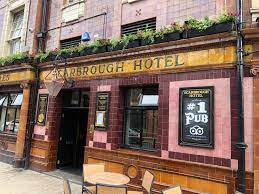
Being so well served by transport links made it relatively simple for me to make my way to Leeds so, after a two hour train journey, I arrived in the city at around 11.15 am on what was a cold, but not altogether unpleasant Thursday, eager to throw myself into the drinking delights of this fine northern city. I had a route planned, I'd done my research and I'd arrived in plenty of time. It was time to get stuck in. Luckily, my first stop was mere yards from the main station entrance. Negotiating roadworks and a taxi rank, I crossed to the opposite side of New Station Street, where the first pub of the day was handily located. My day in Leeds would properly begin at the Good Beer Guide 2022 listed Scarbrough Hotel.


Located in an area that was formerly known as Castle Hill, the pub sits on the site of a medieval manor house which had a deep moat that looped around between the River Aire and nearby Boar Lane. The building was lavishly rebuilt in 1765 by Richard Wilson and then became a hotel owned by Henry Scarbrough (from whom it takes its name, not the seaside town, hence the spelling) in 1823. The present pub is a surviving extension from this structure. The Scarbrough Hotel is operated under the Nicholson's branding and has retained many original features. Inside, the main entrance leads directly to the bar. Seating areas are located at either side, consisting largely of both low and high tables and chairs, all in scrubbed wood. The gents toilets are located to the left of the bar, with the ladies and accessible toilets to the right. The tiled frontage of the exterior is married up with bare wood and brass inside. The bar is long and, amongst its many delights, features 9 handpulls. 8 of these were available for my perusal on the day. The choice was varied: Tetley Bitter doubled up (this is one of the few venues in Leeds that still has this on cask), Timothy Taylor Landlord, Adnams Mosaic, St, Austell Tribute, the house Nicholson's Pale Ale, Titanic Plum Porter and Oakham Citra. There are much worse ways to start the day than with Citra, so my decision was made almost instantly. I took my beer to a high table in a snug-like area to the right hand side of the bar, which was quieter. The early lunchtime rush was starting to kick in as I arrived and, in general, I would find most of the pubs to be busier than expected, given it was Thursday afternoon. My choice of Citra proved to be a good one as it was in excellent condition, reaffirming that the pub's listing in the GBG is more than justified. It wasn't long until it was time to venture on.

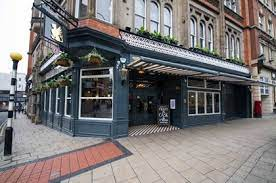
Leaving the Scarbrough, I turned left and then left again onto Mill Hill, passed some pubs that weren't yet open but to which I would return later, and emerged on the junction with Boar Lane. On the corner, in a large, and rather imposing, Victorian building is the Griffin.


This surprisingly large, Greene King-operated pub occupies the ground floor of the former Griffin Hotel, which was built in 1872 as a railway hotel for wealthy travellers. The decor is very much reminiscent of a classic London pub and the interior is considerably more expansive than it appears from outside. The entrance leads into the main space which features low, wooden tables in the centre, booths in the windows and pillars throughout that feature drinking shelves. To the rear of this section is another, more open, seating area with banquette seating along the rear wall. A further section beyond this is styled like a London underground station and acts as a large restaurant and function space. The interior is broken up by the aforementioned pillars, which create the illusion of several smaller drinking areas. This pub was busy too and, after negotiating a cluster of people at the bar, I was able to investigate the beer selection. 6 handpulls are on the bar here, and 5 of these were in use, offering a choice from amongst the Greene King stable, The options were Greene King IPA, a house beer called Griffin, Greene King Yardbird, Hardy's & Hanson's Rocking Rudolph and Lilley's Mulled Cider. Avoiding the festive beer, until later on at least, I instead went for Yardbird, which I generally find is one of the better beers that Greene King put out. I retreated to the banquette seating, underneath a large mirror and within view of one of the various TVs distributed throughout the place. The Yardbird was decent enough, delicately hoppy and with a clean finish, so I was pleased with my decision here too. It was ticking on towards midday now, which meant that the vast majority of the other pubs on the day's itinerary would be opening very shortly. My day had started relatively strongly and I was excited to see how the coming hours were going to progress. 

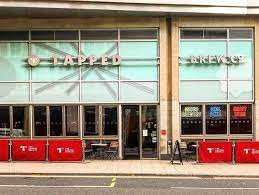
My third stop of the day was something a little bit different but definitely somewhere I wasn't going to pass up the chance to visit. It also happens to be virtually opposite the Griffin so it made sense for my day to continue there. I crossed over Boar Lane as the clock chimed 12 and arrived at Tapped Leeds.

The sister pub to Tapped at Sheffield station, this is another venue in the impressive portfolio of the Pivovar group and is essentially a more modern variation on a theme. This is both a bar and a microbrewery, with brewing vessels at the back of the room as you enter. The interior is open plan, with a mixture of retro and modern design features. Large windows at the front can be opened out directly onto the street in warmer weather, which also accommodates a small, outdoor drinking space. The bar runs directly down the right hand side of the room and, as well as an impressive keg beer selection, also features 8 cask beers, served through wall-mounted pumps on the back bar. Once I'd taken a moment to marvel at how cool the place is aesthetically, I located the cask beer list. The beers up for selection were J.W. Lees Dark Ale, Titanic Plum Porter, Oakham JHB, Anarchy Blonde Star, Black Iris Endless Summer, Bristol Beer Factory Live Forever, Roosters Variation on a Theme and Anarchy Flat Out IPA. I was immediately drawn to the two offerings from Newcastle's Anarchy but, as time only permitted one, I swung for the Flat Out IPA (4.5%). Taking this to a table opposite the bar, where I could snap some photos of the brewing vessels, I was finally able to fully take the place in. It's no surprise that Tapped is Good Beer Guide 2022. The beer was superb. Flat Out IPA is a hazy session IPA, brewed with Vermont yeast. Notes of orange and lime give way to a hoppy, earthy finish. This is a great beer and a great place to drink it. I particularly enjoyed the pun-tastic food names on the menu. Livin' la Fajita Loca anyone?

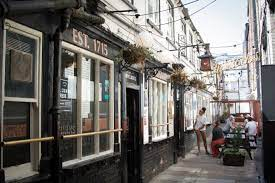
The next stop on my list was a must-visit and an absolute, bonafide Leeds institution. Leaving Tapped, I again turned left and continued down Boar Lane for a couple of minutes, until I reached Briggate, one of the central shopping streets in the city centre. A short walk down here led me to a sign on the wall between two shops that pointed me to my next destination. A small alleyway leads into a narrow courtyard, on one side of which is the Good Beer Guide 2022 listed Whitelocks Ale House.

Dating from 1715, Whitelocks occupies land on what was a medieval burgage plot, now known as Turk's Head Yard, which it shares with the pub of the same name. John Betjeman once described this place as the 'beating heart of Leeds', which is entirely justified, especially inside. The interior is largely unchanged from 1895 and is made up of mirrors, polished metal and woodwork, stained glass, iron pillars and faience tiling. Assorted old posters and bric-a-brac are displayed throughout. The raised bar is front and centre and runs virtually the whole length of the room. The pub itself is rather narrow and Grade II* listed, with seating along the wall and a small, restaurant-style space at one end reserved for dining. The outside yard provides additional tables for outside drinking. Testament to the pub's reputation and popularity, when I arrived, a mere 20 minutes after opening, it was quite literally standing room only. Every table was full and there were quite a few people making do with whatever space they'd been able to fashion for themselves at and around the bar. Speaking of the bar, it is taken up by 11 handpulls. 9 of these were available when I arrived and I was eventually able to determine their contents. Five Points Railway Porter and Five Points XPA were both doubled up, with the remaining pumps offering a choice of Thornbridge Astryd, North Open Space, Northern Monk Centennial Star, Kirkstall XXX Mild and Timothy Taylor Landlord. Being in Leeds, I went local and chose the Open Space from North Brewing Co. Open Space (4.6%) is a West Coast pale ale, dry hopped with Simcoe and Chinook. This provides it with aromas of grapefruit, lemon and floral bouquets and pine flavours, leading to a spiky finish. I managed to find a spot to lean and imbibe. This place is fantastic and I am very glad that I was able to visit. The reputation and regard in which this place is held is thoroughly deserved. 

As difficult as it was to leave Whitelocks, there was much exploring to be done. Returning to Briggate, I crossed it and made my way down Kirkgate. After a couple of minutes of walking, I took a left onto Harper Street, where my next location sits on the right. Next up: the Crowd of Favours.

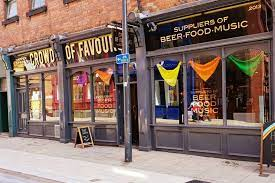
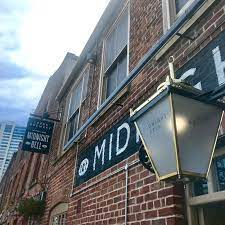
Taking up most of the street, this many-windowed pub is operated by Camerons as part of their agreement with Leeds Brewery, whose beers feature heavily here and throughout the city. Inside, the lighting is subtle and the decor is extensively woody, with heavy use of reclaimed furniture. The central bar is surrounded by uneven floorboards and there are murals and prints across the walls. To the right of the bar is an area of traditional wooden seating. A snug area is located to the left, featuring comfy furniture whilst a downstairs level contains a function area with sofas and fairy lights, whilst also providing toilet access. I entered the Crowd of Favours and was immediately greeted by a very friendly cocker spaniel, who it turns out is the pub dog (always a winner!). Making my way to the bar, I was pleased to see 8 handpulls, half of which were given over to Leeds Brewery beers, with the others supplying guests. The Leeds offerings were Pale, Midnight Bell, Best and Christmas Porter, whilst the remaining hand pumps featured Mobberley Bunji, Camerons Strongarm and two ciders from Lilley's, specifically Apple & Blackcurrant and Rhubarb. I was certainly feeling in a festive mood so it seemed logical to give the Leeds Christmas Porter (4.2%) a try. This is an easy-drinking porter, with subtle hints of plums and spices. It's tasty enough but I did expect a bit more festive punch. I chose the right hand seating area to enjoy the beer, during which time the dog, whose name I learned was Ruby, came over for more of a fuss. A Christmas beer in a nice warm pub with a lovely dog? What's not to love!

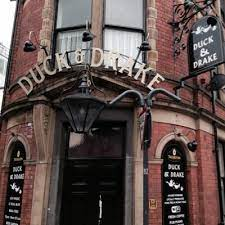
I would retrace my steps a little now. Heading out of the Crowd of Favours, I turned left and headed back down Harper Street to the junction with Kirkgate, where I had already spotted the next destination whilst on my way to the previous pub. Situated on the corner, is the Good Beer Guide 2022 listed Duck & Drake.
 

This two-roomed Victorian corner pub has retained many of its original features, including some of the floorboards, which are still going strong after two hundred years of trade. The front room features a small stage, where live music is held most nights of the week, whilst the back room includes a mural of various rock and blues musicians, and is decorated with music memorabilia. The decor in general, is minimal with bare wood and scrubbed wood furniture. The central bar serves both rooms and sits in between the two. There is also a well-kept beer garden to the rear. The original features even extend to the gents toilets, which features traditional porcelain units. The aforementioned bar includes a whopping 15 handpulls, with beers handily listed on a board behind the bar. One of these had just run out on my visit but this still gave me a choice of beer from amongst the following 14 options: Timothy Taylor Landlord, Theakston's Old Peculier, Bridgehouse Blonde, Daleside Bitter, Roosters Yankee, Taylor's Golden Best, Yorkshire Heart Ghost Porter, Roosters YPA, Bridgehouse Cherry Choc, Bridgehouse Mary Jane, Stancill Barnsley Bitter, Saltaire South Island Pale, Wychwood Hobgoblin IPA and Ossett All Cask, No Brakes. Despite being understandably overwhelmed, I eventually managed to settle on a choice, in the shape of Ossett's All Cask, No Brakes (5.5%), and made my way to a small table adjacent to the bar, where I could bathe in both the traditional feel of the pub and the soundtrack of classic rock that accompanies it. All Cask, No Brakes isn't a beer that I was initially familiar with but I'm glad I took the leap of faith. Billed as an Antipodean Pale Ale, this is a cask version of a keg lager that was originally brewed by Green Duck brewery. Pilsner and Vienna malts combine with Motueka hops and lime zest to give lime, lemon and floral aromas. It's a cracking beer, and goes down surprisingly quickly given the ABV. Whilst making my obligatory notes, I was noticed by two older gents nearby who happened to be fellow CAMRA members and took the time to say hello, ask where I was visiting from and what I did with the notes I took. They also pointed me in the direction of the Kirkstall Brewery tap if I had the time to visit whilst I was in town. I didn't have the time on this occasion but I suspect there will be a return visit to these parts in the future. In all the years writing this blog, I think I've only had that kind of interaction a handful of times and it often catches me off guard, but it was nice to have a little bit of a chat about a shared interest. 

The Duck & Drake had, thus far, been one of the standout locations and it pained me to have to leave. Needs must, however. Heading back out onto Kirkgate, I again turned left and continued onwards. A bit further down the road, in the shadow of Leeds Minster, is the next place I would turn my attention to: the Lamb & Flag.


This Grade II listed pub was originally known as the Thirteen Bells in the nineteenth century, its name derived after the bells of the nearby Leeds Minster (then known as Leeds Parish Church). After a long period of closure, it was tastefully restored by Leeds Brewery and the name was changed to its current moniker. The pub is laid out over two floors, with exposed brickwork, timber and large windows and an upstairs balcony with seating, overlooking a covered courtyard which is heated in winter. The main bar is on the ground floor, immediately opposite the entrance and there is a second bar upstairs, which is often used for functions. The pub was busy when I entered, both with drinkers and with large Christmas bookings. It was easy enough to get served though and I was soon faced with 8 hand pumps. Again the choice here included several Leeds Brewery beers, namely Christmas Porter, Pale, Midnight Bell, Best and Yorkshire Gold but Camerons Road Crew, Northern Monk Eternal and Thornbridge Galaxia were also available. I decided to go down the dark beer route again and went for the delicious Midnight Bell (4.8%). This is a premium dark mild with a full bodied and complex character from Willamette hops. Whilst mild is by no means my favourite style of beer, when they're as good as this, I'm happy to be converted. I found myself standing again here, a little way from the bar, with a drinking shelf as support. This proved to be an optimum spot to watch plates of amazing looking and fantastic smelling food being ferried to hungry diners. 

After a brief food break myself, it was on to the next one. Taking an immediate right out of the Lamb & Flag, I walked parallel with the Minster churchyard for a few feet before turning left again. Directly in front of me, on the other side of the Minster itself is the Palace.
 

Formerly the Palace Hotel, at which time it was a Melbourne Brewery house, the building dates from 1741. Now operated by Oak Tree, a branch of Mitchells and Butlers, this is another pub which is deceptively large inside. A long, central bar links two drinking areas at either end of the building with traditional scrubbed wood furnishings and booth seating throughout. There are a number of TVs throughout that show sport and there is also a heated courtyard area decorated with fairy lights. 11 handpulls occupy the bar here, although just 4 were in use when I arrived. A neighbouring bank of 5 had pump clips on and attached tags saying 'Coming Soon', clearly suggesting the available beer range increases at weekends, which is always good. The 4 that were on offer at the time were Leeds Pale, Tetley Cask Bitter, Big Smoke Solaris and Wychwood Hobgoblin. I was surprised to see Surrey-based Big Smoke being represented so far north so it made sense to go for the Solaris (3.8%). This is an easy-drinking session pale with flavours of citrus, a light malt sweetness and a balanced, bitter grapefruit finish. It definitely wasn't a beer I expected to find and it turned out to be very enjoyable. The Palace was busy and bustling with locals when I was in and was very welcoming. It was certainly something of a wild card when I was selecting pubs for the trip and it's always a pleasant surprise when selections like that end up paying off. One local who may or may not have been in attendance is Michael Hill, a local actor, singer, poet and entertainer who died in the pub in 1948 and whose shade has allegedly been seen lurking around the place from time to time, by both customers and staff. It's certainly somewhere that is quite easy to want to come back to.

More retracing of the route would be required now. Leaving the Palace, I made my way back along Kirkgate and Briggate, eventually emerging back on New Station Street, not far from where my day had begun. I was nowhere near ready to head home yet though. Instead, to The Brewery Tap.

This is a moderately sized pub on the main approach to the train station. Set over two levels, the ground floor has a light and airy main bar area with lots of comfortable seating. Upstairs is a function room with an additional bar and a small roof terrace with additional seating. The large windows downstairs look out over the street and the overall decoration is bright and colourful with lots of murals, posters and quirky design evident. The bar is well stocked too, with 8 handpulls. This is another Camerons operated venue and Leeds Brewery beers again feature prominently, alongside various guests. On the day of my visit, the available Leeds beers were Christmas Porter, Pale, Yorkshire Gold and Best, alongside Rudgate Chocolate Stout, Fell Brewery Azacca, Camerons Road Crew and Rudgate Ruby Mild. Fell Brewery was a new name to me so I instantly decided to investigate further with their Azacca (4%). This turned out to be a delicious, single-hopped session pale ale with big hop notes and tropical flavours. Fell Brewery are, perhaps not surprisingly, based in Cumbria, specifically at Grange-over-Sands. Based on this, I'll be seeking their beers out more in future!

Another redirect now. Turning left out of the Brewery Tap, I made my way back up New Station Street and rejoined Boar Lane. On the adjacent corner to the Griffin from earlier, is The Bankers Cat.

Located in a building that was formerly a bank, The Bankers Cat is operated by Thornbridge Brewery which, given my experiences with their pubs in the past, is always a good sign. It's even more promising when the pub is Good Beer Guide listed, as this one is (as of 2022). The front door leads directly to a central, horseshoe-shaped bar which has seating on all sides, including booths with mirrors to the left. A stained glass window dominates part of the right hand wall and there are quirky cat portraits throughout. Additional seating can be found downstairs in the old bank vault, which still has the original vault door in situ. Large chandeliers provide lighting in the main bar. For all intents and purposes, the pub reminds me of a smaller version of The Market Cat, it's York sister pub, even down to the layout and the decor. I already knew I was going to be in for a treat in terms of beer choice. Of the 8 handpulls, 7 were in use with the majority given over to beers from Thornbridge's extensive catalogue. Thornbridge Roisin, Brother Rabbit, Astryd and Jaipur were joined on the bar by Titanic Plum Porter, Saltaire DDH Citra and Black Iris Bajan Breakfast. There was no way on Earth that I wasn't going to have a Thornbridge beer in a Thornbridge pub and Roisin was a beer that I'd never encountered so the stars aligned and I dived in. Roisin (4%) is an Irish red ale. That means it's malty but with an almost caramel-like sweetness. It's a definite yes from me!

The Bankers Cat sits on the corner of Boar Lane and Mill Hill and so is very conveniently located for my next stop, which happened to be on Mill Hill itself. Having walked past it earlier in the day, I was now able to enter Head of Steam.


Confusingly, Leeds has three Head of Steam venues, of which two are in the city centre, with the third a bit further out in Headingley. The Mill Hill venue is the oldest of the trio, the closest to the train station and the only one to currently feature in the Good Beer Guide (2022). Opening in 2014, before which it was known as Spencer's, the pub occupies a three storey stone and brick building with a curved frontage. Inside, the island bar is octagonal and sits central to the downstairs room, underneath a chandelier made from empty beer bottles. Although the layout is basically one room, it does have different areas, including a few tables close to the bar, an alcove which is often used for live music, a rear raised area and an upstairs balcony area. The pub has a strong emphasis on cask and Belgian beers, which is evidenced by the 9 handpulls that take up some of the bar space. On the day that I popped in, one of these was occupied by Lilley's Pineapple cider with the rest give over to various beers, respectively Timothy Taylor Landlord, Camerons Strongarm, Northern Monk Little Faith, Camerons Road Crew, Brew York X-Panda, Fell Tinderbox, Northern Monk Festive Star and Ilkley Laka. It definitely felt like a good time for another festive beer so I settled for Northern Monk's Festive Star (5.2%) and retired to a table by the window to enjoy it. And enjoy it I did! Festive Star is a vanilla, cinnamon and chocolate porter with sweetness in the flavour, a gentle spice in the aroma and a nice, warming kick in the mouthfeel. It's like being smacked in the face by Christmas but with less blood and flying Monopoly boards.

Drinking a Northern Monk beer set me up nicely for the next stop of my Leeds beer tour. Leaving Head of Steam and turning right, I headed under the nearby railway bridge and crossed over the River Aire, until I got to Water Lane, where I turned right. Following this road took me into the Holbeck area of the city, an area which was once for its mills. Turning onto Marshall Street, I followed this to an area known as Marshalls Mill where the Northern Monk Refectory looms over the river. 

The Refectory occupies a building that was once a flax mill. The Northern Monk brewery is located on the ground floor with the Refectory itself on the floor above. The decor is best described as 'modern industrial' with exposed brickwork and metal pipes, as well as modern art adorning the walls. Outside of the building, to the front, there are benches for seating and a cycle rack. Seating in the Refectory is largely high tables and chairs but there is an area of sofas and lower seating on one side. The bar occupies the corner of the room with an extensive beer list on a blackboard above. There is a significant amount of keg beer here, across 15 lines and a wide variety of styles and there are also two handpulls dispensing cask, usually a mixture of Northern Monk and guests. As tempted as I was by the sheer array of keg beers, I'd promised myself that I would stick to cask on this particular trip and so had a decision to make between BBNo. 11 Citra and Northern Monk/Independent North/Jack King The Ceremony. The description of the latter instantly hooked me. The Ceremony is billed as a spiced Cascadian dark ale which, quite frankly, sounded both baffling and intriguing. I had to give it a go. The beer is part of Northern Monk's Patrons Project range and was brewed to celebrate the release of The Ceremony, a new film by local filmmaker Jack King. The flavour profile has combined Middle Eastern and winter ale flavours for something very different. It's 5.4% and uses a black IPA base combined with cinnamon, nutmeg, green cardamom and black pepper, and hopped with Centennial, Simcoe, Mosaic and Sabro. It's equal parts spicy, sweet, coconutty and peppery. My brain struggled to define it but I do know that I enjoyed it!

I found myself pleasingly ahead of time which meant I could afford myself a more leisurely stroll to the final two pubs, the first of which I'd already been past on my way to Northern Monk. Making my way back to Water Lane and turning left, I headed to the final Leeds Brewery/Camerons pub of the day, in the shape of the Midnight Bell.

Located in the heart of a regenerated urban area, the Midnight Bell is a brick-built pub that caters to local office workers, as well as those visiting or popping in for a drink or some food. Inside, the pub is cosy with dimmed lighting, comfy seating and fairy lights as well as exposed beams and brickwork. To the rear is an outside courtyard which, in warmer weather, is served via a hatch from the bar. The bar itself occupies a corner and faces into a large, central room where the majority of the seating is situated. And on this bar, there are 7 handpulls. Once again, most of these carry Leeds beers, on this occasion Midnight Bell, Best, Pale and Christmas Porter were present but there were also guest beers in the form of Ilkley Blonde, Camerons Lifeboat and Roosters Buckeye. The Lifeboat immediately called to me and so I took the plunge and was rewarded with a very nice pale ale, packed full of delicate floral aromas and hop notes. The beer is part of a range that the Hartlepool-based brewery have brewed to raise money for the local RNLI with 5p from every pint going to the charity, so not only is it delicious but it's for an excellent cause!

I had one final pub to visit before I made my way home and it just so happened to be very very close to the train station. In fact, it's actually underneath it! Retracing my steps back over the river and towards the station, I made my way to Granary Wharf and a road called Dark Neville Street where my final stop is located. Last but certainly not least, the Good Beer Guide 2022 listed The Hop.


Situated beneath the arches of platform 17 of Leeds Station, The Hop is operated by Ossett Brewery. The central bar is surrounded by comfortable seating with bare brick walls decorated with murals and pictures of rock bands. Another seating area above is reached by staircases at either end of the room, and hosts regular live music. Due to the pub's location, the beer cellar is actually at ground level and can be seen through windows in the drinking area. The ambience is very much neon signs and dim lighting, which creates a comfortable feeling and completely detracts from the trains that run overhead. The long bar, which is behind the entrance, boasts 10 handpulls, 8 of which were in use during my short stop there. The beers are primarily from Ossett with White Rat, Silver King, Yorkshire Blonde, Voodoo, Excelsius and Butterley all being present on the day, alongside Wilde Child Rik van Nutter, Fireside Cellar Hero and Pulp Rhubarb & Strawberry Cider. It was another Ossett beer for me this time. I decided on Silver King (4.3%) as the beer that would round off my day out. For those not in the know, Silver King is an American pale ale with Cascade hops for a crisp, refreshing and dry beer with citrus aromas and a balanced bitterness. It was over far too quickly. All that was left was for me to leave The Hop and walk up a nearby ramp that eventually took me to platform 17, from where my train back to Nottingham would soon depart.

It had been a very good day. I'd managed to complete my route without any need to rush or miss pubs out. The results speak for themselves. Leeds thoroughly deserves acclaim for it's excellent beer scene. Each pub I visited was different but each made me welcome and made me feel positive that, in an era of such uncertainty and economic upheaval, it's not all doom and gloom. Some pubs will fight on and, given how busy each and every one was, come out of this in a good position, possibly even stronger. There were, of course, standouts amongst the crowd. Whitelocks Ale House and the Duck & Drake have both earned a place in my heart but every pub on this list deserves a visit. If you're ever thought about visiting Leeds, I suggest you follow through with it. You won't be disappointed and, regardless of your beery predilections, you will definitely find something you enjoy. I'm glad I braved the cold to pay this fine city a visit. I left knowing that it's somewhere I'll come back to. There's so many pubs I didn't have time for, which is incentive enough to plan my return. My list of planned excursions continues to grow. And, to that end, time, money and rail strikes notwithstanding, I hope to squeeze another trip in before the end of the year, although it's very unlikely that that entry will be published before the arrival of jolly old Saint Nick. With that in mind, all that remains this time is for me to sign off, wishing you a Merry Christmas and an excellent festive period.